




The insightful articles, inspiring narrations and analytical perspectives presented by the Editorial Team, establish an alluring connect with the reader. My compliments and best wishes to SP Guide Publications.
"Over the past 60 years, the growth of SP Guide Publications has mirrored the rising stature of Indian Navy. Its well-researched and informative magazines on Defence and Aerospace sector have served to shape an educated opinion of our military personnel, policy makers and the public alike. I wish SP's Publication team continued success, fair winds and following seas in all future endeavour!"

Since, its inception in 1964, SP Guide Publications has consistently demonstrated commitment to high-quality journalism in the aerospace and defence sectors, earning a well-deserved reputation as Asia's largest media house in this domain. I wish SP Guide Publications continued success in its pursuit of excellence.
India's decision to sign a $1 billion deal with General Electric (GE) for 113 x F404 jet engines marks more than just a commercial transaction; it's a pivotal moment for the Tejas LCA programme and India's broader quest for defence self-reliance
 |
The Author is Former Director General of Information Systems and A Special Forces Veteran, Indian Army |

On November 9, 2025, Defence Minister Rajnath Singh announced that India is set to manufacture advanced fighter jet engines domestically within the next year. Speaking in an exclusive interview to the media, he said that ongoing discussions with major aerospace firms, including GE Aerospace and France's Safran, are making solid progress. Rajnath stated that the government's vision is to ensure that fighter engines for Indian aircraft are built on Indian soil, by Indian engineers and technicians. He emphasised that any agreement signed with international partners will prioritise full technology transfer to enable indigenous production. This, he said, is aligned with the government's overarching objective of achieving complete self-reliance in defence manufacturing, while confirming that the final decision rested with the Cabinet Committee on Security (CCS) chaired by Prime Minister Narendra Modi.
Defence Minister Rajnath Singh emphasised that any agreement signed with international partners will prioritise full technology transfer to enable indigenous production.
While India remains open to international collaboration, Rajnath made it clear that such partnerships must contribute directly to local manufacturing and domestic skill development. "We may buy engines from abroad, but manufacturing must happen in India," he asserted. At present, India continues to import several critical aerospace components and engines to support its fleet, including those for the Tejas Light Combat Aircraft (LCA) and other operational platforms. Rajnath said the long-term goal is absolute indigenisation across the entire supply chain; stressing that future defence partnerships would adhere strictly to India's strategic and technological self-reliance requirements. Referring to the increasing private sector participation and focused technology transfer agreements, Rajnath said India's journey towards full defence autonomy is no longer a distant dream but a measurable, achievable goal on the near horizon.
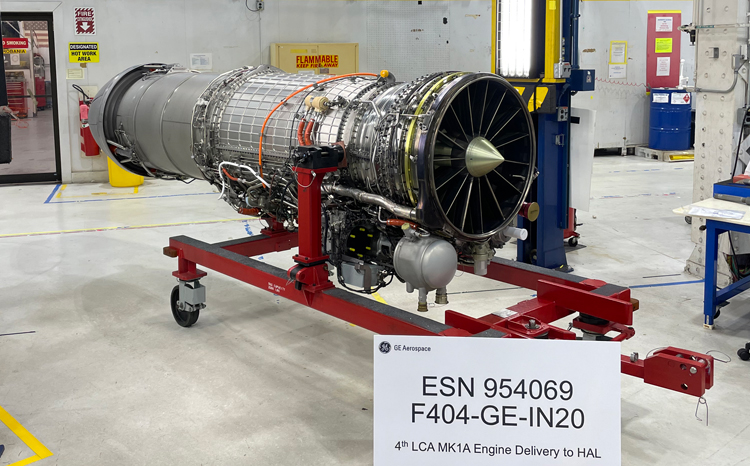
India's decision to sign a $1 billion (₹8,900 crore) deal with General Electric (GE) for 113 x F404 jet engines marks more than just a commercial transaction; it's a pivotal moment for the Tejas LCA programme, the Indian Air Force (IAF), and India's broader quest for defence self-reliance under the Atmanirbhar Bharat initiative. The deal was signed between Hindustan Aeronautics Limited (HAL) and GE at Bengaluru. With this latest GE deal, India wants to change the narrative over the past two decades of the Tejas programme mired by delays, slowed by technological hurdles, supply chain gaps, and limited industrial capacity. Moreover, shortages of engines and unfinished weapon integration trials have repeatedly pushed back production.
Under the agreement, 113 new GE F404 engines will be delivered between 2027 and 2032, supplementing an existing order of 99 x F404 engines placed in 2021.
Under the agreement, 113 new GE F404 engines will be delivered between 2027 and 2032, supplementing an existing order of 99 x F404 engines placed in 2021.These engines will power 180 Tejas Mk-1A aircraft, the advanced variant of India's homegrown fighter jet, ordered by the IAF in two batches worth a combined ₹113,000 crore. The deal comes at a critical juncture. The Hindustan Aeronautics Limited (HAL), which manufactures the Tejas, has been struggling to meet delivery timelines.
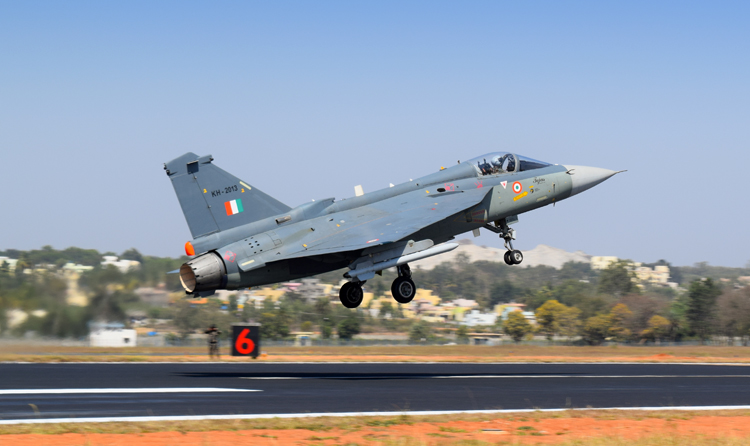
HAL Chairman D.K. Sunil has said the company has 11 Tejas Mk-1A jets ready, including four already fitted with GE engines. "We aim to deliver the first 10 aircraft to the IAF by March next year," he was quoted as saying, signalling that the programme could finally be turning a corner. With GE now committing to deliver 20 engines annually, HAL can finally stabilise its manufacturing pipeline. The IAF currently operates just about 29 fighter squadrons against an authorised strength of 42, urgently needs new fighter aircraft with the MiG-21 phased out and no fifth-generation fighter yet inducted, the IAF has pinned its hopes on the Tejas Mk-1A to rebuild its numbers. With each squadron consisting of 18 fighter jets, the Tejas fleet once fully delivered, could form nearly 10 full squadrons, bolstering India's defensive and offensive capabilities. Given that Pakistan fields about 25 fighter squadrons, soon to be enhanced with 40 Chinese J-35A stealth fighters, while China maintains more than four times India's air strength, including strategic bombers and electronic warfare aircraft, the addition of Tejas Mk-1A becomes all the more important for the IAF.
The $1 billion HAL-GE deal aims for 80 per cent transfer of technology, a massive leap toward domestic engine manufacturing capability.
The $1 billion HAL-GE deal aims for 80 per cent transfer of technology, a massive leap toward domestic engine manufacturing capability. So far, six rounds of technical discussions have been completed between GE and HAL, with commercial negotiations expected to conclude by March 2026. If finalised, this would mark the first time India co-produces a high-thrust combat jet engine with deep technology transfer, giving its aerospace industry an unprecedented capability boost. If HAL delivers on its promises and GE's supply chain holds steady, the Tejas Mk-1A could finally soar, not just as an aircraft, but as a testament to India's Atmanirbhar (Self-Reliance) ambition and aerospace resurgence.
This would mark the first time India co-produces a high-thrust combat jet engine with deep technology transfer, giving its aerospace industry an unprecedented capability boost.
Notably, Defence Minister Rajnath Singh also mentioned negotiations with French firm Safran for developing aero-engines for India's Advanced Medium Combat Aircraft (AMCA). India has signed a deal with Safran for co-developing the jet engine for the AMCA. Notably in 2008, a French firm offered to co-develop a jet engine with the Defence Research and Development Organisation (DRDO) HAL for $1.3 billion. After years of wrangling with DRDO's Gas Turbine Research Establishment (GTRE), the price was halved to $650 million. However, DRDO rejected the offer calling it too costly. What we turned down then now costs India ten times more – with an estimated cost of $7 billion.