





The insightful articles, inspiring narrations and analytical perspectives presented by the Editorial Team, establish an alluring connect with the reader. My compliments and best wishes to SP Guide Publications.
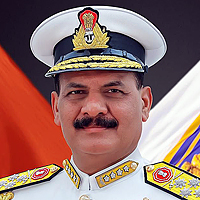
"Over the past 60 years, the growth of SP Guide Publications has mirrored the rising stature of Indian Navy. Its well-researched and informative magazines on Defence and Aerospace sector have served to shape an educated opinion of our military personnel, policy makers and the public alike. I wish SP's Publication team continued success, fair winds and following seas in all future endeavour!"

Since, its inception in 1964, SP Guide Publications has consistently demonstrated commitment to high-quality journalism in the aerospace and defence sectors, earning a well-deserved reputation as Asia's largest media house in this domain. I wish SP Guide Publications continued success in its pursuit of excellence.
India is accelerating naval modernisation through indigenous shipbuilding, the commissioning of INS Mahe, plans for next-generation P-18 destroyers, and the expansion of nuclear and conventional submarine capabilities to strengthen maritime dominance and self-reliance
 |
The Author is Former Director General of Information Systems and A Special Forces Veteran, Indian Army |
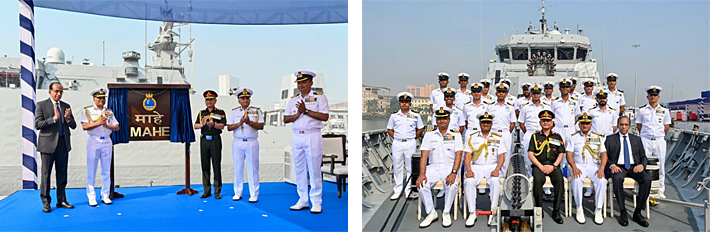
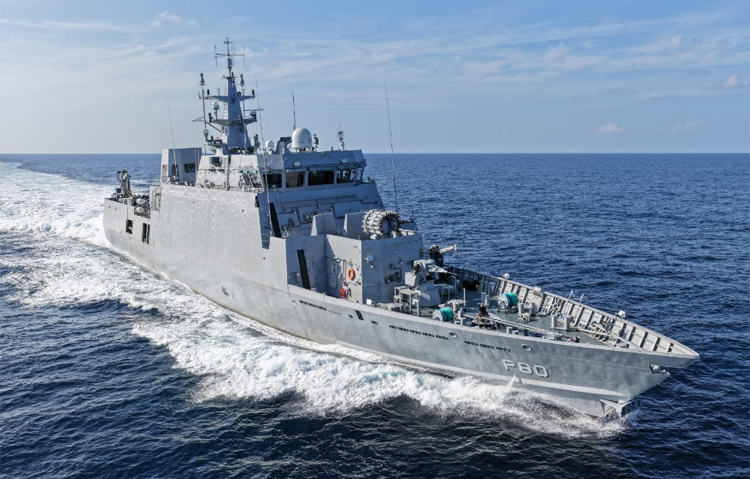
India's shipbuilding industry received a major boost on November 24, 2025, with the commissioning of INS 'Mahe', the first of the indigenously designed Mahe-class Anti-Submarine Warfare Shallow Water Craft (ASW-SWC). The vessel, built by Shipping Ministry-run Cochin Shipyard Limited (CSL), represents a major leap in India's ability to design, integrate, and deliver frontline naval platforms entirely through its domestic industrial ecosystem. The ship is equipped with advanced sonar, radar, torpedoes, and anti-submarine rockets, with over 80 per cent of its components being indigenous. The Mahe-class programme is one of the most significant demonstrations of indigenous naval construction in recent years. For the shipbuilding industry, this represents a benchmark in the localisation of complex naval systems, sensors, and machinery control suites.
India's shipbuilding industry received a major boost on November 24, 2025, with the commissioning of INS 'Mahe', the first of the indigenously designed Mahe-class ASW-SWC.
Commissioned at the Naval Dockyard in Mumbai, INS Mahe underscores the expanding capabilities of India's shipyards at a time when China is rapidly scaling up its naval production and Pakistan is inducting new submarines from Beijing. The ceremony was presided over by Army Chief General Upendra Dwivedi and hosted by Western Naval Command Chief Vice Admiral Krishna Swaminathan, highlighting the strides in shipbuilding made by India. CSL, the prime contractor, partnered with a wide range of Indian defence manufacturers, including Bharat Electronics Ltd (BEL), L&T Defence, Mahindra Defence Systems, NPOL, and more than 20 MSMEs, to build a platform that boasts over 80 per cent indigenous content.
The Mahe-class ASW craft will play a critical role in India's coastal defence architecture, forming the first layer of defence against underwater threats from adversaries in the region.
INS Mahe also reflects India's maturing capability in maritime design and engineering. The ship's compact yet potent combat suite integrates multiple indigenous systems for detecting, tracking, and engaging submarines operating in the difficult environment of shallow coastal waters. The vessel features advanced propulsion, communication networks, and fully integrated control systems; showcasing how Indian shipyards are moving beyond hull fabrication to complete systems integration. For Cochin Shipyard, INS Mahe is the lead vessel in a series of eight ships, demonstrating its growing production efficiency and capacity to handle multi-ship programmes. The Indian Navy's decision to rely heavily on CSL and its domestic suppliers signals a strong vote of confidence in India's emerging naval industrial base. The Mahe-class ASW craft will play a critical role in India's coastal defence architecture, forming the first layer of defence against underwater threats from adversaries in the region.
INS Mahe stands not only as a frontline naval asset, but also as a symbol of India's transformation into a competitive shipbuilding nation, one capable of delivering sophisticated platforms and support the strategic goal of Atmanirbhar (self-reliance) in defence.
For the shipbuilding sector, the project's success represents something even larger: a confirmation that India can build high-end warships at scale, with indigenous technology, and with industry-wide collaboration. INS Mahe stands not only as a frontline naval asset, but also as a symbol of India's transformation into a competitive shipbuilding nation, one capable of delivering sophisticated platforms that match global standards and support the strategic goal of Atmanirbhar (self-reliance) in defence.
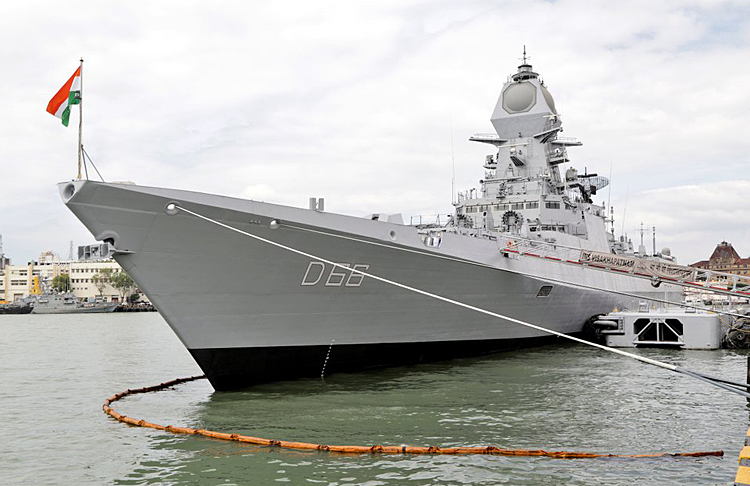
According to news reports of November 24, 2025, the Indian Navy is set to initiate the process of Acceptance of Necessity (AoN) for its futuristic 11,000-tonne P-18 Next Generation Destroyers (NGDs) to dominate the Indian Ocean. These vessels represent a bold step towards securing maritime superiority in the coming decades. Addressing the media during a recent Naval Commanders' Conference, Vice Chief of Naval Staff Vice Admiral Sanjay J. Vatsayan confirmed that the Navy has finalised a robust design for these advanced ships. He expressed strong optimism regarding the project's administrative progress, anticipating government clearance within the current FY 2025-2026. Saying, "We are hopeful of securing the AoN this fiscal year itself, which will allow us to award the construction contracts within the next two years." The introduction of P-18 NGDs aligns with the Indian Navy's broader strategic goal of maintaining a 170-175 ship fleet by 2035 to counter expanding regional navies. The P-18 is not just about tonnage but about dominating the Indian Ocean Region (IOR) in the 2040s and beyond with capabilities that match or exceed vessels fielded by regional navies.
Indian Navy is set to initiate the process of Acceptance of Necessity (AoN) for its futuristic 11,000-tonne P-18 Next Generation Destroyers (NGDs) to dominate the Indian Ocean.
With a projected full-load displacement of 11,000-tonnes, the P-18 destroyers are slated to become the largest combatant vessels ever constructed for the Indian Navy. They significantly outstrip the current frontline destroyers, including the 7,500-tonne Kolkata-class (P-15A) and the 8,200-tonne Vishakhapatnam-class (P-15B), marking a shift towards heavier, more enduring platforms capable of sustained blue-water operations. A key focus of the P-18 is automation. The new class is projected to operate with a crew complement reduced by 25-50 per cent compared to the Vishakhapatnam-class, while simultaneously offering improved survivability and damage control mechanism. The construction of these vessels are planned under the Strategic Partnership (SP) model. Leading Indian shipyards, specifically Mazagon Dock Shipbuilders Limited (MDL) and Garden Reach Shipbuilders & Engineers (GRSE) are considered the frontrunners for the project. When a foreign collaborator will be selected to assist the critical propulsion and combat systems integration, the Navy is wanting a high indigenous content of 70-75 per cent from the very first vessel.

The introduction of P-18 NGDs aligns with the Indian Navy's broader strategic goal of maintaining a 170-175 ship fleet by 2035 to counter expanding regional navies.
The P-18 class destroyers, designed to address future threats, are expected to host an array of cutting-edge technologies, including: Advanced Sensors – the vessels will feature next-generation multifunction digital Active Electronically Scanned Array (AESA) radars utilising Gallium Nitride (GaN) modules for superior detection capabilities; Integrated Stealth & EW - a unified integrated mast will house Signal Intelligence (SIGINT), and Communication Intelligence (COMINT) suites, alongside advanced electronic warfare systems. The hull design will focus on enhanced stealth, significantly reducing radar infrared, acoustics, and magnetic signatures; Future Weaponry – the destroyers will be equipped with high-energy Directed Energy Weapons (DEWs) in the 50-100kW range, primarily for countering drones and incoming missiles. They will also feature hardpoints for experimental railguns or hyper-velocity projectiles (HVP); Firepower – an expanded Virtual Launch System (VLS), likely housing between 96 and 128 cells, will accommodate a mix of Barak-8ER, VL SRSAM, and future hypersonic missiles. The ship will include provisions for integrating the hypersonic or high-supersonic BrahMos-II missiles; Propulsion – the class will utilise an advanced hybrid Integrated Electric Propulsion (IEP) system offering greater efficiency and power management for energy-intensive weapons; Unmanned Integration – the ships will be fully networked to operate in tandem with unmanned aerial, surface and underwater vehicles, acting as mothership for autonomous systems.
Indian Navy Chief Admiral Dinesh K. Tripathi has said that India will commission its third nuclear-powered submarine early next year, which is larger than the first two and is capable of carrying more long-range nuclear tipped ballistic missiles.
Indian Navy Chief Admiral Dinesh K. Tripathi has said that India will commission its third nuclear-powered submarine early next year, which is larger than the first two and is capable of carrying more long-range nuclear tipped ballistic missiles. The third such SSBN is in the final stages of trials and will be commissioned soon as INS 'Aridhaman'. According to sources, the fourth SSBN, codenamed S-4, which will have a displacement of 7,000-tonnes like INS 'Aridhaman', is likely to be commissioned in 2027. The first two, INS 'Arihant' and INS "Arighaat', both with 6,000-tonne displacement, became fully operational in 2018 and 2024 respectively. Parallelly, India will get a nuclear-powered attack submarine (SSN) armed with conventional or non-nuclear weapons for long-range missions for a 10-year lease from Russia by 2027-2028. The delivery of this Akula-class SSN, to be commissioned as INS 'Chakra' was to take place earlier under the $3 billion deal with Russia in 2019 but has been delayed due to the US-NATO war on Russia, using Ukraine as proxy.