






The insightful articles, inspiring narrations and analytical perspectives presented by the Editorial Team, establish an alluring connect with the reader. My compliments and best wishes to SP Guide Publications.

"Over the past 60 years, the growth of SP Guide Publications has mirrored the rising stature of Indian Navy. Its well-researched and informative magazines on Defence and Aerospace sector have served to shape an educated opinion of our military personnel, policy makers and the public alike. I wish SP's Publication team continued success, fair winds and following seas in all future endeavour!"

Since, its inception in 1964, SP Guide Publications has consistently demonstrated commitment to high-quality journalism in the aerospace and defence sectors, earning a well-deserved reputation as Asia's largest media house in this domain. I wish SP Guide Publications continued success in its pursuit of excellence.
India has unveiled a bold plan to construct the world's deepest underwater research laboratory, positioned 6,000 metres (19,700 Feet) beneath the Indian Ocean
 |
The Author is Former Director General of Information Systems and A Special Forces Veteran, Indian Army |
India has unveiled a bold plan to construct the world's deepest underwater research laboratory, positioned 6,000 metres (19,700 Feet) beneath the Indian Ocean, according to news reports of November 19, 2025. The project seeks to redefine humanity's understanding of the deep ocean and establish India as a global leader in marine science and technology. The upcoming deep-sea habitat is conceptualised as an oceanic counterpart to the International Space Station, enabling long-duration human operations in extreme underwater environments. The initiative marks a major milestone under India's Vision 2047 programme, aligning with the centenary of India's independence won in 1947. This initiative dovetails with the broader 'Samudrayaan' Project, under the Ministry of Earth Sciences, which is already developing crewed submersibles capable of descending to similar depths.
The upcoming deep-sea habitat is conceptualised as an oceanic counterpart to the International Space Station, enabling long-duration human operations in extreme underwater environments
To validate the concept, a pilot phase will first deploy a prototype module at 500 metres depth. The deep-ocean lab's engineering design will represent a fusion of advanced material science and systems innovation. Its hull will be made of pressure-resistant titanium alloys and composite materials capable of withstanding pressures 600 times that at the surface. According to the report, the preliminary stage will host three scientists underwater for more than 24 hours, testing pressure endurance, life-support systems, and the logistical workings required for sustained habitation in the deep ocean. Success in this stage will clear the path for full-scale construction at 6,000 metres, a depth never before reached by a manned research facility. The laboratory will incorporate transparent viewing panels, offering a 360-degree panorama of the surrounding deep-sea environment. Autonomous life-support systems will regulate oxygen, carbon dioxide, and temperature while independent laboratory modules will permit simultaneous research activities.
The laboratory will have docking bays for submersibles and remotely operated vehicles to enable crew transfer, resupply, and emergency evacuation. A robust underwater communication network will link the station to surface control centres using acoustic transmission and fibre-optic data lines. These systems will transmit real-time scientific data and video feeds to research hubs located onshore. The habitat will also feature renewable energy integration and modular expandability, making it suitable for multi-mission use and long-term deployment. Together, these elements will allow an uninterrupted human presence at depths previously accessible only to remote instruments.
The preliminary stage will host three scientists underwater for more than 24 hours, testing pressure endurance, life-support systems, and the logistical workings required for sustained habitation in the deep ocean
India's underwater lab at the depth of 6,000 metres promises transformative discovery potential scientifically. It will unlock access to uncharted ecosystems and unique life forms thriving under immense pressure and darkness. Marine biologists will be able to study rare organisms and their adaptations, potentially leading to new insights for biotechnology and regenerative medicine. Also pharmaceutical researchers can focus on extracting bioactive compounds from deep-sea microbes, which may inspire next-generation antibiotics and anti-cancer agents. Extreme-environment enzymes could further be applied in industrial biotechnology and materials science. Geologists and geophysicists will use the platform to investigate tectonic plate interactions, undersea volcanic processes, and mineral deposits across the abyssal plains. These studies could illuminate the dynamics of Earth's crust and support strategic exploration of critical minerals such as cobalt, nickel, and manganese from polymetallic nodules. Human performance researchers will explore the physiological and psychological challenges of functioning in high-pressure isolation, offering valuable parallels to long-term space missions.
China is building a deep-sea research station, termed a "deep-sea space station" 2,000 metres (about 6,500 feet) underwater in the South China Sea, with a target operational date of 2030. This facility will serve as a research hub for studying the deep sea, including methane-rich cold seeps and energy exploration, and is expected to house up to six scientists for month-long missions. When completed, India's 6,000-metre lab will set a global benchmark far exceeding the current standards. No other nation has attempted a manned research station at such profound depths, positioning India at the forefront of oceanic exploration. By 2047, the underwater research station aims to serve as a permanent hub for international collaboration, much like the International Space Station (ISS) does in space. It will symbolise the country's transition from a regional maritime power to a global science and technology leader. It will portray India's commitment to sustainable ocean exploration in the service of humankind's shared scientific future.
India's underwater lab at the depth of 6,000 metres promises transformative discovery potential scientifically. When completed, it will set a global benchmark far exceeding the current standards
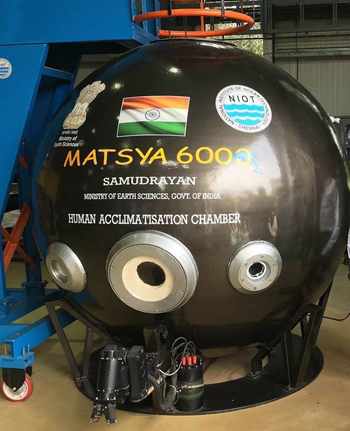
In early 2026, India is preparing its first crewed submersible, 'Matsya-6000', for initial test dives off the Chennai coast. This will be a key step under the 'Samudrayaan' programme, placing India among a select group of nations capable of human-rated underwater operations at abyssal depths. The 28-tonne 'Matsya-6000' has been designed and built by the National Institute of Ocean Technology (NIOT). Standing at 2.25 metres in diameter, it is fitted within a support frame that houses the submersible's propulsion systems, high-density lithium-polymer batteries, and sophisticated ballast and safety mechanisms. The vessel's design incorporates redundancy for safety, including drop-weight release systems, propellers with autonomous control, and emergency buoys forming part of a drag-anchor rescue arrangement. Each critical subsystem is being certified by Det Norske Veritas (DNV); the global benchmark agency for marine and underwater safety.

NIOT scientists, Ramesh Raju and Jatinder Pal Singh, have been selected to pilot Matsya-6000 during the initial 500-metre trial phase to validate its pressure resistance, propulsion stability, and environmental control systems. These dives will be the first time Indian scientists directly explore the deep ocean in a domestically built submersible. The full-depth descent to 6,000 metres is targeted for 2027, coinciding with India's 'Gaganyaan; human spaceflight mission. The ultimate vehicle configuration for this mission will replace the current steel sphere with a titanium version capable of enduring 600 bars of pressure. The titanium sphere is under fabrication at ISRO's Liquid Propulsion Systems Centre (LPSC) in Bengaluru.
In early 2026, India is preparing its first crewed submersible, 'Matsya-6000', for initial test dives off the Chennai coast
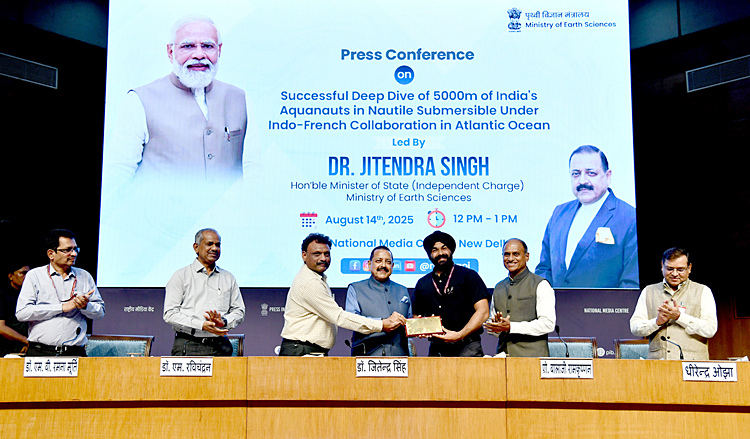
While several attempts were made to procure foreign-built deep-sea vehicles, restrictions on transfer of critical technologies prompted the government to build one indigenously, according to NIOT's Director, Dr Balaji Ramakrishnan, Director NIOT. Through close coordination with DRDO, CSIR, and ISRO laboratories, India developed the specialised systems and materials required for crewed deep-ocean operations. This cooperation represents a major stride towards strategic technological autonomy in a frontier domain long dominated by global powers like the US, Russia, Japan, France, and China. At a descent rate of 30 metres per minute, Matsya-6000 will be equipped with three view ports, high-intensity LED lighting, manipulator arms for geological and biological sampling, and multiple imaging systems. It will operate for up to 12 hours under standard conditions, extendable to 96 hours in emergencies. To prepare for the mission, scientists Ramesh Raju and Jatinder Pal Singhjoined a 5,000-metre dive aboard the French submersible 'Nautile' earlier in 2025. Experience from this training has been incorporated in the planned dive of Matsya 6000. Crewed exploration platforms like Matsya-6000 are expected to play a pivotal role in resource mapping, ecosystem studies, and high-precision sampling, supporting national initiatives in sustainable ocean resource utilisation.