



The insightful articles, inspiring narrations and analytical perspectives presented by the Editorial Team, establish an alluring connect with the reader. My compliments and best wishes to SP Guide Publications.
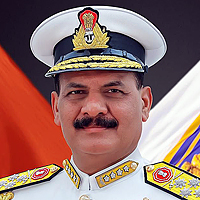
"Over the past 60 years, the growth of SP Guide Publications has mirrored the rising stature of Indian Navy. Its well-researched and informative magazines on Defence and Aerospace sector have served to shape an educated opinion of our military personnel, policy makers and the public alike. I wish SP's Publication team continued success, fair winds and following seas in all future endeavour!"

Since, its inception in 1964, SP Guide Publications has consistently demonstrated commitment to high-quality journalism in the aerospace and defence sectors, earning a well-deserved reputation as Asia's largest media house in this domain. I wish SP Guide Publications continued success in its pursuit of excellence.
During the 23rd India-Russia Annual Summit, both leaders reaffirmed ambitions to expand bilateral trade, including by increasing India's exports to Russia, strengthening industrial cooperation, forging new technological and investment partnerships, plus bilateral trade of $100 billion by 2030
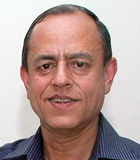 |
The Author is Former Director General of Information Systems and A Special Forces Veteran, Indian Army |

Russian President Vladimir Putin paid a State visit to India on December 4-5, 2025 for the 23rd India-Russia Annual Summit. This marked the 25th anniversary of the Declaration on Strategic Partnership between India and Russia, established during the first state visit of Putin to India in October 2000.
Russia is a longstanding and time-tested partner of India since signing the "Declaration on the India-Russia Strategic Partnership" in October 2000. India-Russia ties have evolved significantly, touching political, security, defence, trade and economy, science and technology, culture, and people-to-people cooperation. In December 2010, during Putin's visit to India, this partnership was elevated to the level of a 'Special and Privileged Strategic Partnership' under which several institutionaliSed dialogue mechanisms operate at both political and official levels to ensure regular interaction and cooperation activities.
Both sides encouraged joint manufacturing in India of spare parts, components, aggregates and other products for maintenance of Russian origin arms and defence equipment through transfer of technology (ToT) and setting up of joint ventures
During the 23rd India-Russia Annual Summit, both leaders underscored that this relationship continues as an anchor of global peace and stability. They underlined that India-Russia ties have remained resilient in the backdrop of the prevailing complex, challenging and uncertain geopolitical situation and welcomed opening of two Consulates General of India in Yekaterinburg and Kazan. Both reaffirmed ambitions to expand bilateral trade, including by increasing India's exports to Russia, strengthening industrial cooperation, forging new technological and investment partnerships, plus bilateral trade of $100 billion by 2030. Both countries have agreed to continue jointly developing systems of bilateral settlements through use of the national currencies to ensure uninterrupted bilateral trade.
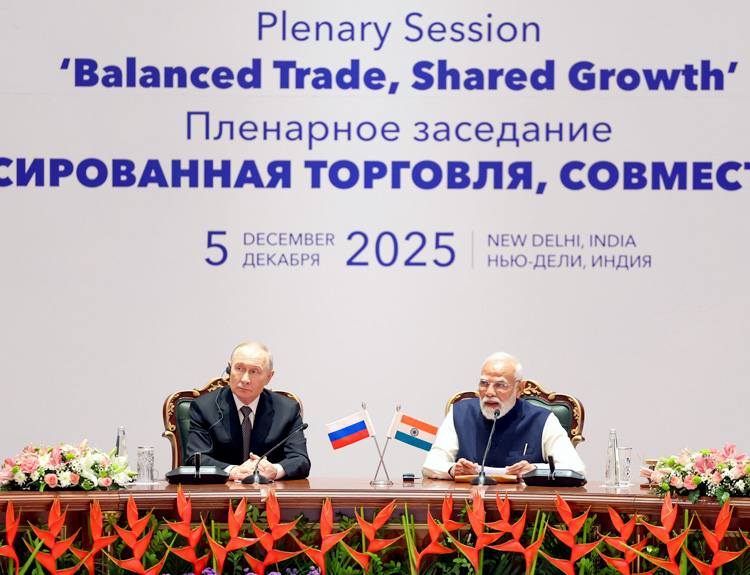
Both sides commended cooperation in the energy sector, mutually beneficial technology exchanges, and agreed building stable and efficient transport corridors, focused on improving connectivity to support the International North-South Transport Corridor (INSTC), the Chennai–Vladivostok (Eastern Maritime) Corridor, and the Northern Sea Route. India is ready to play an active role as an Observer in the Arctic Council.
In terms of nuclear energy cooperation, both sides agreed to accelerate technical/commercial discussions on the VVER of the Russian design, research and joint development of NPPs, localisation and joint manufacturing of nuclear equipment and fuel assemblies for Russian-designed large capacity NPPs. They noted the ISRO- Roscosmos cooperation in the use of outer space, human spaceflight programs, satellite navigation and planetary exploration.
Defence is one of the most important parts of the bilateral strategic partnership, following a special 10-year agreement that guides military and defence technology cooperation
In terms of military-to-military cooperation, both sides appreciated the joint military exercises, encouraged joint manufacturing in India of spare parts, components, aggregates and other products for maintenance of Russian origin arms and defence equipment under 'Make in India' programme through transfer of technology (ToT) and setting up of joint ventures for meeting the needs of the Indian Armed Forces as well as exports to mutually friendly third countries. Emphasising the importance of joint research in science, technology and innovation, both sides called for strengthening cooperation under the "Roadmap for Science, Technology & Innovation Cooperation".
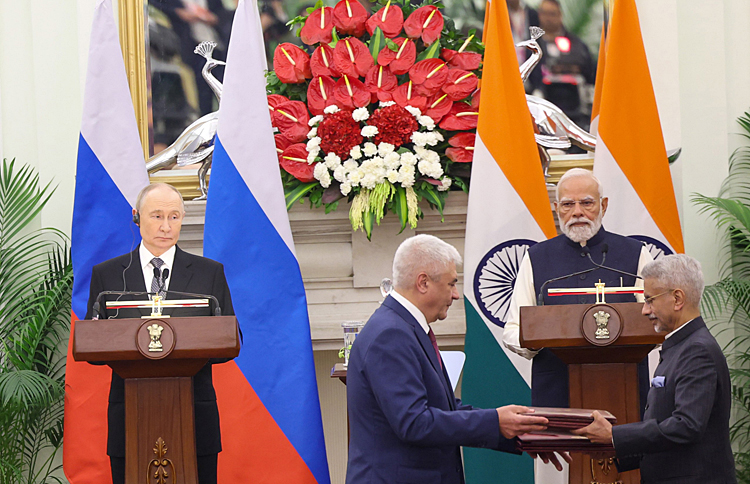
Both sides called for comprehensive reform of the UNSC to reflect contemporary global realities and to make it more representative, effective and efficient in dealing with issues of international peace and security. Russia reiterated its support for India's permanent UNSC membership. They emphasised G20 as the premier international economic forum that provides a platform for dialogue of both emerging and developed economies. Both Sides stressed strengthening BRICS partnership and promote cooperation in the expanded BRICS under the three pillars of political and security, economic and financial, cultural and people-to-people cooperation. Both sides emphasised the importance of further strengthening SCO's potential, especially in the fields of countering terrorism, extremism, separatism, drug trafficking, cross-border organised crime, and information security threats. They underlined the importance of strengthening cooperation within various regional fora, including the East Asia Summit, ASEAN Regional Forum, ASEAN Defence Ministers' Meeting Plus.
Both sides appreciated India-Russia coordination on Afghanistan, welcoming counter-terrorism measures against international terrorist groups, including ISIS and ISKP and their affiliates. They stressed the need to ensure urgent and uninterrupted humanitarian assistance to the Afghan people. They expressed concern over the humanitarian situation in Gaza and strongly stressed the importance for all parties concerned to remain committed to agreements and understandings reached between them for cessation of conflict, humanitarian assistance and a sustainable peace.
Russia's Duma ratified the Reciprocal Exchange of Logistics Support (RELOS) agreement one day before Putin's India visit, adapting to new strategic realities
India-Russia bilateral trade reached a record $68.7 billion in FY 2024-25, with Indian exports at $4.9 billion. Bilateral investments between the two countries remain strong with a target of $50 billion investment by 2025. The major bilateral investments by Russia in India are in the oil and gas, petrochemicals, banking, railways and steel sectors, while Indian investments in Russia are mainly in oil and gas and pharmaceuticals sectors.
Defence is one of the most important parts of the bilateral strategic partnership, following a special 10-year agreement that guides military and defence technology cooperation. The military-technical cooperation agreement for 2021–2031 inked on December 6, 2021 in New Delhi, focuses on joint research, development, production, and after-sales support of weapons and military equipment. Indi-Russia joint venture of BrahMos supersonic cruise missiles is a flagship achievement. Licensed production of the Su-30 MKI fighter jets and T-90 Bhishma MBT is being done in India. The joint Indo-Russian AK-2023 assault rifle venture in India is the recent addition. The Russian S-400 Triumph AD Missile systems played a prominent role in Operation 'Sindoor'.
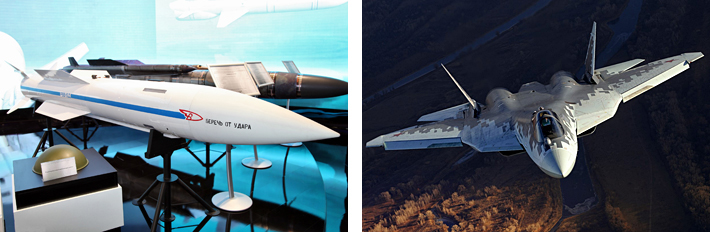
Before Putin's visit, Russia had offered the Su-57 to India, including joint production of fighter aircraft in India under the 'Make in India' at the existing facilities of Su-30Mk-1 production facilities at the Hindustan Aeronautics Limited (HAL). However, despite defence ties being a key focus in Indo-Russian partnership, no new defence deal was announced in the joint statement during Putin's visit. This is because India hosting Putin, although under a 25-year-old annual summit mechanism, raised hackles in the West while US-NATO (using Ukraine as proxy) continues to wage war against Russia. Also, India is in the advanced stages of a free trade agreement (FTA), both with the US, which has slapped a 50 per cent tariff on India including 25 per cent for its oil trade with Russia, and the EU.
Russia has green lighted full Su-57E Izdeliye 177S engine technology transfer to India for manufacture at Hindustan Aeronautical Limited (HAL), Koraput
Most significantly, Russia's Duma ratified the Reciprocal Exchange of Logistics Support (RELOS) agreement one day before Putin's India visit, adapting to new strategic realities. RELOS lays down procedures for dispatching warships, military aircraft, and even mutual troop deployments for various activities between India and Russia, while governing the logistical support they can access. Russia has conveyed that RELOS may give India reciprocal access to over 40 Russian naval and air bases, including key Arctic and Pacific facilities. According to Professor Jeffrey Sachs, Russia has broken into the Indian Ocean with RELOS turning India into a 'Floating Super Base' challenging America.
Meanwhile Russia's Rosatom has made the first delivery of nuclear fuel for Tamil Nadu's third nuclear power plant. These shipments are provided under a contract signed in 2024, which includes fuel supply for the third and fourth VVER-1000 reactors of the Kudankulam plant for the entire service life, staring from initial loading.
Russia has green lighted full Su-57E Izdeliye 177S engine technology transfer to India for manufacture at Hindustan Aeronautical Limited (HAL), Koraput. In addition, Russia has offered to supply and integrate the R-37M long-range air-to-air missile, having beyond-visual-range (BVR) capability of 200-400 kms that would allow hostile aircraft to be engaged much earlier than before. Once operational on the Su-30MKI (and possibly later on the MiG-29), India gains a clear edge over Pakistan and narrows the gap with China.