






The insightful articles, inspiring narrations and analytical perspectives presented by the Editorial Team, establish an alluring connect with the reader. My compliments and best wishes to SP Guide Publications.

"Over the past 60 years, the growth of SP Guide Publications has mirrored the rising stature of Indian Navy. Its well-researched and informative magazines on Defence and Aerospace sector have served to shape an educated opinion of our military personnel, policy makers and the public alike. I wish SP's Publication team continued success, fair winds and following seas in all future endeavour!"

Since, its inception in 1964, SP Guide Publications has consistently demonstrated commitment to high-quality journalism in the aerospace and defence sectors, earning a well-deserved reputation as Asia's largest media house in this domain. I wish SP Guide Publications continued success in its pursuit of excellence.
This fully commercial venture, facilitated by NewSpace India Limited, underscored ISRO's prowess with the 43.5-metre-tall Bahubali, positions India as a key player in the global space launch market
 |
The Author is Former Director General of Information Systems and A Special Forces Veteran, Indian Army |
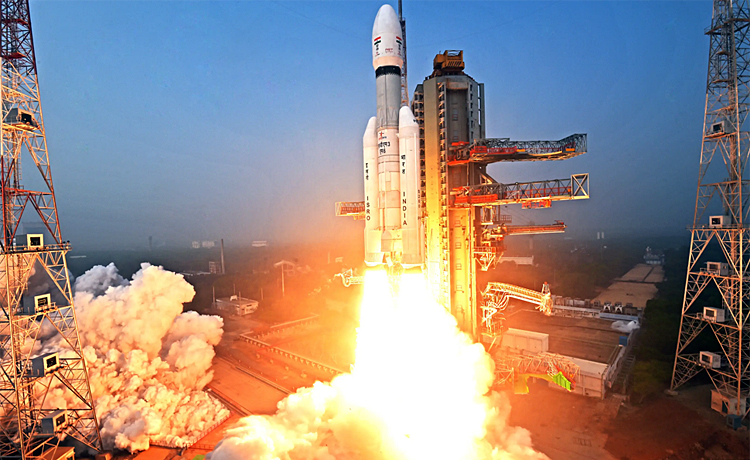
The Indian Space Research Organisation (ISRO) successfully launched America's BlueBird-6 satellite into a precise Low-Earth Orbit (LEO) using the LVM3-M6 rocket, nicknamed 'Bahubali', from the Satish Dhawan Space Centre in Sriharikota, Andhra Pradesh. The mission lifted off at 8:54 AM IST on December 24, 2025, injecting the 6.5-tonne satellite into a circular orbit at approximately 520 kilometres altitude after a 15-minute ascent. This was ISRO's ninth LVM3 flight, fifth mission in 2025 and 101st overall launch.
BlueBird-6, a next-generation communications satellite, represents a leap in satellite telecommunications with its record-breaking 223-square-metre phased-array antenna, the largest commercial communications array planned to be deployed in LEO
BlueBird-6, also called BlueBird Block-2, a next-generation communications satellite developed by US-based 'AST SpaceMobile', which weighs around 6,100 kg, represents a leap in satellite telecommunications with its record-breaking 223-square-metre phased-array antenna, the largest commercial communications array planned to be deployed in LEO, enabling direct 4G and 5G connectivity to unmodified smartphones without specialised hardware. BlueBird-6 has up to 10 times the bandwidth of its five predecessors, supporting over 5,600 individual signal cells for peak speeds of 120 megabits per second, facilitating voice calls, messaging, data transfers, and video streaming in remote regions like the Himalayas, oceans, and deserts.
Executed under a commercial agreement between NewSpace India Limited (NSIL), ISRO's commercial arm, and AST SpaceMobile, the launch demonstrated flawless Indo-US coordination. Prime Minister Narendra Modi lauded the feat as a "proud milestone". Dr V Narayanan, ISRO Chairman, praised the "precise" orbital insertion after 15 minutes of flight, calling it one of the finest performances by any global launch vehicle and the third fully commercial LVM-3 mission, bolstering India's heavy-lift capabilities and global commercial launch market presence. Narayanan called it a standout flight on multiple fronts, with the launcher achieving orbital accuracy of less than 1.5 km, placing BlueBird-6 at 518.9 km against a target of 520 km – the best performance by an Indian rocket to date.
Executed under a commercial agreement between NewSpace India Limited (NSIL), ISRO's commercial arm, and AST SpaceMobile, the launch demonstrated flawless Indo-US coordination

AST SpaceMobile's CEO, Abel Avellan, hailed it as the "largest-ever commercial communications satellite in low Earth orbit," featuring a massive phased-array antenna spanning nearly 2,400 square feet (223 square metres)—over three times larger than the company's prior BlueBird satellites and boasting ten times the capacity. Built in Midland, Texas, the spacecraft now operates under nominal telemetry from AST's Washington D.C. command centre, enabling direct-to-smartphone broadband with peak speeds up to 120 Mbps for voice, data, video, and 4G/5G services without specialised equipment. Avellan extended congratulations to Prime Minister Narendra Modi, ISRO, and NewSpace India Limited (NSIL) for what he termed a flawless execution by teams in both nations.
Though ISRO delivered its heaviest punch with Bahubali launching BlueBird-6 into space, globally, LVM-3 occupies the lower end of heavy-lift capabilities compared to giants like SpaceX's Falcon Heavy, which hauls 63,800 kg to LEO and 26,700 kg to GTO using reusable boosters for cost efficiency. China's Long March-5 dwarfs it with around 25,000 kg to LEO and 14,000 kg to GTO, while Europe's Ariane-6 targets 21,900 kg to LEO and 11,500 kg to GTO for commercial dual launches. NASA's SLS Block-1, designed for crewed deep space, lifts 95,000 kg to LEO, far surpassing LVM-3's scale but at vastly higher costs. However, LVM-3 excels in reliability and economy, with a near-perfect success rate since 2014, including Chandrayaan missions and OneWeb deployments totalling over 5,700 kg payloads. Its per-kilogram cost to GTO remains competitive against Western rivals, aided by indigenous tech and no reusability yet, though ISRO plans a reusable Next Generation Launch Vehicle (NGLV) for enhanced capacity. This positions LVM-3 ideally for emerging markets like direct-to-phone satellite broadband, as seen in the BlueBird-6 launch.
Narayanan called it a standout flight on multiple fronts with the launcher achieving orbital accuracy of less than 1.5 km, the best performance by an Indian rocket to date
BlueBird-6 serves as a technology demonstrator for AST SpaceMobile's expanding low Earth orbit constellation, targeting 45 to 60 satellites by end-2026 with launches every one to two months. Operating at around 600 km altitude for near-global coverage, it supports unmodified smartphones, bridging digital divides for commercial and governmental uses. The satellite's deployment advances space-based cellular broadband, eliminating reliance on ground infrastructure. Post-deployment, AST SpaceMobile confirmed full control of BlueBird 6 from its Washington D.C. command centre, reporting nominal telemetry across all systems.
Beyond mass and accuracy, the launch carried historical weight. It marked ISRO's 434th satellite deployment for 34 countries across 45 years, and the first back-to-back Bahubali mission executed in 52 days. Technological upgrades pushed the rocket further – payload capacity rose by more than 150 kg after two hydraulic actuators were replaced with electro-mechanical systems to control the S200 booster motors. Mission Director T. Victor Joseph said, "With additional technologies, we have demonstrated that ISRO is in a much better position for future missions, including Gaganyaan." Veteran Lt General A.K. Bhatt, Director General Indian Space Association, described the mission as a quantum leap, saying, "The mission strengthens India's self-reliance in launch services and positions ISRO as a preferred provider for international missions, while accelerating growth across the domestic ecosystem."
Finally, this fully commercial venture, facilitated by NewSpace India Limited, underscored ISRO's prowess with the 43.5-metre-tall Bahubali comprising two S200 solid-fuel boosters, a core liquid stage, and an indigenous cryogenic upper stage, while positioning India as a key player in the global space launch market.