






The insightful articles, inspiring narrations and analytical perspectives presented by the Editorial Team, establish an alluring connect with the reader. My compliments and best wishes to SP Guide Publications.

"Over the past 60 years, the growth of SP Guide Publications has mirrored the rising stature of Indian Navy. Its well-researched and informative magazines on Defence and Aerospace sector have served to shape an educated opinion of our military personnel, policy makers and the public alike. I wish SP's Publication team continued success, fair winds and following seas in all future endeavour!"

Since, its inception in 1964, SP Guide Publications has consistently demonstrated commitment to high-quality journalism in the aerospace and defence sectors, earning a well-deserved reputation as Asia's largest media house in this domain. I wish SP Guide Publications continued success in its pursuit of excellence.
Laser technology is rapidly advancing, driving a new era of DEWs
 |
The Author is Former Director General of Information Systems and A Special Forces Veteran, Indian Army |
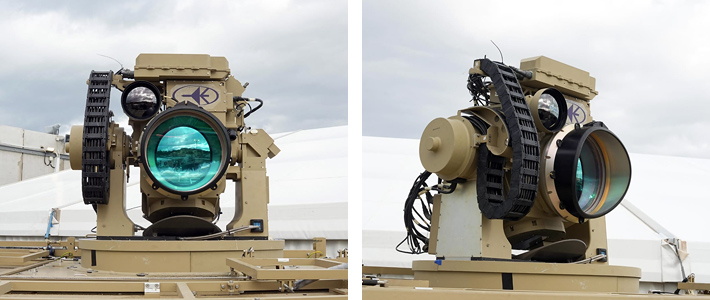
On December 28, 2025, Israel operationally deployed the 'Iron Beam' laser defence system. The Iron Beam is a short-range line-of-sight laser interceptor that is extremely cheap to run and, therefore, perfectly suited for intercepting low-cost, high-volume threats. Central to the Iron Beam are an advanced laser source and a unique electro-optical targeting system, enabling the interception of a wide range of targets at an enhanced operational range, with maximum precision and superior efficiency. Moreover, it works at a negligible marginal cost, which constitutes the laser system's primary advantage.
According to the official Israeli announcement, Iron Beam systems have "successfully intercepted rockets, mortars, and UAVs." This 100kW laser weapon thus became the world's first high-power drone defence zapper to be operationally deployed. Iron Beam lasers will fortify Israel's multi-layered defence, complementing the existing Iron Dome, David's Sling, and Arrow system architecture. Iron Beam drastically cuts operating costs per shot compared to systems like Iron Dome, with Iron Beam costing just a few dollars in electricity versus $40,000 - $50,000 per Iron Dome missile and up to $2 million Arrow long-range missile, offering a huge advantage in high-intensity conflicts, though the initial deployment and infrastructure for lasers are costly, and they face limitations in range and weather compared to traditional kinetic interceptors.
On December 28, 2025, Israel operationally deployed the 'Iron Beam' laser defence system. This 100kW laser weapon thus became the world's first high-power drone defence zapper to be operationally deployed.
India has successfully developed and tested high-powered, indigenous laser weapon systems (DEWs); notably a 30 kW laser (Mk-II(A)) capable of neutralising drones and sensors up to 4-5 km away, marking a significant step in anti-drone technology. These truck mounted systems offer precise, rapid, and cost-effective air defence; taking down drones, UAVs, and static targets with high speed and precision, functioning as a potent counter-drone solution. The system is fully indigenous, showcasing India's advancement in directed energy weapons (DEW) technology. The Defence Research and Development Organisation (DRDO) DRDO is presently working on 50-100 kW lasers to counter cruise missiles, jets, and artillery, with Project DURGA II aiming for even greater power and versatility. Concurrently, under 'Mission Sudarshan Chakra', a broader initiative has been taken up to build a comprehensive indigenous "security shield" by 2035; a futuristic defence dome with lasers, satellites and 360 degrees coverage to guard against drones and missiles for strategic defence.
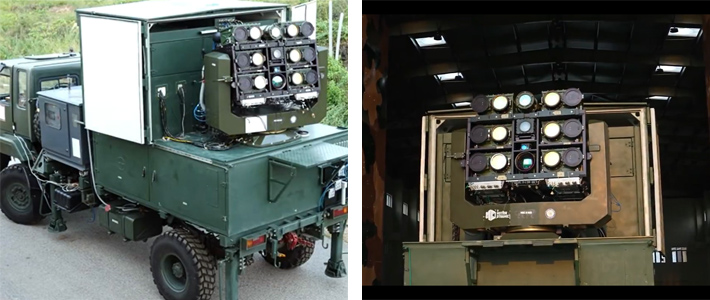
As of October 2025, 18 countries (including India) are publicly known to possess high-energy laser weapons. The United States and China are currently the most advanced in terms of both the quality and quantity of systems operationally deployed, as well as under development. China is building a state-of-the-art attosecond laser facility to observe ultrafast particle behavior and drive innovation in science and technology, according to a report published in 'Guangdong Today' on January 12, 2025, China is making significant strides in expanding its satellite constellations network, with an increasing number of launches scheduled for 2025. By deploying innovative technologies like laser technology for satellite-to-ground communication, China is reinforcing its competitive edge in the satellite industry.
Iron Beam drastically cuts operating costs per shot offering a huge advantage in high-intensity conflicts, though the initial deployment and infrastructure for lasers are costly, and they face limitations in range and weather.
China's laser technology development is rapidly advancing, making it a global leader in both industrial applications (like cutting and marking) and cutting-edge defence/space systems, with significant government support driving innovation in areas like ultrafast lasers, space-based laser communications (achieving high speeds), and portable, wide-temperature-range laser weapons, aiming for self-sufficiency and global competitiveness.
In space and communications, China's significant breakthroughs include high-speed satellite laser communication (1 Gbps) and research into Free Electron Lasers (FELs) for advanced applications, potentially rivalling international standards. In terms of defence and weaponry, China is developing diverse laser weapon platforms (ground, air, sea, space), claiming technological advantages in power and range, with portable systems capable of operating in extreme conditions. According to reports, China's major advancements in compact, high-power ultrafast lasers and deep ultraviolet (DUV) lasers are crucial for semiconductor manufacturing (photolithography) and scientific research. In industry and manufacturing, China dominates the global laser machine market, heavily using lasers for automation, precision cutting, 3D printing (additive manufacturing), and advanced display (OLED/Micro-LED) production.
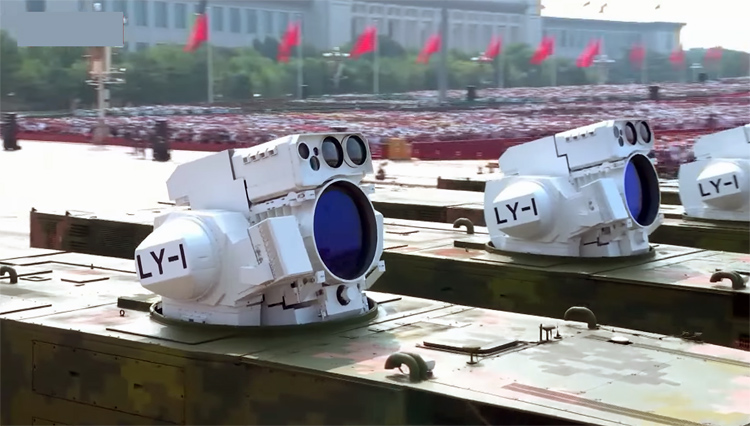
China's 'LY-1' is a Chinese shipborne or ground-based high-energy laser weapon designed to intercept drones, cruise missiles, helicopters, and fixed-wing aircraft. This laser weapon system was unveiled at the 2025 China Victory Day Parade. A very similar system was tested on a Type 071 amphibious dock of the Peoples' Liberation Army Navy (PLAN) in 2024, with the earliest report of such a system under development in 2019. As a ship-borne weapon, the LY-1 is expected to form a layered air defence system with missiles such as the HQ-10 and HQ-16.
China's laser advancements, with strong state support for high-tech sectors is accelerating development, including shifting focus towards energy-efficient, compact systems, advanced sensing (LiDAR), and integration into smart factories, are creating new global benchmarks, reducing reliance on foreign technology, and presenting both opportunities (economic, industrial) and strategic concerns in military and space.
India has successfully developed and tested high-powered, indigenous laser weapon systems (DEWs); notably a 30 kW laser (Mk-II(A)) capable of neutralizing drones and sensors up to 4-5 km away, marking a significant step in anti-drone technology.
Pakistan has laser-guided weapons like the 'Al-Battar' bomb kit that can be fitted to standard bombs (Mk 83/84) for increased accuracy for fighter jets and unmanned aerial vehicles (UCAVs). It also has the laser-guided 'Burq' missile system; a family of laser-guided missiles designed for use on UCAVs and other aircraft for air-to-ground missions. Pakistan is seeking to acquire advanced Chinese laser weapons, such as the LY-1, to defend against drones and missiles. The focus is on developing or acquiring directed energy weapons (DEWs) to counter threats like drones, which is a strategic priority.
Laser technology is rapidly advancing, driving a new era of DEWs. Lasers won't entirely replace traditional weapons but will become essential components in modern militaries, offering speed, affordability and deep magazines (limited by power). Artificial Intelligence (AI) and Machine Learning (ML) are crucial for autonomous target detection, classification, and optimising firing sequences in complex environments, transforming raw power into battlefield dominance. Lasers will complement traditional systems (cannons, missiles) for affordable, rapid defence against swarms of drones, rockets, artillery, and cruise missiles. As anti-drone (C-UAS), their low cost per shot makes them ideal for neutralizing numerous, low-cost drone threats, including terrorist attacks. Future applications of lasers could include targeting satellites, potentially shifting conflict into space.