






The insightful articles, inspiring narrations and analytical perspectives presented by the Editorial Team, establish an alluring connect with the reader. My compliments and best wishes to SP Guide Publications.
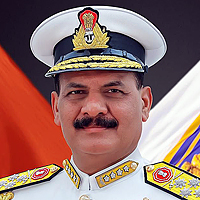
"Over the past 60 years, the growth of SP Guide Publications has mirrored the rising stature of Indian Navy. Its well-researched and informative magazines on Defence and Aerospace sector have served to shape an educated opinion of our military personnel, policy makers and the public alike. I wish SP's Publication team continued success, fair winds and following seas in all future endeavour!"

Since, its inception in 1964, SP Guide Publications has consistently demonstrated commitment to high-quality journalism in the aerospace and defence sectors, earning a well-deserved reputation as Asia's largest media house in this domain. I wish SP Guide Publications continued success in its pursuit of excellence.
The trial marks a major step toward a true uncrewed system-of-systems, combining long-endurance surface vessels and subsea gliders for over-the-horizon deployment without a crewed ship
 |
The Author is Former Director General of Information Systems and A Special Forces Veteran, Indian Army |
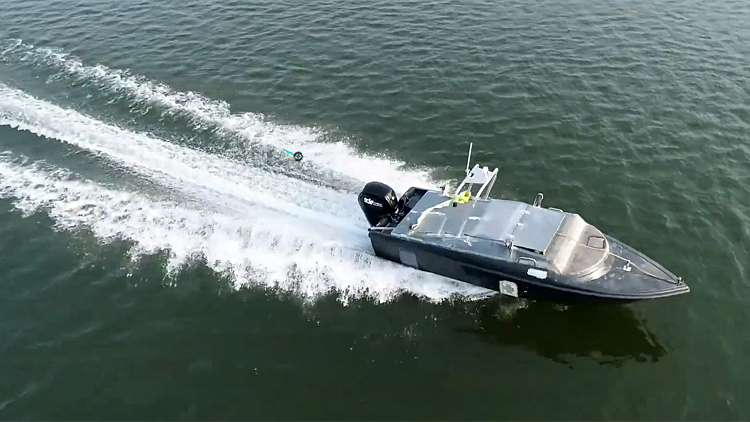
Unmanned Surface Vehicles (USVs) are critical autonomous or remote-controlled marine vessels that enhance maritime safety, efficiency, and surveillance while reducing risks to human personnel. They play vital roles in defence (anti-submarine warfare, surveillance), environmental monitoring, hydrographic surveys, and asset inspection, offering cost-effective and persistent operational capabilities. USVs improve intelligence, surveillance, and reconnaissance (ISR) capabilities, monitoring Exclusive Economic Zones (EEZs) and aiding in anti-piracy, anti-submarine warfare, and mine countermeasures (MCM). Operating in dangerous or hazardous environments, they reduce risks to human crews and lowering maintenance/deployment costs compared to traditional manned vessels. USVs enable accurate mapping of sea floors, coastal areas, and inland waterways for construction and infrastructure development. They are used to inspect subsea assets (pipelines, cables) and provide real-time data to optimise port operations and security. Due to their generally compact size, they can access shallow waters (riverine areas) where larger ships cannot navigate effectively.
USVs improve ISR capabilities, monitoring Exclusive Economic Zones (EEZs) and aiding in anti-piracy, anti-submarine warfare, and mine countermeasures
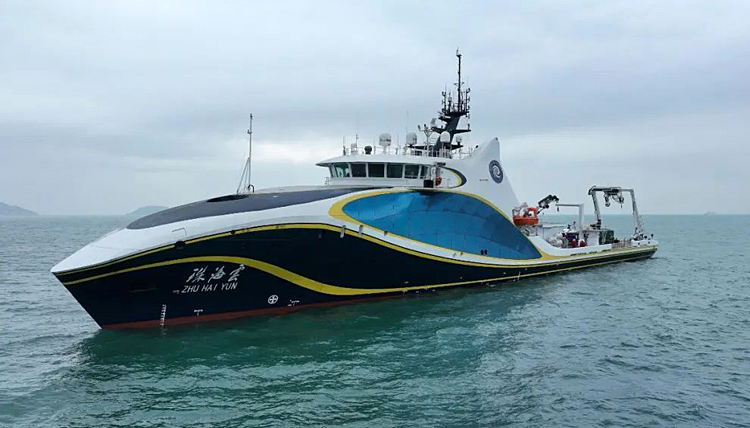
USVs are being developed and deployed globally for surveillance and strike missions by many countries, including by the US, China, France, Israel and South Korea among others. China has deployed various USVs ranging from small reconnaissance boats to large, armed autonomous warships for intelligence gathering, mine countermeasures, and as potential force multipliers, some examples include the JARI USV, a 20-tonne multi-purpose armed vessel, and the Zhu Hai Yun, a drone carrier ship that deploys aerial, surface, and underwater drones.
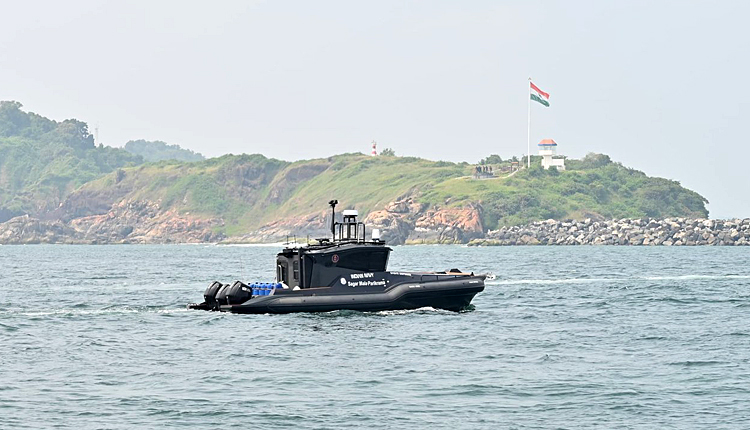
It was reported in these columns recently that Sagar Defence Engineering is producing indigenous USVs and has delivered the first two units of a 12-USV order to the Indian Navy for autonomous intelligence, surveillance, reconnaissance (ISR), and weaponised roles. In 2024, the 'Matangi' Autonomous Surface Vessel completed an 850-nautical-mile autonomous transit, proving its capability. In March 2026, Sagar Defence broke ground on the world's first Autonomous Maritime Shipbuilding and Systems Centre in Andhra Pradesh to produce USVs, Autonomous Underwater Vehicles (AUVs), and AI-based navigation systems. Projects include the 'Bali' USV and weaponised, high-speed autonomous boats designed for combat.
China has deployed various USVs ranging from small reconnaissance boats to large armed autonomous warships for intelligence gathering, mine countermeasures, and as potential force multipliers
According to news reports of March 20, 2026, UK-based firm 'ZeroUSV' has conducted a successful trial of a high-endurance drone vessel deploying anti-submarine warfare glider autonomously; the trial showcased scalable deployment of multiple gliders from a single USV. The ZeroUSV's vessel deployed a Slocum glider autonomously. The trial demonstrated that USVs can serve as launch platforms. Claimed to be the world's first of its kind, the trial involved Oceanus12 USV and Teledyne Slocum Glider. The company said that the trial marks a major step toward a true uncrewed system-of-systems, combining long-endurance surface vessels and subsea gliders for over-the-horizon deployment without a crewed ship.
UK based firm has conducted a successful trial of a high-endurance drone vessel deploying anti-submarine warfare glider autonomously showcasing scalable deployment of multiple gliders from a single USV
The trial also demonstrates scalable deployment of multiple gliders from a single USV and extended reach into harsh maritime environments. The Oceanus12 involved in the trial is a novel series of 12m USVs; a fully autonomous, low-carbon, and mission-agonistic USV, engineered to operate over-the-horizon. Through autonomy, it will increase the efficiency, coverage, and speed of marine operations, while decreasing costs and CO2 emissions. According to Matthew Ratsey, Managing Director and Co-founder of ZeroUSV, "This is an incredible milestone. For the first time, the world has seen the launching and operating of an ocean glider from an uncrewed vessel, which opens up new possibilities for persistent subsea monitoring and long-endurance operations at sea. This ushers in a new operational model for persistent, distributed ocean data collection, directly relevant to defence ISR (Intelligence, Surveillance, and Reconnaissance), ASW (Anti-Submarine Warfare) and REA (Rapid Environmental Assessment) missions, as well as commercial and scientific oceanographic applications."
The trial also demonstrates scalable deployment of multiple gliders from a single USV and extended reach into harsh maritime environments
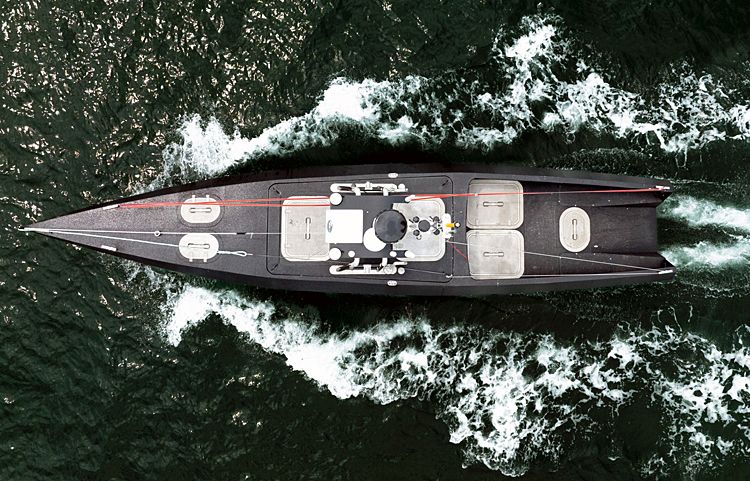
Delivered as part of the Royal Navy's Atlantic Bastion technical programme and witnessed by senior Royal Navy and DSTL personnel, this milestone underscores the growing operational maturity of autonomous maritime systems. The integration of USVs and subsea gliders is accelerating – and this collaboration with Teledyne Marine and MSubs highlights what high-readiness, sovereign capability can look like in practice, according to ZeroUSV. The Slocum glider involved in this trial is produced by Teledyne Webb Research (TWR). Slocum gliders carry the largest number and greatest variety of payloads of any glider AUV. The company highlighted that the Slocum glider is designed to be a sensor platform with a dry modular centre payload bay. Wetted bays in the bow and stern provide more opportunities for sensor loading. According to Teledyne Webb, this modularity, along with the energy-efficient buoyancy propulsion system, provides the Slocum with a most flexible system for integrating sensors for optimal ocean observation.