




The insightful articles, inspiring narrations and analytical perspectives presented by the Editorial Team, establish an alluring connect with the reader. My compliments and best wishes to SP Guide Publications.
"Over the past 60 years, the growth of SP Guide Publications has mirrored the rising stature of Indian Navy. Its well-researched and informative magazines on Defence and Aerospace sector have served to shape an educated opinion of our military personnel, policy makers and the public alike. I wish SP's Publication team continued success, fair winds and following seas in all future endeavour!"

Since, its inception in 1964, SP Guide Publications has consistently demonstrated commitment to high-quality journalism in the aerospace and defence sectors, earning a well-deserved reputation as Asia's largest media house in this domain. I wish SP Guide Publications continued success in its pursuit of excellence.
India is weighing a major strategic choice between the Russian Su-57E and French Rafale, based on technology transfer, source-code access, 'Make in India' ambitions, costs, operational capability and the geopolitical risks of possible US sanctions
 |
The Author is Former Director General of Information Systems and A Special Forces Veteran, Indian Army |
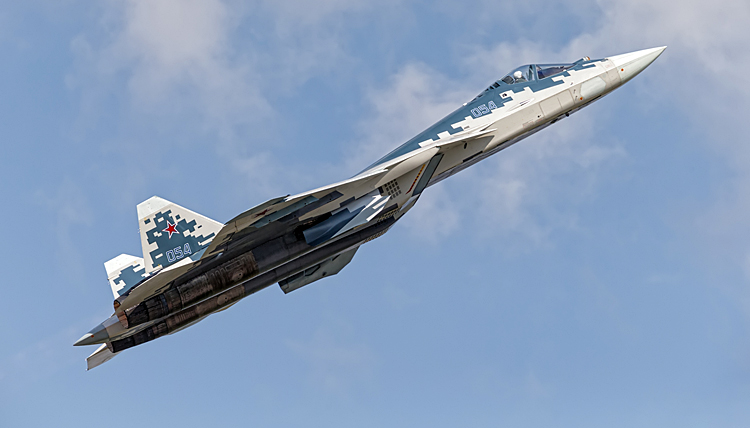
D.K. Sunil, Chairman and Managing Director of Hindustan Aeronautics Limited (HAL), according to new reports of April 6, 2026, has provided details on ongoing plans for the license production of the Su-57 5th generation fighter jet in India, 14 months after it was confirmed that talks for such a deal were underway.
Sunil was quoted as saying, "I think presentations have been made regarding the Su-57 to the Indian Air Force (IAF) team by the Russian team regarding the capabilities of the aircraft. We have had one estimation of the capacity of our Plants for the Russian equipment. A committee of Russians has also studied and said that roughly 50 per cent of the facilities can be used for producing this aircraft, but some new investments will be required," he observed. The Su-57 began deliveries tp Algeria, the aircraft's first client, in late 2025, with the aircraft having already been brought into active service.
Russian Defence Ministry had offered India full access to the aircraft's source code as part of a license production deal, which would place Indian Su-57s in the same league as the Russian military
Sunil further said, "We are awaiting the Russian quotation about the investment. Then we will approach the Air Force that these are the kind of numbers required to produce these aircraft and these are the timelines." Indian media outlets have reported that Russian defence agencies have been conducting internal analyses to determine the capital required for Su-57 production in India, with the goal of reducing costs, shortening timelines, and leveraging existing infrastructure, in particular facilities for the manufacture of the older Su-30 MKI 4th+ generation fighter jet, of which over 220 were built in India.
In December 2025, Dmitry Shugayev, Director of the Russian Federal Service for Military-Technical Cooperation suggested the possibility of a full India-Russia full joint programme to develop a new Su-57 variant being pursued, providing India with ownership of key technologies. A former IAF Group Captain had responded to the Russian offer by saying, "When you combine the exceptional aerodynamics of Su-57 and the Indian avionics and software to it, you have an airplane much better than the F-35." It is also believed that a miniaturised variant of the 'Virupaksha' AESA radar currently under development for the Su-30 MKI could be integrated onto a local variant of the Su-57.
In June 2025, the Russian Defence Ministry had offered India full access to the aircraft's source code as part of a license production deal, which would place Indian Su-57s in the same league as the Russian military – allowing the same levels of customisation and the degree to which they can integrate indigenous technologies. In January 2026, the Indian Ministry of Defence (MoD) confirmed that talks for the license production of the Su-57 had reached an advanced technical stage with the Russians. In February 2026, local media reported that the MoD is considering the near-term procurement of 40 x Su-57s to enhance the combat capabilities of the IAFs frontline units, which would be followed by a license production deal. This deal would mirror the procurement of 50 x Russian-built Su-30 MKI fighters before deliveries from local production lines could commence.
MoD is considering the near-term procurement of 40 x Su-57s to enhance the combat capabilities of the IAFs frontline units, which would be followed by a license production deal.
Indian media is overloaded with news about the Multi-Role Fighter Aircraft (MRFA) deal India is to make for the French Rafales. Rostec had earlier told Indian media that the Su-57E package for India could cost about 50 per cent of what India would pay for the Rafale MRFA Deal. Russia had also said that the deal would include complete transfer of technology (ToT), and the existing Su-30 facilities in India, can already accommodate bulk of the Su-57E production under 'Make in India'. But do the US threat of sanctions and tariffs for a defence deal with Russia, rule out the MFRA deal in favour of the Russian Su-57E? The fact that no Indo-Russian defence deal was announced during the recent visit of Russian President Vladimir Putin to India for the 23rd India-Russia Summit, is indication enough.
India is preparing for its largest ever defence deal of $39-40 billion for 114 Rafales, the Defence Procurement Board (DPB) has reportedly cleared the proposal before being forwarded to the Cabinet Committee on Security (CCS) for final clearance, The deal envisages import of 12-18 Rafale jets in fly-away condition, while the remaining aircraft would be assembled in India with involvement from local aerospace partners. Under the 'Make in India' initiative, indigenous components are expected to account for more than 30 per cent of the total content, supporting the government's aim to expand domestic defence manufacturing.
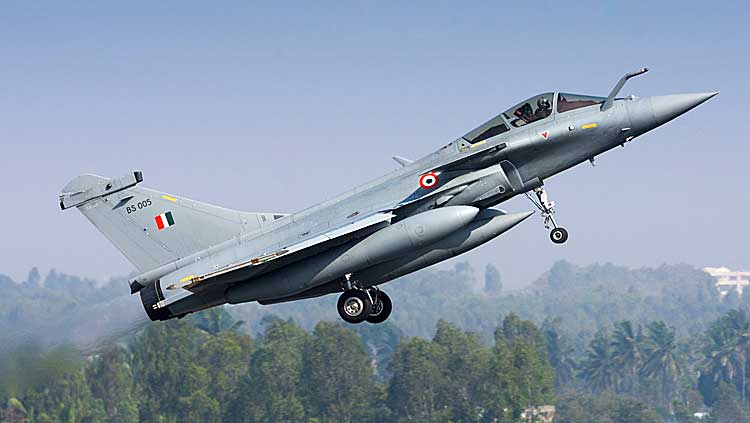
India is also wanting France to integrate domestically developed weapons systems and mission electronics into the Rafale platform. French officials have indicated interest in establishing a maintenance, repair and overhaul (MRO) facility, potentially in Hyderabad, to support M88 engines powering the Rafale fleet. France has also said that of the additional 114 Rafales being ordered, 24 could be of the future Rafale F5 standard, which is expected to enter service after 2030. However, these 24 Rafale F5 would be manufactured in France, not in India under the 'Make in India' initiative.
French have now intimated that the source codes for the Rafale aircraft's core software would remain under French control; implying France will have the upper hand for every future upgrade.
However, the French have now intimated that the source codes for the aircraft's core software would remain under French control; implying France will have the upper hand for every future upgrade. This defeats the very aim of 'Make in India. Not only will the control (including possible kill switch) remain with the French forever, future integration of any indigenous radar or weapon in the Rafales would also be subject to modifications and control by the French. Should we accept this despite a $39-40 billion deal.
Finally, there is speculation that negotiations for the Russian Su-57E deal was deliberately delayed to push through the additional Rafales costing $39-40 billion. But the question is will India dump the Su-57E offer, which is far better than the Rafales for fear of American sanctions/tariffs or kickbacks ignoring the operational requirements of IAF amid mounting national security threats?