



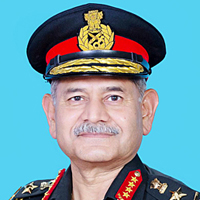
The insightful articles, inspiring narrations and analytical perspectives presented by the Editorial Team, establish an alluring connect with the reader. My compliments and best wishes to SP Guide Publications.
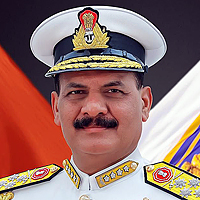
"Over the past 60 years, the growth of SP Guide Publications has mirrored the rising stature of Indian Navy. Its well-researched and informative magazines on Defence and Aerospace sector have served to shape an educated opinion of our military personnel, policy makers and the public alike. I wish SP's Publication team continued success, fair winds and following seas in all future endeavour!"

Since, its inception in 1964, SP Guide Publications has consistently demonstrated commitment to high-quality journalism in the aerospace and defence sectors, earning a well-deserved reputation as Asia's largest media house in this domain. I wish SP Guide Publications continued success in its pursuit of excellence.
In a significant press briefing, Chief welcomed the induction of the indigenous Tejas Mk-1A fighter jets and outlined the success of the recently executed 'Operation Sindoor'. However, in more clear tones for the Tejas, Chief also called for “more R&D” for the induction – there needs to be more R&D work before it is formally inducted.
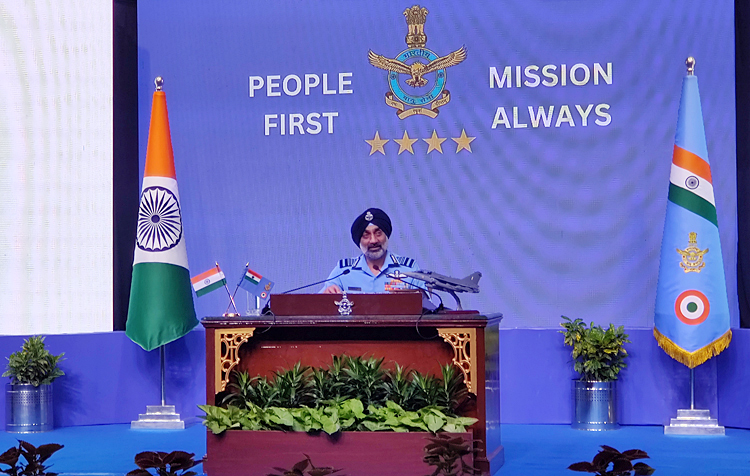
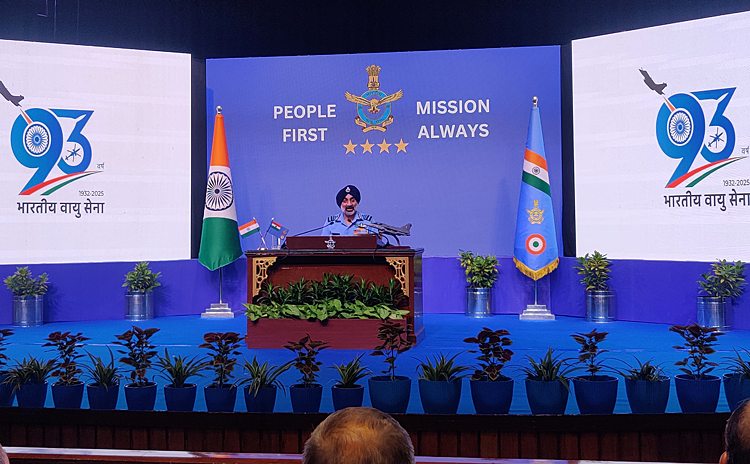
In the annual press briefing held on Friday, October 3, 2025, on the occasion of the upcoming IAF Day, Indian Air Force (IAF) Chief Air Chief Marshal Amar Preet Singh shared crucial updates on two of the most critical developments in India's air power narrative: the induction of the indigenous Tejas Mk-1A fighter jets and the success of the recently executed 'Operation Sindoor'.
However, in more clear tones, for the Tejas, Chief also called for “more R&D” for the induction – there needs to be more R&D work before it is formally inducted.
“Hungry mouths are ready, waiting for the food now.” His comment highlighted the operational urgency and readiness to induct the aircraft into active service.
“We are very excited to have this aircraft with us as early as possible. I believe the engine flow has started, and some promises are being made. Some more R&D work, which is still pending. That work is still going on, as soon as they can certify the aircraft against set standards, we are ready to welcome it,” he outlined.
Addressing the much-anticipated arrival of the Tejas Mk-1A fighter aircraft, Air Chief Marshal Singh expressed both excitement and clarity in expectations.
“As far as Tejas Mk-1A is concerned, our expectations are based on what QRs (Qualitative Requirements) we had given them earlier, which were set a few years back, and our expectations remain the same. We expect the aircraft to be able to achieve those parameters that are set in those documents,” Singh said.
He metaphorically captured the eagerness within the force by saying, “Hungry mouths are ready, waiting for the food now.” His comment highlighted the operational urgency and readiness to induct the aircraft into active service.
The Mk-1A variant, which has already completed weapons integration trials–including successful firing of Astra beyond-visual-range missiles and ASRAAM–is a major leap forward in India's indigenous fighter capability. The IAF is expecting the delivery of 83 Tejas Mk-1A aircraft by 2029, following a reported delay of four quarters.
The Chief also confirmed that work on the more advanced LCA Mk-2 is on track, with its rollout expected by 2027.
On the operational front, Air Chief Marshal Singh described Operation Sindoor as a landmark success, carried out with precision and swiftness.
“This will be remembered as a conflict that achieved its objectives with speed and precision, and brought Pakistan to its knees,” Singh declared, underlining the effectiveness of India's air power projection. He revealed that during the operation, the IAF neutralised 11 to 12 Pakistani aircraft, including F-16s and JF-17s, effectively countering Islamabad's claim of having downed seven Indian jets.
“We have signs of one C-130 class of aircraft... and at least 4 to 5 fighter aircraft, most likely F-16s. That place happened to be where F-16s were stationed, with some under maintenance,” he explained, referring to a key Pakistani air base targeted during the operation.
On the operational front, Air Chief Marshal Singh revealed that during the operation, the IAF neutralised 11 to 12 Pakistani aircraft, including F-16s and JF-17s, effectively countering Islamabad's claim of having downed seven Indian jets.
In a major revelation, he confirmed the destruction of a Surface-to-Air Missile (SAM) system and a long-range strike on a high-value airborne target. Singh confirmed that five Pakistani fighter jets and one large surveillance / AEW&C or ELINT aircraft were destroyed using the S-400, including strikes occurring at about 300 km range. These are described as among the longest recorded surface-to-air kills India has made.
“We have clear evidence of one long-range strike–more than 300 km–which appears to have been either an AEW&C (Airborne Early Warning & Control) aircraft or another significant asset,” he said. The strike reportedly neutralised a major component of Pakistan's aerial surveillance and command capabilities.
On the precision and firepower of S-400 air defence systems, Chief said: “It has proved to be a good weapon system. We have our own system also developing... there's a requirement to have more such.” This suggests that while the S-400 has met expectations, India is also looking at scaling and possibly supplementing existing capabilities.
On the precision and firepower of S-400 air defence systems, Chief said: “It has proved to be a good weapon system. We have our own system also developing... there's a requirement to have more such.”
Following Singh's statements, which mentioned the success and performance of the S-400, there have been reports of India showing further interest in even more advanced systems like the S-500. However, there are no official words on this from either India or Russia. India has also largely focused on high-calibre indigenous air defence systems, which make the off-the-shelf import of equipment difficult; for the national interest and quest for self-reliance, it is also vital that the import option must be the last option, if any.
With a growing emphasis on indigenous capabilities and operational readiness, Singh's statements reflected the IAF's dual-track strategy: strengthening its technological edge while maintaining an assertive stance on national defence.
The Tejas Mk-1A, a cornerstone of India's "Make in India" initiative in defence, coupled with the operational success of Operation Sindoor, marks a defining moment in India's air warfare capabilities.
As the IAF prepares for the induction of the Tejas Mk-1A and anticipates the rollout of the Mk-2, it is clear that India is focused on building a future-ready air force, capable of asserting dominance both in terms of defence preparedness and technological self-reliance.
Manish Kumar Jha is a Consulting & Contributing Editor for SP's Aviation, SP's Land Forces and SP's Naval Forces and a security expert. He writes on national security, military technology, strategic affairs & policies.