




The insightful articles, inspiring narrations and analytical perspectives presented by the Editorial Team, establish an alluring connect with the reader. My compliments and best wishes to SP Guide Publications.

"Over the past 60 years, the growth of SP Guide Publications has mirrored the rising stature of Indian Navy. Its well-researched and informative magazines on Defence and Aerospace sector have served to shape an educated opinion of our military personnel, policy makers and the public alike. I wish SP's Publication team continued success, fair winds and following seas in all future endeavour!"

Since, its inception in 1964, SP Guide Publications has consistently demonstrated commitment to high-quality journalism in the aerospace and defence sectors, earning a well-deserved reputation as Asia's largest media house in this domain. I wish SP Guide Publications continued success in its pursuit of excellence.
Indian Air Force must prepare for Multi-Domain Operations (MDO) involving integrated actions across land, sea, air, space, and cyberspace. It needs to leverage advanced technologies and innovative strategies to counter complex threats and achieve strategic objectives more efficiently.
Wars in Ukraine, West Asia, and closer home, "Operation Sindoor" have been dominated by use of air power. Aerospace has become the most preferred means of prosecution of war and seen the fastest evolution since WW II. Recent wars have highlighted the importance of cheaper drones, air defence systems, and innovative exploitation of platforms and weapon systems. Clearly aerial technologies are reshaping the future wars.
The continued need for air and space superiority to allow favourable prosecution of air, surface and sub-surface operations remains underscored. The combat aircraft have become more agile with characteristics of high speed and manoeuvrability, delivered with greater efficiency. Aerial platforms have become stealthier, and support low-observable sensors that can see and sense farther. Aircraft can carry and deliver very long-range air-to-air and air-to-surface precision weapons. The aircraft's ability to operate in an intense electronic warfare environment has increased.
Nearly 50 per cent of all forms of platform related expenditure since WW II have been on fighter aircraft. Ships, submarines and tanks are distant away. Integrated sensors across platforms coupled with secure data-linked communications have allowed the system-of systems approach. Artificial Intelligence (AI) supports speedier decision-making and weapon and platform autonomy. Cyber and Electronic Warfare are seeing greater role. It is time to know if Indian Air Force (IAF) is future ready.
The next generation aircraft have to be designed for a highly contested and well-defended environment. The combat engagements will be at very long ranges. Platforms that can "see first, shoot first, and destroy first", and yet are survivable. They will be multi-role, and carry weapons for both air-to-air and air-to-surface targets. Aircraft should be able to act as mother-ships or controllers in a manned-unmanned teaming (MUM-T) mix. Aircraft will be closely integrated and securely data-linked with other platforms in the space, air and on the surface.
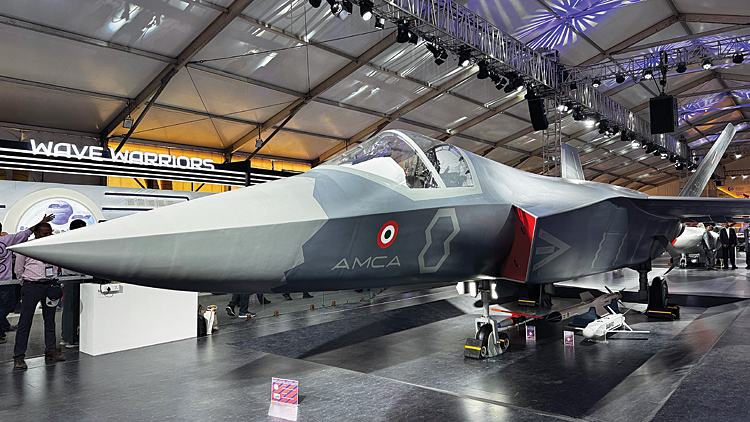
India will have to push the Advanced Medium Combat Aircraft (AMCA) and as it grows, imbibe some 6th-generation technologies
Aircraft will require all hemisphere situational awareness allowing comprehensive threat assessments and response options. Futuristic avionics will include agile advanced electronically scanned array (AESA) radars, and passive data-linked sensors. Stealth will be in-built in the airframe design through advanced shaping. The conformal weapon bays will carry very long-range weapons. Weapons will have increased degree of post-launch autonomy. Enhanced on-board power generation will support powerful electronic warfare systems and directed energy weapons (DEW).
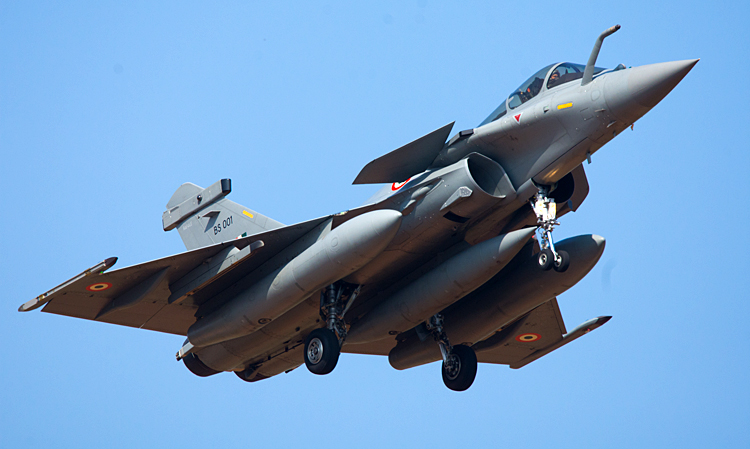
India is still struggling at LCA Mk1A stage. LCA Mk2 will at best be closer to Rafale and needs to be accelerated. India will have to push the Advanced Medium Combat Aircraft (AMCA) and as it grows, imbibe some 6th-generation technologies. India is at 29 fighter squadrons vis-à-vis authorised 42.5. It must quickly finalise the private partner for AMCA programme. While India pushes its indigenous fighters, to make good the large shortfall, IAF should acquire 114 latest variants of Rafale "Make-in-India" fighters to maintain continuity and avoid adding another fleet. It may also add few squadrons of Russian Su-57 5th generation aircraft with transfer of technology as an interim measure.
Long range air defence systems will keep the enemy air at distance and achieve air denial, as was seen during "Operation Sindoor." S-400 class indigenous "Kusha" AD system needs to be accelerated. The advanced Akash-NG with air-breathing solid ramjet engine and increased range of 70–80 km needs hastening. Bhargavastra multi-layer micro-missile Anti-Drone/Counter-Unmanned Aerial System (C-UAS) designed and developed by the Indian private sector company Solar Defence and Aerospace Limited needs early induction.
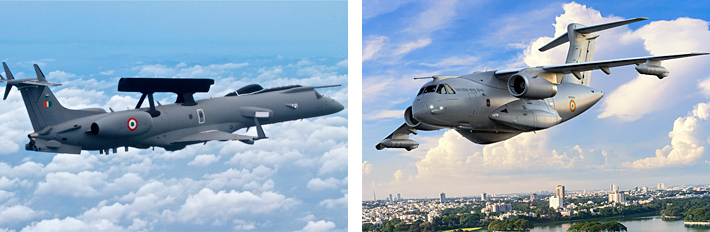
While IAF has adequate transport aircraft fleet, it is time for India to develop its own cargo aircraft and regional jet. Time to unfold a roadmap for the Medium Transport Aircraft (MTA). Similarly, India has decent sized helicopter fleet, but Hindustan Aeronautics Limited (HAL) needs to resolve design and production quality issues of ALH variants. Development of the Light Utility Helicopter (LUH) needs to be hastened. Also the Indian Multirole Helicopter (IMRH) needs a serious push.
For the continental size of the country, the number of Flight Refuelling Aircraft (FRA) and Airborne Early Warning and Control (AEW&C) are highly inadequate. While the roadmap has been spelt out, the pace has to be accelerated for both Netra Mk1 and Netra Mk2. Satellite-based ISR, navigation and targeting capabilities have to go up. NavIC must be operationalised quickly. Need to develop jet-powered stealth HALE UAVs for ISTAR, EW & Armed Strike missions.
Future missiles will have long range detection, cruise farther and have high no escape zones. Major countries are pushing advanced hypersonic weapon programmes. Future weapons will shoot down incoming air-to-air and surface-to-air missiles. New turret systems will allow high-energy lasers to engage enemy aircraft and missiles. Stand-alone high-energy laser weapon pod are being designed. These could daze or burn electronics of other airborne platforms. Hypersonic cruise missiles (HCMs) have already been used in combat in Ukraine. Hypersonic Glide Vehicles (HGVs) and HCMs will bring game-changing vulnerabilities to strategic targets and large ships and aircraft carriers. Large platforms like the AEW&C and FRA will be kept farther away from tactical area by long-range missiles. Meanwhile, explore Counter Hypersonic solutions.
Identify some national programmes such as the critical minerals and advanced alloys, AMCA, the MBT, Hypersonic, DEW, Electronic Warfare, AI and Robotics and put them under a specially selected CEO to drive as a national mission
India's Astra Mk-1 (110 km) AAM is operational. Mk-2 (160 km) is under induction. The very long range (VLRAAM) Mk-3 will have range over 300 km. The air-launched BrahMos missile (500 km) has been integrated on the Su-30 MKI. Longer range variants are evolving. The hypersonic version, BrahMos-II, is under testing. Future variants will have ranges up to 1,500 km. India needs to accelerate its weapons development. IAF must build larger inventories.
Drones and UAS are already flying in large numbers. Optionally manned aircraft are evolving. Autonomous UAS are operating from aircraft carriers. The next generation UAS will be able to take on ISR, surface strike, air defence, aerial refuelling, and air delivery. Swarms could overwhelm defences by sheer numbers. Aerial drone swarms have been repeatedly demonstrated, including by Indian manufacturers. Loitering Munitions inventories are going up. Drone counters using small arms, electro-optical weapons (laser), data-link jamming, electronic or cyber-attack, are evolving. A drone swarm may be engaged by a counter-drone swarm.
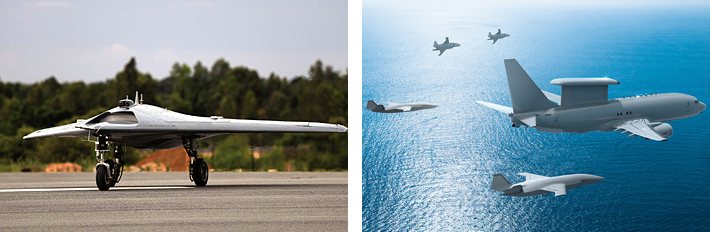
MUM-T will exploit the advantage of the human in the loop with the strength of numbers to take on well-defended target systems. A large number of Indian companies are engaged in UAV and drone manufacture. HAL is working on MUM-T. The same needs acceleration.
Modern AESA radars will require to operate in heavy Electronic Counter-Measures (ECM) environments. In order to reduce the size, weight, power consumption, and cost of AESA radars, small computer-controlled solid-state transmit/receive modules (TRMs) are put together in an array, using multiple-input multiple-output (MIMO) technology. AESA's beam forming and steering agility will permit better tracking of very fast supersonic cruise missiles and aircraft. AESA radars are also used in missiles for the same reason. To reduce spectrum congestion many applications have moved beyond 20 GHz. Millimetre wave radars can give much better resolution because of ultra wide bandwidths, and lower ground clutter, and they also give the benefit of smaller size. Gallium Nitride (GaN) power transistors can operate at higher power levels and higher frequencies, more efficiently. Future radars will have lower power sectorial emissions and, thus, would be electronically stealthy. India's Uttam AESA radar is evolving well. Finally India will have indigenous radar even for the Su-30 MKI.
Passive systems like the Infra-Red Search and Track (IRST) do not radiate, as such, don't expose own location, and are considered counter-stealth technology. But IR systems are susceptible to weather and atmospheric phenomena. The detection range (100 km) are currently much lower than radar. Evolving universal podded IRST give flexibility to match the sensors to the mission quickly. Future sensors will be more sensitive with greater range, and use advanced image processing technology. New generation dual-band IR detectors are based on Quantum Wall IR Photo-detectors (QWIP). Multiple Aperture IR (MAIR) will mean many IR sensors around the aircraft for all-hemisphere detection. It will also act as missile warner. India has a long way to go on passive sensors, albeit some work is going on.
High mission rates are possible through better online aircraft health monitoring. Aircraft systems are connected in real-time to the fleet data bases through secure communications. Advanced data-processing incorporates fault diagnostics using AI. Technology allows predictive maintenance solutions. Online real-time monitoring reduces turn-around maintenance time, and improves aircraft utilisation rate. It could, in the long run, reduce the 'life cycle cost'. With greater usage of composite, self-healing materials, quicker repairs have become possible and save time. Robots will support aircraft inspection and maintenance tasks. Newer systems have redundancies and designed for low meantime between failures (MBTF) to ensure maximum airtime and minimum logistics requirements. Indian companies are working on this.
Future engine technologies must support a reduced development cycle, reduce engine weight, improved engine propulsive efficiency and better specific fuel consumption (SFC), improve reliability and maintainability, and reduce life the cycle costs. New materials will be lighter and withstand higher temperatures. Fully computer controlled "smart engines" and use of magnetic bearings, will also improve engine operations. Additive 3D manufacture will reduce production and maintenance time and cost. Aero-engines will be versatile, flight phase adaptive, more fuel-efficient, and feature thrust-vectoring, and in-built super-cruise, and allow longer ranges and higher performance. Bio-fuels will be increasingly used. The future will see increased use of electrical power for aircraft propulsion and various subsystems.
Future air war will increasingly be between stealth platforms, and uninhabited systems, and loitering munitions
Developing an indigenous aero-engine is a core area for India's 'Atmanirbharta' (Self-Reliance) in defence. There are handful of global aero engine manufacturers and they do not easily part with technology. Joint ventures (JV), is the best option forward for India. It must exploit large domestic market. DRDO's Gas Turbine Research Establishment (GTRE) is now likely to join Safran of France to develop an indigenous fighter engine of 120 kN class. India will have the intellectual property rights (IPR). Small engines are also required for cruise missiles and UAVs. India must also invest in electric and hybrid engines.
5G and 6G telecommunications networks will be crucial for aviation design and on-board data handling. They will also be crucial for satellite and ground-based communications. This will also involve the beaming of millimetre length microwaves at the earth from large number of new communication satellites. These speeds will also be required for cyber security. Imported electronic hardware of the aircraft could be a high-risk with embedded chips. Indigenisation is very important. Similarly, the electronic warfare equipment has to the home-developed. Microchips are required for aircraft, automation, electro-optical systems, including the weapon sensors. India has decided to invest largesums in their manufacture. 5G will also be required for network-centred warfare. Secure, jam-proof data-links will be required for UAS and drone swarms. Developing and operationalising Software Defined Radios (SDR) across all fleets is an imperative.
The demand for streaming high-quality data requires bandwidth, which involves innovating sensor/processing systems. The data fusion will be deepened by integrating sensors on different platforms, including satellites and drones. Network-centric payload processing units enable on-board datafusion prior to sending to digital links. AI will support aircraft systems management and determine which data should be presented to the pilot. Sensor fusion and optional-manning, would mean heavy reliance ondata-links and networks. The sixth-generation avionics will have to be resilient to jamming and have the capability to jam adversary systems.
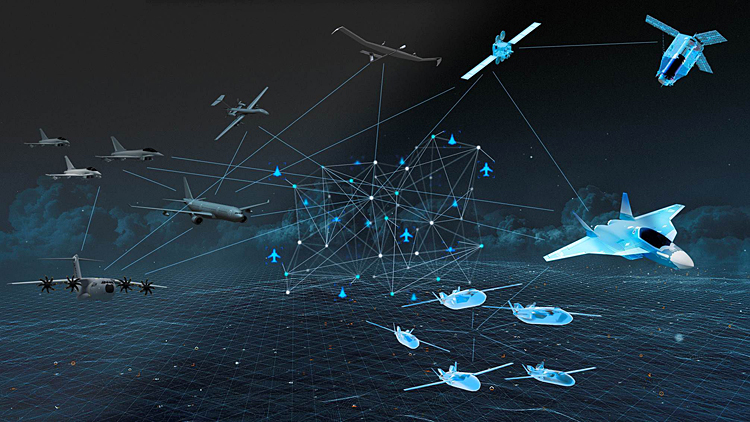
IAF has to prepare for MDO, involving integrated actions across multiple war-fighting domains including land, sea, air, space, and cyber-space, to achieve information and decision superiority, and synchronised effects by exploiting the interdependencies between these domains. The approach leverages advanced technology and innovative strategies to create a unified and synergistic effect, countering complex threats and achieving strategic objectives more efficiently. Advanced technologies like AI, machine learning, and cloud computing are crucial for enabling MDO by facilitating data processing, platform integration, and rapid decision-making. MDO aims to outpace the adversary by operating at a faster tempo and manipulating key control parameters, creating uncertainty and disrupting the enemy's decision-making processes. MDO allows decisive outcomes with less effort.
For long, India's military assets and infrastructure were Pakistan border centric. This is fast changing, for both infrastructure build up and assets positioning. While border roads and connectivity are being improved, IAF has upgraded its Advanced Landing Grounds (ALG) near China border. All IAF airfields are getting hardened aircraft and equipment shelters. IAF now has significant number of Su-30 MKI squadrons facing China. Also the new acquisitions like Rafale, C-130J, Chinook and Apache helicopters have all been located in the eastern sector. The same is also applicable to air defence systems and weapons positioning.
Future air war will increasingly be between stealth platforms, and uninhabited systems, and loitering munitions. Air combat engagements will be long distance. Precision in degraded electronic environment will be crucial. Space has become a war-fighting domain, an assessment that calls for doctrinal changes and the ability to intervene there more quickly. Hastening establishing secure tri-service data links for joint operations is important.
Air combat engagements will be long distance. Precision in degraded electronic environm ent will be crucial. Space has become a war-fighting domain, an assessment that calls for doctrinal changes and the ability to intervene there more quickly.
Atmanirbharta in aerospace and defence, is now an existential strategic necessity. Integrating private sector more closely must be ac-celerated. India must invest much more in R&D. Indian economy must continue to grow at around 8-10 per cent for adequate funds to be available for defence. Keeping in view the global average and India's threat perception, at least 2.5 per cent of GDP should be spend on defence, up from current 1.9 per cent.
HAL must concentrate being an integrator and not so much a manufacturer. Work force human productivity must go up to interna-tional standards. Product and sub-component quality assurance needs to improve much more. Both DRDO and HAL make over opti-mistic projections. Time lines have always slipped very considerably. HAL must be freed from MoD's bureaucratic control. Selection and procurement cycle for aerial platforms must be cut from existing 6–8 years to 2–3 year. Total self-reliance by 2047 is ambitious but desirable target. Needs clear directions and whole of nation approach. Identify some national programmes such as the critical minerals and advanced alloys, AMCA, the MBT, Hypersonic, DEW, Electronic Warfare, AI and Robotics and put them under a specially selected CEO to drive as a national mission. Aviation systems require high capital expenditure, the government will have to back these. Need to support Indian MSMEs in navigating complex regulations and certifications process.
Airpower reforms are essential for India's strategic rise. The IAF must continue to evolve as the nation's cutting edge force, driven by indigenous capability, stakeholder collaboration and innovation. New technologies require doctrinal and tactical changes. Time to Act is now!