






The insightful articles, inspiring narrations and analytical perspectives presented by the Editorial Team, establish an alluring connect with the reader. My compliments and best wishes to SP Guide Publications.

"Over the past 60 years, the growth of SP Guide Publications has mirrored the rising stature of Indian Navy. Its well-researched and informative magazines on Defence and Aerospace sector have served to shape an educated opinion of our military personnel, policy makers and the public alike. I wish SP's Publication team continued success, fair winds and following seas in all future endeavour!"

Since, its inception in 1964, SP Guide Publications has consistently demonstrated commitment to high-quality journalism in the aerospace and defence sectors, earning a well-deserved reputation as Asia's largest media house in this domain. I wish SP Guide Publications continued success in its pursuit of excellence.
India's Defence Budget 2026–27 signals intent through higher capital outlay, steadier funding, and a push for domestic industry and emerging technologies. However, persistent challenges in procurement speed, coordination, and execution will determine whether increased allocations translate into real military capability.
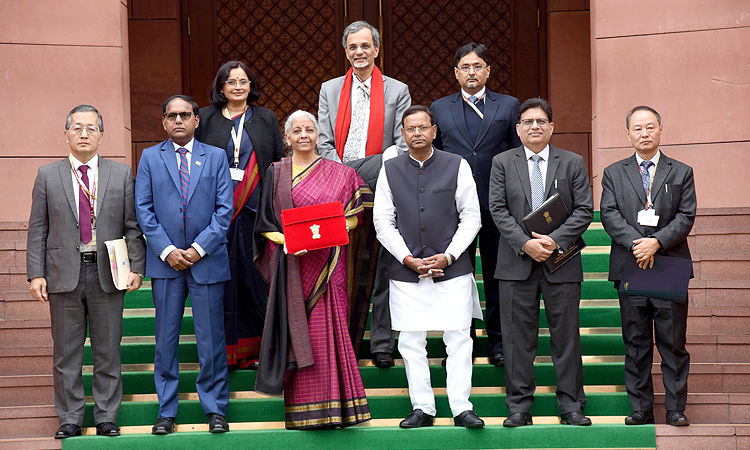
This year's Defence Budget is not a radical break from the past. It is something more interesting. It is a budget of intent, incremental correction, and cautious confidence — but also one that leaves uncomfortable questions unanswered.
At around ₹7.84–7.85 lakh crore, with roughly 15 per cent growth, the headline number is impressive. Yet, as anyone who has followed defence budgeting knows, the real story is not the total figure. It is what lies beneath it.
The ₹2.19 lakh crore capital outlay, up nearly 22 per cent, is the most meaningful shift. This is where capability is built — aircraft, ships, submarines, missiles, sensors, networks, electronic warfare, and unmanned systems. For years, India talked about modernisation while most of the money went into salaries, pensions, and routine expenditure. This Budget does not fully correct that imbalance, but it tilts the needle in the right direction.
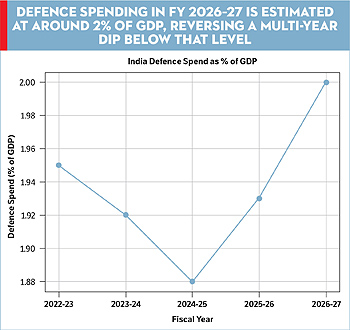
It is also important to note that defence spending this year is estimated at around two per cent of GDP. This marks a recovery from the multi-year dip below that level in recent years. It does not represent a dramatic expansion, but it does signal renewed attention to strategic priorities.
As Ankit Mehta of ideaForge observed, this rise in capital spending is a serious signal of long-term commitment to modernisation. He is right. But here is the first hard question: is India's procurement system ready to absorb and execute this money at the required speed? History suggests that allocation alone does not guarantee outcomes.
Defence spending in FY 2026–27 is estimated at around two per cent of GDP, reversing a multi-year dip below that level
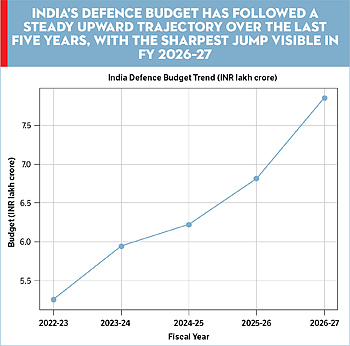
From ₹5.25 lakh crore in 2022–23 to nearly ₹7.85 lakh crore in 2026–27, the trajectory is steady rather than erratic. That is good.
Long-cycle programmes — submarines, warships, fighter aircraft, air defence networks — cannot be built on yearly budget shocks. Predictability matters. For the Services, this budget provides planning certainty. For industry, it reduces risk and encourages investment in manufacturing, testing, and R&D.
But stability alone is not strategy. If procurement timelines remain slow, if testing infrastructure remains stretched, and if contracts are delayed, then steady funding could still produce slow capability.
The ₹2.19 lakh crore capital outlay, up nearly 22 per cent, is the most meaningful shift
The focus on artillery, air defence, logistics, border infrastructure, and ammunition is practical and necessary. These are the foundations of readiness. Yet, there is a legitimate concern: is incremental modernisation enough when warfare is becoming more networked, data-driven, and sensor-heavy? The Budget supports today's Army. Does it fully prepare tomorrow's?
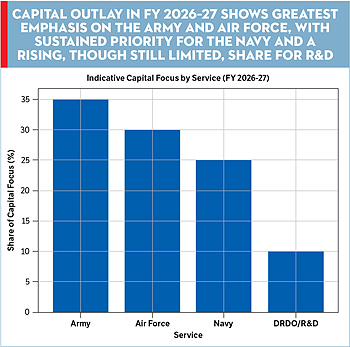
Prioritising aircraft and aero engines is logical. Air power remains decisive. But squadron strength continues to be a structural vulnerability. The growing reliance on drones and force multipliers is smart, but it must not become a convenient way to avoid tough decisions on fighter numbers.
This is where alignment is strongest. Sustained investment in shipbuilding, submarines, naval aviation, and maritime surveillance fits India's Indo-Pacific priorities and undersea ambitions. If there is one service where vision and resources are most closely matched, it is the Navy.
Reserving around 75 per cent of capital procurement for domestic industry is a bold policy. It creates visibility for Indian firms but also raises the bar.
Raj Kumar Pandey of ADSL (JCBL) rightly highlighted that this Budget strengthens India's defence and aerospace ecosystem and opens space for global partnerships. That is true. But preferential policy cannot substitute performance indefinitely. Indian industry must now deliver on quality, timelines, and scale.
Nowhere is this more evident than in drones. As Sai Pattabiram of Zuppa said, drones are no longer optional. They are core tools for surveillance, border security, and precision operations. The real test is whether India can move beyond assembly to mastering subsystems, software, and AI-enabled payloads. That is where true sovereignty lies.
With defence production crossing ₹1.5 lakh crore and exports at record highs, India is clearly shifting from buyer to builder — and increasingly, to exporter. That is a structural change worth acknowledging.
Reserving around 75 per cent of capital procurement for domestic industry is a bold policy
The Budget's support for semiconductors, advanced electronics, AI, drones, and electronic warfare is strategically sound. These are not just industrial policies. They are national security policies. This is also where the space and data layer becomes important.
As Krishanu Acharya, Co-Founder & CEO of Suhora Technologies, noted, "The Union Budget 2026 strengthens technology and space-led growth through initiatives like the IndiaAI Mission and the ₹10,000 crore SME Growth Fund." The 15 per cent rise in the defence budget is a strong signal for the space sector and should drive greater use of satellite data for ISR, terrain surveillance, and maritime awareness, accelerating the growth of India's indigenous space ecosystem."
This is a crucial point. Defence modernisation today is as much about satellites, data, AI, and analytics as it is about tanks and aircraft. Yet, India still lacks a fully integrated, tri-service doctrine for AI, autonomous systems, electronic warfare, and space-enabled operations. Money is flowing. Strategy and coordination must now catch up. Cdr. Navneet Kaushik of Jamwant Ventures Angel Fund put it aptly, "It's a positive budget as far as defence budget goes. 15 per cent increase over the last budget and 21 per cent increase in capital outlay. But this doesn't have to be looked in isolation. There is new focus on MSMEs and semiconductors, both of which have huge defence application, and the focus on Orange economy adds another dimension for security establishment." Defence is no longer just about weapons. It is about industrial depth, supply chains, data, space, and emerging domains.
Here is the hard question: is India's procurement system ready to absorb and execute this money at the required speed?
On Budget day, when the broader market corrected sharply, defence stocks held up comparatively well. That divergence was telling. Investors saw continuity, credibility, and long-term opportunity. Defence was treated as a structural sector, not a cyclical one. But markets price expectations, not battlefield outcomes. The real test is whether this Budget leads to faster inductions and stronger deterrence.
India is now among the top five defence spenders globally, but the gap with the United States and China remains vast. That means India cannot win through spending alone. The path forward must be smarter:
This Budget nudges India in that direction.
Long-cycle programmes — submarines, warships, fighter aircraft, air defence networks — cannot be built on yearly budget shocks
As Baba Kalyani of Bharat Forge observed, defence is now a central pillar of India's economic and strategic story, linked to semiconductors, data centres, advanced manufacturing, and green technologies. The opportunity is real. So is the responsibility. Industry must move beyond licensed production and offsets to build genuine design, systems integration, and export competitiveness.
This is the central question of this Budget. Allocations are better. Intent is clearer. Capital is higher. Domestic industry has visibility. Emerging technologies are being prioritised. But capability will depend on:
If execution improves, this Budget could mark a turning point. If not, it risks becoming another year of good intentions.
This Defence Budget is necessary, positive, and strategically better structured — but not sufficient on its own. It provides more capital, clearer direction, and stronger confidence. That is the upside. But real military power will be determined not in Parliament, but in shipyards, factories, test ranges, and procurement offices.
Money is on the table. Capability must now follow. But Speed of Execution is A MUST!