


The insightful articles, inspiring narrations and analytical perspectives presented by the Editorial Team, establish an alluring connect with the reader. My compliments and best wishes to SP Guide Publications.
"Over the past 60 years, the growth of SP Guide Publications has mirrored the rising stature of Indian Navy. Its well-researched and informative magazines on Defence and Aerospace sector have served to shape an educated opinion of our military personnel, policy makers and the public alike. I wish SP's Publication team continued success, fair winds and following seas in all future endeavour!"

Since, its inception in 1964, SP Guide Publications has consistently demonstrated commitment to high-quality journalism in the aerospace and defence sectors, earning a well-deserved reputation as Asia's largest media house in this domain. I wish SP Guide Publications continued success in its pursuit of excellence.
French President Emmanuel Macron's visit to India focuses on industrial cooperation with India. Helicopter assembly line, HMMER JV and progress on critical minerals and energy with India lend the partnership a tangible depth in the wider geopolitical arenas
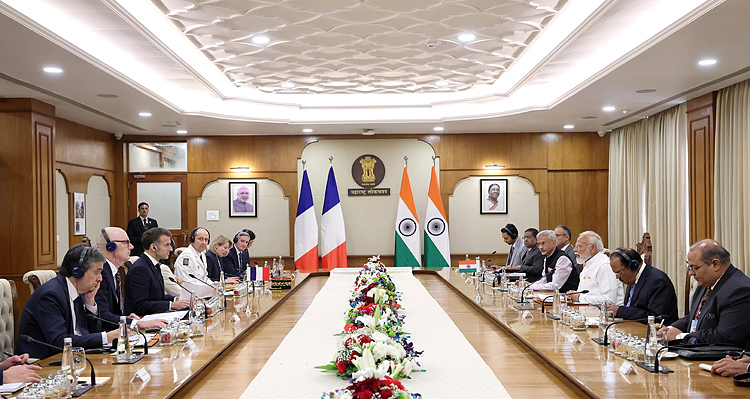
The three-day state visit of French President Emmanuel Macron to India this February has marked a decisive reset in bilateral relations, culminating in a raft of security and economic agreements that are drawing close attention in world capitals.
As global geopolitics grows increasingly fragmented, Paris and New Delhi have signalled their intent to act as a beacon of stability through a newly elevated "special global strategic partnership."
Paris and New Delhi have signalled their intent to act as a beacon of stability through a newly elevated "special global strategic partnership."
Macron's itinerary-spanning India's financial hub Mumbai and the political capital New Delhi-was carefully choreographed to underline the full spectrum of cooperation, from boardroom investments to high diplomacy.
Macron's visit and talks with Prime Minister Modi unfolded crucial industrial collaboration spanning from helicopter assembly to fighter jets and a potential collaboration to procure Rafale combat jets. Recently, the Defence Acquisition Council (DAC), led by the Ministry of Defence, has initiated such potential.
The convergence of worldviews has provided a solid foundation for India–France bonhomie across defence, energy, space and the Indo-Pacific
At the heart of the visit was a shared conviction in strategic autonomy-a doctrine India has long championed in its foreign policy and one France strongly endorses within the European context. Here, the convergence of worldviews has provided a solid foundation for India–France bonhomie across defence, energy, space and the Indo-Pacific.
The visit built upon the ambitious Horizon 2047 roadmap unveiled in 2023, a forward-looking framework that charts bilateral cooperation through 2047, when India marks a century of independence. Building on the blueprint, India and France commit to deepening collaboration in defence manufacturing, critical technologies, clean energy, space research, and Indo-Pacific security.
In fact, officials on both sides described Macron's visit as the first major operationalisation of that roadmap-translating long-term intent into concrete action.

The standout takeaway of the visit was a decisive push towards security and energy ties.
The two countries formally upgraded relations to a Special Global Strategic Partnership, signalling broader global coordination beyond bilateral interests. While several agreements were signed during the visit, the focused areas remained on defence industrial cooperation, critical minerals supply chains, advanced technology development, and civil nuclear and renewable energy collaboration.
The visit built upon the ambitious Horizon 2047 roadmap unveiled in 2023, a forward-looking framework that charts bilateral cooperation through 2047, when India marks a century of independence
That reflects in a joint statement as both leaders positioned their partnership as a "force for global stability and progress in a turbulent era," an unmistakable message amid ongoing geopolitical realignments.
The big announcement was the inauguration of an H125 helicopter assembly line at Vemagal in Karnataka. The project is a collaboration between Airbus and Tata Advanced Systems Limited (TASL), marking the first time these helicopters will be assembled in India.
The two countries formally upgraded relations to a Special Global Strategic Partnership, signalling broader global coordination beyond bilateral interests
Currently manufactured only in France, the United States and Brazil, the H125 is a versatile 2.8-tonne light helicopter capable of carrying up to six passengers. It boasts a maximum altitude of 23,000 feet, A range of 630 km with a top speed of 250 kmph.
The helicopter is suited for wider activities beyond the military to commercial transport, emergency medical services, disaster management, offshore operations, law enforcement and firefighting.
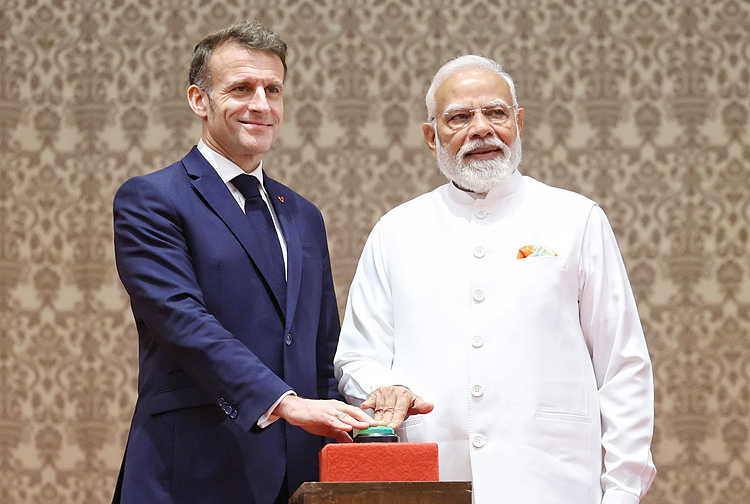
Airbus projects demand for nearly 500 light helicopters of the H125 class across India and South Asia over the next two decades-making the Karnataka facility both a domestic manufacturing boost and a regional export hub.
In another major defence breakthrough, India's Bharat Electronics Limited (BEL) signed an agreement with Safran to establish a joint venture to manufacture Hammer precision-guided munitions (HAMMER) in India. The deal significantly strengthens indigenous production capabilities while reinforcing supply chain resilience.
Both leaders positioned their partnership as a "force for global stability and progress in a turbulent era,"
The two sides also renewed and upgraded their broader defence cooperation agreement. Importantly, they agreed on reciprocal deployment of officers between the Indian Army and French Land Forces establishments-steps designed to improve interoperability and operational trust in military domain.
Beyond defence, Macron's visit yielded commitments to collaborate on civil nuclear energy, green hydrogen, and resilient supply chains for critical minerals essential to high-tech manufacturing and renewable energy transitions.
In the bilateral discussion, officials emphasised cooperation in emerging technologies-including artificial intelligence, quantum computing and space exploration. These are the key sectors that are expected to define strategic influence in the coming decades.
India's Bharat Electronics Limited (BEL) signed an agreement with Safran to establish a joint venture to manufacture Hammer precision-guided munitions (HAMMER) in India
What distinguishes the India–France partnership from many other bilateral equations is its grounding in strategic autonomy. For India, this has meant maintaining decision-making independence amid shifting global alignments. For France, it reflects a long-standing pursuit of European strategic sovereignty within the transatlantic alliance.
This vocabulary has lent unusual depth to the relationship. Unlike transactional partnerships driven by immediate crises, India and France have steadily constructed a multi-dimensional engagement spanning defence, maritime security in the Indo-Pacific, climate action, and high technology.
Macron's visit comes at a moment when middle powers are seeking greater agency in a world shaped by great-power competition. Analysts in Washington, Beijing, Brussels and Tokyo are closely tracking the India–France axis as an emerging stabilising partnership that balances interests without entering rigid blocs.
What distinguishes the India–France partnership from many other bilateral equations is its grounding in strategic autonomy
The progress on the industrial cooperation with France is what lends the partnership a tangible depth in the wider geopolitical arenas.
As both countries look toward 2047 and beyond, the message from Mumbai and New Delhi is clear: Paris and New Delhi intend to shape, not merely react to, the evolving global order amid wider global conflict.
Manish Kumar Jha is a Consulting & Contributing Editor for SP's Aviation, SP's Land Forces and SP's Naval Forces and a security expert. He writes on national security, military technology, strategic affairs & policies.