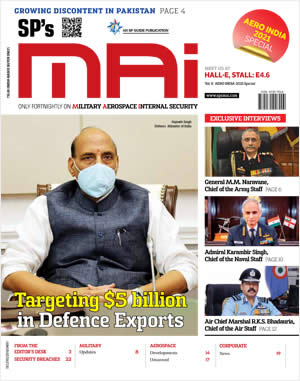




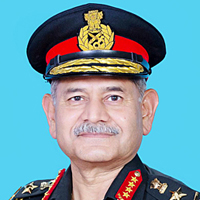
The insightful articles, inspiring narrations and analytical perspectives presented by the Editorial Team, establish an alluring connect with the reader. My compliments and best wishes to SP Guide Publications.
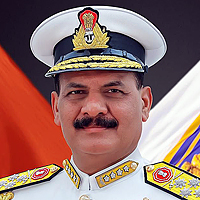
"Over the past 60 years, the growth of SP Guide Publications has mirrored the rising stature of Indian Navy. Its well-researched and informative magazines on Defence and Aerospace sector have served to shape an educated opinion of our military personnel, policy makers and the public alike. I wish SP's Publication team continued success, fair winds and following seas in all future endeavour!"

Since, its inception in 1964, SP Guide Publications has consistently demonstrated commitment to high-quality journalism in the aerospace and defence sectors, earning a well-deserved reputation as Asia's largest media house in this domain. I wish SP Guide Publications continued success in its pursuit of excellence.
In his address in New Delhi, Elbridge Colby, Undersecretary of War Policy sent out a message that the United States is committed to further expanding defence cooperation with India, focusing on deeper military coordination, advanced technology sharing, and stronger strategic alignment in the Indo-Pacific
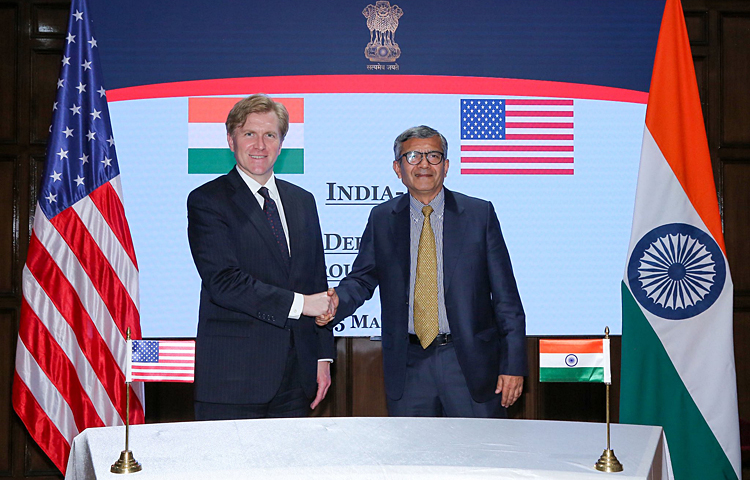
In a significant statement reflecting evolving geopolitical priorities, the United States has underscored India's growing importance in shaping regional and global stability. Addressing a high-level gathering in Delhi, US Under Secretary of War for Policy Elbridge Colby delivered a clear and consequential message: India is "indispensable" to maintaining peace and balance in Asia, particularly in the strategically vital Indo-Pacific region.
His remarks come at a time of escalating tensions in West Asia and growing geopolitical competition in Asia, prompting Washington to recalibrate its global partnerships. Colby's visit to India underscores a broader shift in US strategy—one that places New Delhi at the centre of efforts to ensure regional stability and counterbalance emerging threats.
Colby's visit to India underscores a broader shift in US strategy—one that places New Delhi at the centre of efforts to ensure regional stability and counterbalance emerging threats.
Speaking against the backdrop of mounting tensions in West Asia and shifting global power dynamics, Colby emphasised that a strong, independent India is central to maintaining balance in the Indo-Pacific region. His remarks signal a broader recalibration in US foreign policy—one that places India at the heart of efforts to counter instability and ensure a rules-based international order.
Unlike traditional alliance structures, the India-US partnership is not rooted in dependency but in shared strategic interests. Over the past decade, ties between the two nations have expanded across multiple domains, including joint military exercises, defence technology transfers, and industrial collaboration. This cooperation is now entering what analysts describe as a more mature and consequential phase.
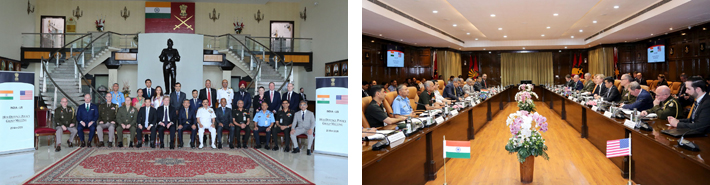
Colby stressed that alignment between the two democracies does not require uniformity on all issues. "The United States and India do not need to agree on everything to cooperate effectively," he said, adding that what truly matters is the growing convergence of interests on fundamental strategic concerns.
He further noted that differences—even disputes—should not be seen as obstacles. "Differences and even disputes are fully compatible with deepening alignment and cooperation on strategic matters," Colby stated, underscoring a pragmatic approach to bilateral relations.
Colby emphasised that a strong, independent India is central to maintaining balance in the Indo-Pacific region. His remarks signal a broader recalibration in US foreign policy—one that places India at the heart of efforts to counter instability.
The Indo-Pacific remains a focal point of this partnership, with both countries advocating for a "free and open" region where no single power dominates. India's emphasis on strategic autonomy, once viewed with caution in Washington, is now increasingly regarded as a strength rather than a liability.
Colby added that the United States is committed to further expanding defence cooperation with India, focusing on deeper military coordination, advanced technology sharing, and stronger strategic alignment in the Indo-Pacific.
He outlined defence cooperation in the relations, saying India is central to India–US ties, with a focus on long-range precision fires, logistics, maritime awareness, and anti-submarine warfare. He added that this will boost India's capabilities and strengthen joint defence production through continued innovation.
The Indo-Pacific remains a focal point of this partnership, with both countries advocating for a "free and open" region where no single power dominates.
Observers believe this shift reflects a broader recognition of India's unique position: a major democratic power capable of influencing regional outcomes without being tied to rigid alliance frameworks. As global uncertainties intensify—from conflicts in West Asia to rising competition in Asia—the US appears keen to strengthen partnerships that offer both resilience and flexibility.
The message from Washington is clear: a stronger India is not only beneficial for bilateral ties but is also vital for sustaining stability across Asia and beyond.
As geopolitical alignments continue to evolve, India-US relations continue to evolve in a quest to reset ties for the better.
Manish Kumar Jha is a Consulting & Contributing Editor for SP's Aviation, SP's Land Forces and SP's Naval Forces and a security expert. He writes on national security, military technology, strategic affairs & policies.