



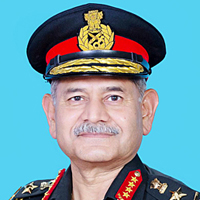
The insightful articles, inspiring narrations and analytical perspectives presented by the Editorial Team, establish an alluring connect with the reader. My compliments and best wishes to SP Guide Publications.
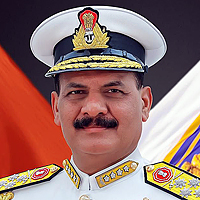
"Over the past 60 years, the growth of SP Guide Publications has mirrored the rising stature of Indian Navy. Its well-researched and informative magazines on Defence and Aerospace sector have served to shape an educated opinion of our military personnel, policy makers and the public alike. I wish SP's Publication team continued success, fair winds and following seas in all future endeavour!"

Since, its inception in 1964, SP Guide Publications has consistently demonstrated commitment to high-quality journalism in the aerospace and defence sectors, earning a well-deserved reputation as Asia's largest media house in this domain. I wish SP Guide Publications continued success in its pursuit of excellence.
The first South Korean presidential state visit to India in eight years is expected to be more than a ceremonial milestone — a necessary recalibration, too. However, expectations must align with “special strategic partnership”, which needs a big push for a new era of bilateral exchanges.
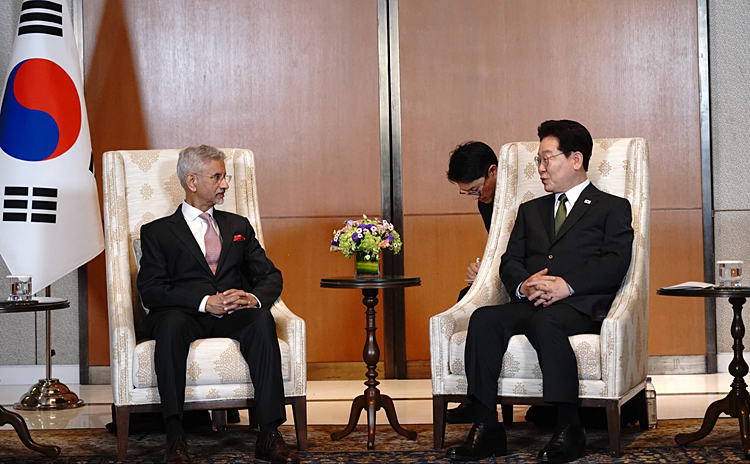
The first South Korean presidential state visit to India in eight years is expected to be more than a ceremonial milestone—it is a necessary recalibration at a moment of global economic uncertainty and shifting geopolitical alignments.
Opening the dialogue on April 19, External Affairs Minister S. Jaishankar, in his meeting with the visiting leader, expressed confidence that talks with Prime Minister Narendra Modi would inject fresh momentum into what is already termed a “special strategic partnership.”
With supply chains under strain, trade routes contested, and technological competition intensifying, New Delhi and Seoul appear ready to move beyond polite diplomacy toward a more purposeful and mutually beneficial partnership.
The phrasing is familiar! However, the challenge, as ever, lies in translating it into substance.
With supply chains under strain, trade routes contested, and technological competition intensifying, New Delhi and Seoul appear ready to move beyond polite diplomacy toward a more purposeful and mutually beneficial partnership.
At the heart of the summit lies an ambitious economic goal - nearly doubling bilateral trade from $25.7 billion to $50 billion by 2030. This target, while aspirational, reflects both the scale of untapped potential and the urgency of diversifying economic ties. South Korea’s $12.8 billion trade surplus—driven by $19.2 billion in exports against $6.4 billion in imports—has long been a source of friction.
However, India’s concerns about a widening deficit are not new, and as analysts have pointed out, political engagement has not kept pace with commercial expansion.
Renegotiating the Comprehensive Economic Partnership Agreement (CEPA) will be critical. For India, the challenge is to secure greater market access and address structural imbalances. For South Korea, the task is to ensure that its economic footprint in India evolves from export dominance to deeper investment and co-production. A more balanced framework will not only stabilise trade relations but also lend credibility to the broader strategic partnership.
At the heart of the summit lies an ambitious economic goal - nearly doubling bilateral trade from $25.7 billion to $50 billion by 2030. This target, while aspirational, reflects both the scale of untapped potential and the urgency of diversifying economic ties.
A leading Korean expert, Professor Santosh Kumar Ranjan from JNU, points out the gaps in the relations that need to be addressed, said: “Besides the commercial ties, India-Korea relations must push the people-to-people ties, reciprocate the visa and look at strategic alignment in a multipolar world.”
Encouragingly, both sides are identifying sectors where their interests align more naturally. Shipbuilding, for instance, offers a compelling opportunity. India’s emphasis on job creation and industrial expansion dovetails with South Korea’s advanced manufacturing capabilities. Collaboration in this sector could yield tangible economic benefits while strengthening maritime capacity.
Defence cooperation is another pillar of growing importance. South Korea’s contribution—particularly through joint production and technology transfer—signals a shift from buyer-seller dynamics to workable industrial partnership.
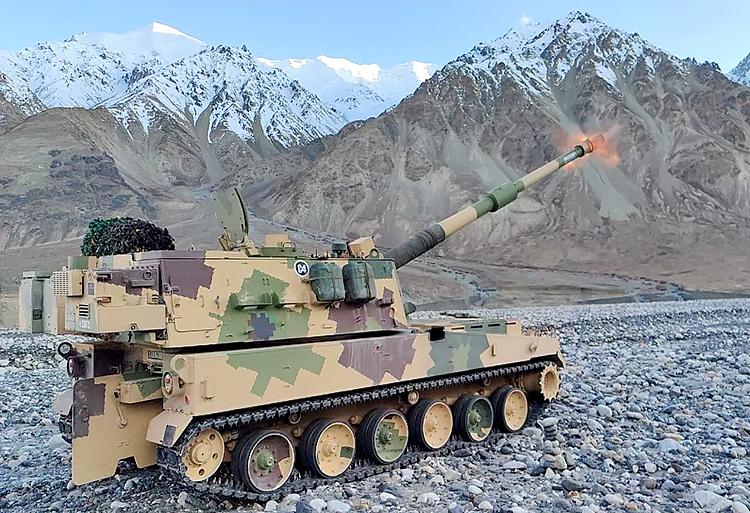
The Indian Army’s K9 Vajra-T howitzer project stands as a model of this approach, with more than 60 per cent of manufacturing localised in India by the Indian defence partner L&T. Such collaborations not only enhance India’s defence capabilities but also integrate supply chains in ways that build long-term resilience.
The partnership is poised to expand into advanced domains—cybersecurity, aerospace, and next-generation defence technologies. These areas will test the depth of trust and the willingness of both sides to share expertise and invest in joint innovation.
Beyond industry, the strategic dimension of the relationship is gaining sharper definition. Both nations share an interest in safeguarding sea lanes of communication, especially in the Middle East, where energy security and freedom of navigation remain critical concerns.
Regular 2+2 dialogues between foreign and defence ministers have provided a structured mechanism for coordination, but the current global environment demands even closer alignment.
The partnership is poised to expand into advanced domains—cybersecurity, aerospace, and next-generation defence technologies. These areas will test the depth of trust and the willingness of both sides to share expertise and invest in joint innovation. If managed well, they could transform the relationship from one rooted in trade to one anchored in strategic interdependence.
This visit, then, should not be seen as a routine diplomatic engagement. It is an opportunity to address longstanding imbalances, unlock new avenues for cooperation, and better align two major Asian economies.
This visit, then, should not be seen as a routine diplomatic engagement. It is an opportunity to address longstanding imbalances, unlock new avenues for cooperation, and better align two major Asian economies.
However, apart from shipbuilding, the success of this effort will depend not on announcements or symbolic gestures, but on real-term bilateral investment.
Eight years is a long gap in diplomacy. The real question now is whether this renewed engagement can close not just the temporal distance, but the strategic one as well.
Manish Kumar Jha is a Consulting & Contributing Editor for SP's Aviation, SP's Land Forces and SP's Naval Forces and a security expert. He writes on national security, military technology, strategic affairs & policies.