



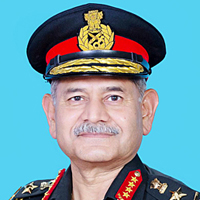
The insightful articles, inspiring narrations and analytical perspectives presented by the Editorial Team, establish an alluring connect with the reader. My compliments and best wishes to SP Guide Publications.
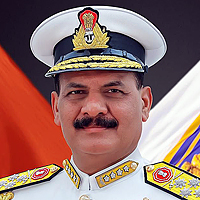
"Over the past 60 years, the growth of SP Guide Publications has mirrored the rising stature of Indian Navy. Its well-researched and informative magazines on Defence and Aerospace sector have served to shape an educated opinion of our military personnel, policy makers and the public alike. I wish SP's Publication team continued success, fair winds and following seas in all future endeavour!"

Since, its inception in 1964, SP Guide Publications has consistently demonstrated commitment to high-quality journalism in the aerospace and defence sectors, earning a well-deserved reputation as Asia's largest media house in this domain. I wish SP Guide Publications continued success in its pursuit of excellence.
Defence Minister Rajnath Singh's visit to Germany underscores greater engagements. The key Project-75(I) deal awaits final clearance; it could become one of the biggest in Indo-German defence relations-setting a precedent for future collaborations that combine German technological expertise with India's manufacturing scale and strategic ambitions.
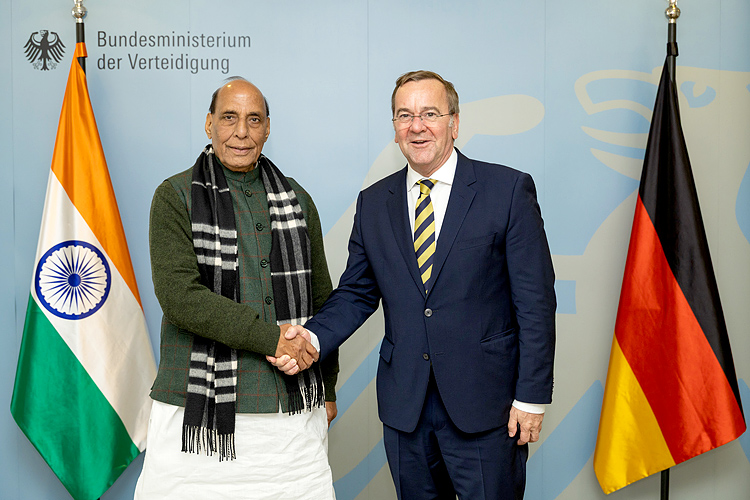
India and Germany have taken a significant step forward in strengthening their defence partnership, with a renewed focus on co-production, industrial collaboration, and advanced military technologies. The visit of Defence Minister Rajnath Singh to Germany, and his discussions with his German counterpart Boris Pistorius, have culminated in a roadmap aimed at deepening bilateral defence cooperation.
At the centre of this evolving partnership is India's ambitious Project-75 (India) submarine programme, a nearly ₹1 lakh crore initiative to build six advanced conventional submarines domestically. Germany's ThyssenKrupp Marine Systems (TKMS), in collaboration with Indian defence firm Mazagon Dock Shipbuilders Limited (MDL), has been selected for the project.
At the centre of this evolving partnership is India's ambitious Project-75(I) submarine programme, a nearly ₹1 lakh crore initiative to build six advanced conventional submarines domestically.
The programme represents a major collaboration in defence manufacturing, with an emphasis on technology transfer and indigenous production. The proposal, which is under the Strategic Partnership model, now awaits final approval from the Cabinet Committee on Security (CCS).
The proposed P-75(I) submarine deal offers India Air Independent Propulsion (AIP) systems, which add significant strength to conventional submarines. The P-75(I) mandated sea proven Fuel-Cell based AIP Plant with contemporary equipment, weapons & sensors, advanced torpedoes, modern missiles (indigenous) and state of the art countermeasure systems.
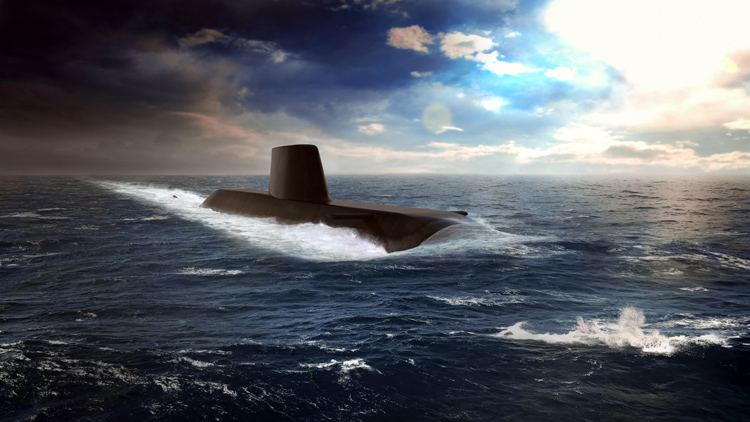
As reported, TKMS needs to collaborate on comprehensive design and engineering with MDL. Initially, the focus will remain on design and improvement – if that allows specific weapon integration, involving the Naval Design Bureau and MDL.
Additionally, the integration of AIP will allow submarines to remain underwater for a longer period, undetected—stealth mode-- to reach further in the region for all purposes.
Project-75(I) will provide an opportunity for local manufacture of state-of-the-art submarines, which will enable the Indian Navy to dominate the undersea domain in our area of interest
Notably, in the past, India had procured four HDW Class 209 submarines from Germany, which worked well over the years, and some of them successfully underwent refit.
The cooperation will boost indigenous know-how and skill force to continue building the next-gen submarines in India. Project-75(I) will provide an opportunity for local manufacture of state-of-the-art submarines, which will enable the Indian Navy to dominate the undersea domain in our area of interest, whilst parallelly providing the Indian industry with an opportunity for long-term partnership in not only submarine construction but also maintenance, logistics and supply chain support.
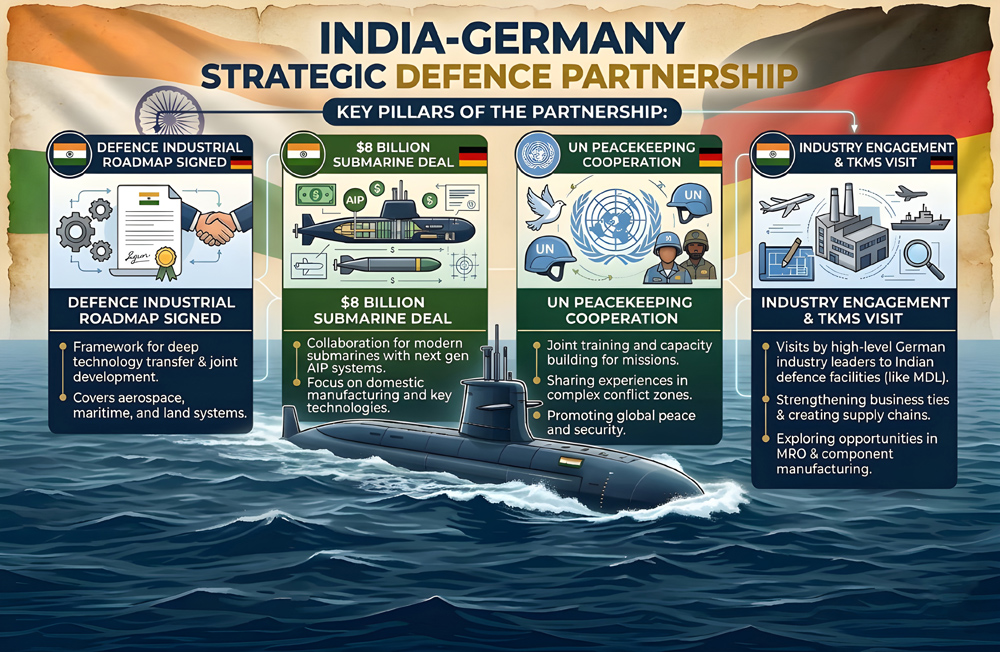
During his address to the German Parliamentary Standing Committee on Defence and Security, Singh highlighted the rapidly evolving global security landscape. He noted that emerging threats and accelerating technological transformation have made the international environment more complex and interconnected than ever before.
He also stressed the importance of adaptability and innovation, calling for a new approach to defence cooperation that is responsive to changing realities.
A key element of the India-Germany defence roadmap is collaboration in niche and emerging military technologies. Both sides acknowledged that their industrial ecosystems are highly complementary. Germany's strength lies in its advanced engineering capabilities and the globally respected Mittelstand—its network of small and medium-sized enterprises specialising in high-precision manufacturing and innovation. India, on the other hand, is witnessing rapid growth in its defence start-up ecosystem and private sector participation.
Such engagements indicate a widening scope of cooperation beyond naval systems into aerospace and logistics capabilities. The strengthening of India-Germany defence ties reflects a broader strategic alignment between the two nations.
Singh underscored this synergy, noting that India's dynamic start-ups and private companies are increasingly enhancing the capabilities of established public-sector defence enterprises.
Building on the recent visit of German Chancellor Friedrich Merz to India, the defence minister said, "Prime Minister Narendra Modi and German Chancellor Friedrich Merz have placed strong emphasis on advancing this strategic partnership. We also see a clear convergence of views at the European Union level, reflected in the growing momentum to engage with India, including through the India-EU Defence and Strategic Partnership," he said.
This convergence of strengths, he said, creates a natural foundation for deeper collaboration between the two countries.
A key element of the India-Germany defence roadmap is collaboration in niche and emerging military technologies.
The Defence Minister's visit also included a stop in Munich, where discussions reportedly touched upon potential transport aircraft collaboration, including possibilities linked to the Airbus A400M platform and broader military transport aircraft (MTA) requirements. While still exploratory, such engagements indicate a widening scope of cooperation beyond naval systems into aerospace and logistics capabilities.
The strengthening of India-Germany defence ties reflects a broader strategic alignment between the two nations. As both countries navigate a shifting global order marked by technological disruption and geopolitical uncertainty, their partnership is important at this stage.
If the Project-75(I) deal receives final clearance, it could become one of the biggest in Indo-German defence relations—setting a precedent for future collaborations that combine German technological expertise with India's manufacturing scale and strategic ambitions.
Manish Kumar Jha is a Consulting & Contributing Editor for SP's Aviation, SP's Land Forces and SP's Naval Forces and a security expert. He writes on national security, military technology, strategic affairs & policies.