



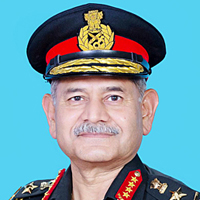
The insightful articles, inspiring narrations and analytical perspectives presented by the Editorial Team, establish an alluring connect with the reader. My compliments and best wishes to SP Guide Publications.
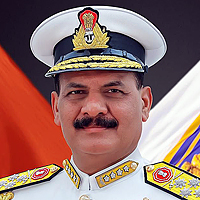
"Over the past 60 years, the growth of SP Guide Publications has mirrored the rising stature of Indian Navy. Its well-researched and informative magazines on Defence and Aerospace sector have served to shape an educated opinion of our military personnel, policy makers and the public alike. I wish SP's Publication team continued success, fair winds and following seas in all future endeavour!"

Since, its inception in 1964, SP Guide Publications has consistently demonstrated commitment to high-quality journalism in the aerospace and defence sectors, earning a well-deserved reputation as Asia's largest media house in this domain. I wish SP Guide Publications continued success in its pursuit of excellence.
India's defence discourse is increasingly shifting from procurement-centric thinking towards integration, industrial resilience, emerging technologies and multi-domain warfare preparedness.
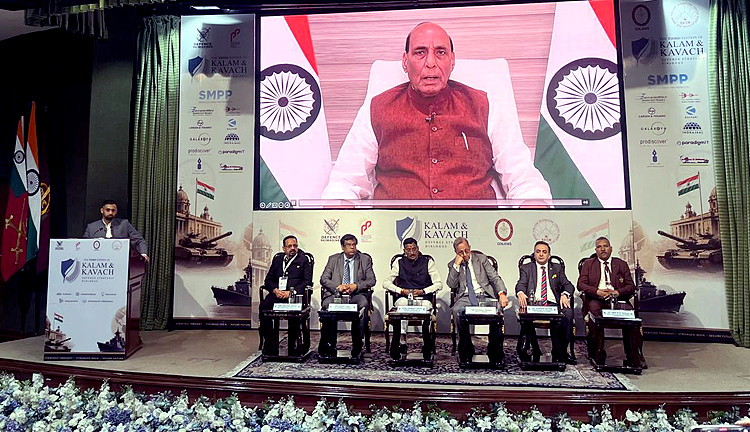
The language of India's defence discourse is changing.
For years, conversations around military modernisation largely revolved around acquisitions, platforms and imports. But at Kalam & Kavach 3.0, held at the Manekshaw Centre in New Delhi, the tone of the discussions reflected something much broader: a strategic shift towards integration, technological adaptation, industrial resilience and future warfare preparedness.
What emerged over the course of the day was not merely a discussion on defence manufacturing or military reforms, but a larger acknowledgement that future conflicts will increasingly be shaped by who integrates faster, adapts quicker and builds stronger ecosystems between the armed forces, industry, technology developers and policymakers.
The third edition of the conclave, themed "Taking JAI Forward With I2" referring to Jointness, Aatmanirbharta and Innovation alongside Indigenisation and International Collaboration, brought together military leadership, policymakers, diplomats, industry executives, startups and strategic experts to deliberate on the changing character of warfare and India's evolving defence preparedness framework.
Rajnath Singh, India's Defence Minister, also addressed the gathering through a video message, reinforcing the importance of indigenous capability development and strategic preparedness in an evolving security environment.
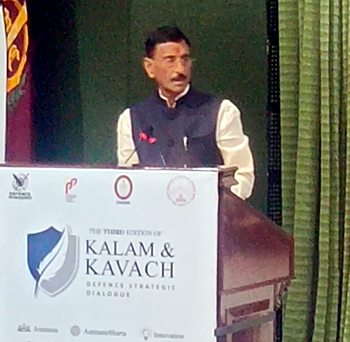
Delivering the inaugural address, Minister of State for Defence Sanjay Seth framed the larger national context in which these conversations are taking place.
"Kalam & Kavach represents the spirit of a modern and self-reliant India where knowledge, innovation and national security come together with purpose."
He added that preparedness in an evolving security environment must increasingly be driven by "technological advancement, indigenous capability, strategic partnerships and the collective strength of our innovators, scientists, industry leaders and armed forces."
That emphasis on collective capability, rather than siloed institutions, remained one of the defining themes of the conclave.
"Future wars may not necessarily be won by the side with the largest inventory, but by the side that integrates faster, innovates quicker and adapts continuously."
Among the most closely watched conversations of the day was the fireside interaction with Chief of Defence Staff General Anil Chauhan, who spoke extensively about jointness, theatre reforms and the operational lessons emerging from recent conflicts.
General Chauhan described the process of integration within the Indian military as "irreversible", noting that the vocabulary of jointness itself has now become institutionalised within the armed forces.
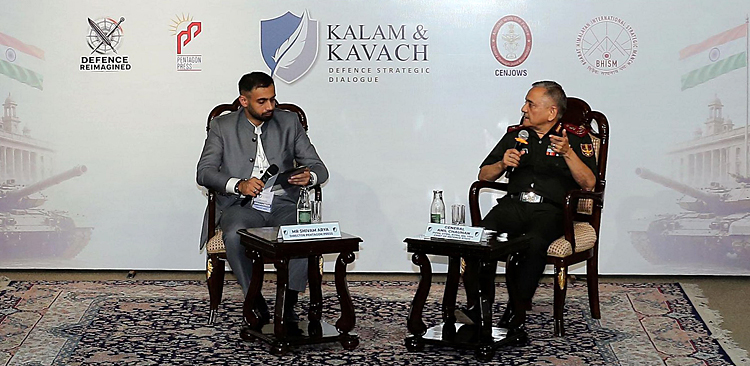
"This process of jointness and integration which we started... has become irreversible. It has gathered sufficient momentum. It cannot be reversed."
Importantly, he argued that theatre commands should not be viewed as the final stage of reforms, but rather the starting point of a much larger transformation.
"Jointness and integration will lead to theatre commands. So that's not the end state of reforms. Sometimes it could be taken as the beginning of reforms, future and faster reforms."
"This process of jointness and integration... has become irreversible." —General Anil Chauhan, CDS
The CDS repeatedly stressed that future warfare would require integration not just between the three services, but across entirely new operational domains.
"There's a need to integrate emerging technologies like artificial intelligence, quantum, man-machine teaming, lethal autonomous weapons... all this probably will give you what today can be termed as non-nuclear strategic capability."
Those remarks reflected the larger strategic undercurrent running through the conclave. India's military transformation is increasingly moving beyond organisational restructuring towards capability integration across technology, doctrine and operational planning.
One of the most striking observations made during the interaction related to escalation management and situational awareness in modern warfare.
Referring to recent operational experiences, General Chauhan remarked:
"We dominated the escalation matrix on all four days because we had superior situational awareness."
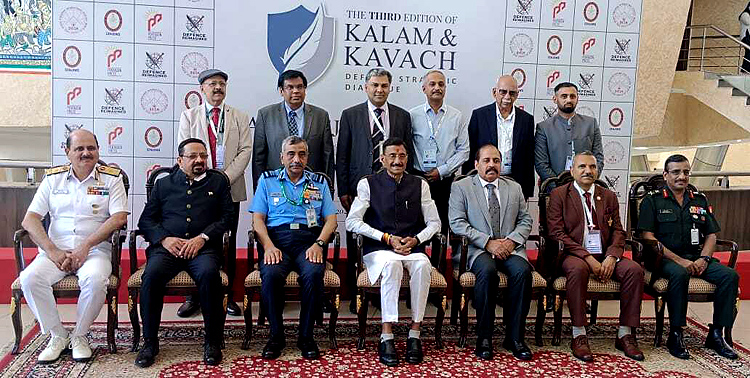
He added that dominance today depends not merely on striking capability, but on the ability to maintain awareness across the battlespace.
"The situational awareness wasn't there only in my own country but also across the borders. I had the situational awareness and that's why I was able to dominate every step or every ladder of escalation."
That statement perhaps best captured the changing nature of modern conflict. Information superiority, integration and real-time operational coordination are increasingly becoming as critical as conventional firepower.
Several discussions during the conclave focused on how rapidly evolving battlefield technologies are reshaping military planning worldwide.
General Chauhan pointed to the Armenia-Azerbaijan conflict and the Russia-Ukraine war as major turning points in the operational evolution of drones and autonomous systems.
"Drones got introduced into warfare during the Armenia-Azerbaijan conflict, but they actually matured during the Ukrainian conflict."
He noted that newer conflicts have also demonstrated the growing threat posed by long-range drones, ballistic missiles and saturation attacks against both civilian and military infrastructure.
"You can today saturate attacks with drones, missiles, hypersonic weapons. So challenges for the world in future are huge and so are for us."
The strategic sessions reflected those concerns. Discussions on future warfare covered AI-enabled warfare, autonomous systems, quantum-enabled C4ISR, hypersonic technologies and multi-domain operations.
A key intervention in this context came from Lt Gen Raj Shukla (Retd.), former GOC-in-C Army Training Command and Member, UPSC, who delivered a special address on "AI and Autonomy Go to War."
His address focused on the transformative impact that artificial intelligence, autonomy and machine-enabled decision systems are likely to have on future battlefields, reinforcing the growing consensus that emerging technologies will fundamentally reshape military operations, command structures and deterrence dynamics in the years ahead and .
The conversation was no longer about isolated platforms. It was increasingly about networks, integration, speed of adaptation and decision superiority.
Perhaps the most significant shift visible at the conclave was the changing way industry is being viewed within India's defence ecosystem.
The language used throughout the sessions suggested that private industry is no longer being seen merely as a supplier fulfilling procurement requirements, but as an integral stakeholder in national security preparedness and capability development.
That sentiment came through strongly in the industry addresses and panel discussions.
Ashish Kansal, CEO and Director of SMPP, highlighted the importance of indigenous manufacturing ecosystems and surge production capability in modern conflict scenarios.
"Any modern conflict demands immediate readiness and surge capacity, and that can only come through a strong indigenous industrial ecosystem."
He added:
"Indian private industry and MSMEs are today proving that they can not only support the armed forces, but also build globally competitive technologies and manufacturing capabilities focused on Make in India, Make for the World."
The remark reflected a broader shift visible across the discussions, where industry was increasingly being viewed not merely as a vendor, but as a strategic partner in capability development and national security preparedness.
"Any modern conflict demands immediate readiness and surge capacity, and that can only come through a strong indigenous industrial ecosystem." —Ashish Kansal, SMPP
The discussions repeatedly reinforced the idea that India's defence preparedness can no longer be separated from the depth of its industrial base, manufacturing resilience and innovation ecosystem.
Sessions on scaling defence manufacturing, future-proofing India's warfighting edge and strengthening industrial partnerships reflected the growing strategic importance being attached to startups, MSMEs and private sector participation.
There was also considerable emphasis on accelerating technology absorption, expanding indigenous manufacturing capability and building trusted supply chains capable of supporting long-term operational requirements.
Another notable feature of the discussions was the increasingly nuanced approach towards indigenisation and foreign partnerships.
Rather than presenting self-reliance and international collaboration as competing ideas, several speakers argued that future capability development would depend on combining domestic innovation with trusted global partnerships.
Lt Gen Rakesh Kapoor (Retd.), former Deputy Chief of Army Staff (IS&T), observed that the current geopolitical environment presents India with a significant opportunity to deepen strategic and industrial partnerships with friendly nations.
"The current geo-strategic environment offers India an enviable opportunity to forge partnerships with friendly nations to build capabilities. A pre-requisite to leverage this capacity is speed in this age of acceleration. Transformation of mindsets and dismantling of institutional silos will help create an enabling environment to realise this potential."
Dr Vivek Lall, CEO of General Atomics Global Corporation, observed:
"Our ability to secure the future will depend on how effectively nations, industry, innovators and academia come together to build resilient ecosystems powered by advanced technology, trusted partnerships and strategic foresight."
He added that India today has the potential to emerge as "a global hub for innovation-led security and aerospace advancement."
The agenda itself reflected this approach. Sessions on "Global Partnerships, Indian Advantage" explored how international OEM collaboration, co-development and advanced manufacturing partnerships could strengthen India's defence-industrial base while supporting indigenous capability creation.
In many ways, that represents one of the more important shifts in India's defence outlook, from being primarily a buyer of defence systems to aspiring towards becoming a long-term strategic manufacturing and technology partner within global supply chains.
The international dimension of India's evolving defence posture was also visible through the participation of foreign diplomats and industry representatives, reflecting the growing convergence between strategic partnerships, industrial cooperation and defence capability development.
Ambassador Vahagn Afyan of Armenia noted that Armenia-India relations have evolved from traditionally friendly ties into a dynamic and multifaceted partnership, with military-technical cooperation emerging as one of its key pillars. He also observed that while the relationship may not yet formally be termed a "strategic partnership", the depth and direction of bilateral cooperation increasingly reflect that character.
Italian Ambassador Antonio Bartoli emphasised the growing scope of India-Italy cooperation in defence, maritime security and industrial collaboration, underlining the importance of deeper defence-industrial engagement between the two countries.
The conclave also witnessed the launch of Defence Reimagined, a strategic volume examining India's evolving defence and national security landscape across domains such as aerospace, cyber warfare, maritime strategy, emerging technologies and indigenous capability development.
The book, authored by Shivam Arya, was formally unveiled by Minister of State for Defence Sanjay Seth alongside senior military and industry leaders during the inaugural session.
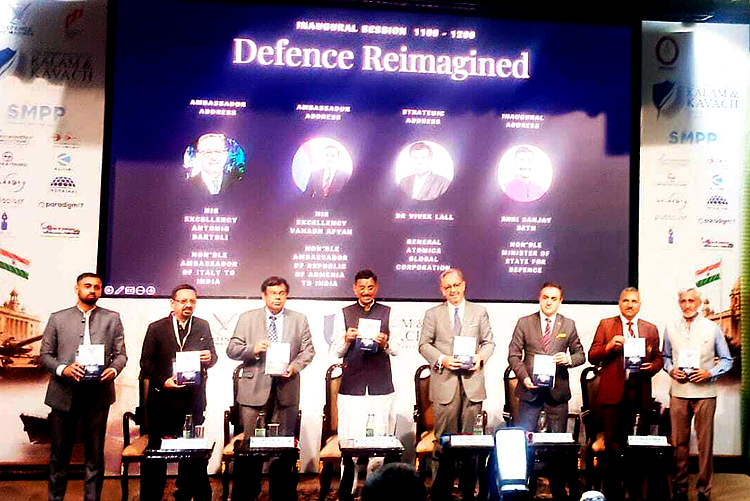
The launch aligned closely with the larger themes discussed throughout the conclave, particularly the need to rethink defence preparedness through the lens of integration, technological adaptation and long-term strategic capability building.
Maj Gen (Dr) Ashok Kumar (Retd.), Director General, CENJOWS, stressed that future military preparedness would depend equally on leadership, intellectual depth and strategic adaptability.
"War preparedness is not only based on soldiers, their equipment and training alone. It requires high-calibre leadership as well to ensure decisive victories."
He added that future leaders would need to operate "from a position of hope taking risks, rather than from the fear of failure," while emphasising that platforms such as Kalam & Kavach help bridge the intellectual gap required for future military leadership.
Dr Chandrika Kaushik, Distinguished Scientist and Director General (PC&SI), DRDO, highlighted the importance of long-term research ecosystems in strategic capability building.
"Today's R&D is not just an investment; it is tomorrow's sovereignty."
The conclave brought together representatives from the armed forces, Ministry of Defence, Department of Defence Production, DRDO, NSAB, foreign missions, global aerospace firms, startups and Indian industry leaders.
But beyond the sessions and speeches, the larger takeaway from Kalam & Kavach 3.0 was the sense that India's defence discourse itself is undergoing transition.
The focus is gradually moving beyond procurement alone towards integrated capability development, where military reforms, emerging technologies, industrial ecosystems and strategic partnerships are increasingly being viewed as interconnected elements of national security.
Future wars, several speakers suggested, may not necessarily be won by the side with the largest inventory, but by the side that integrates faster, innovates quicker and adapts continuously.
As General Chauhan remarked during the interaction:
"If you are static or you don't reform yourself, then you'll become extinct one day."
Kalam & Kavach 3.0 ultimately reflected a larger transition underway within India's defence ecosystem: from platform acquisition to capability integration, from isolated procurement to industrial partnerships, and from traditional warfighting structures towards technology-driven, multi-domain preparedness.