



The insightful articles, inspiring narrations and analytical perspectives presented by the Editorial Team, establish an alluring connect with the reader. My compliments and best wishes to SP Guide Publications.
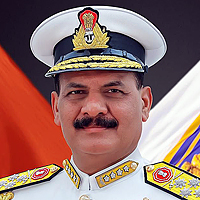
"Over the past 60 years, the growth of SP Guide Publications has mirrored the rising stature of Indian Navy. Its well-researched and informative magazines on Defence and Aerospace sector have served to shape an educated opinion of our military personnel, policy makers and the public alike. I wish SP's Publication team continued success, fair winds and following seas in all future endeavour!"

Since, its inception in 1964, SP Guide Publications has consistently demonstrated commitment to high-quality journalism in the aerospace and defence sectors, earning a well-deserved reputation as Asia's largest media house in this domain. I wish SP Guide Publications continued success in its pursuit of excellence.
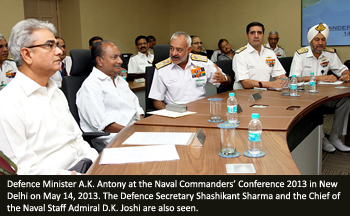
The Defence Minister A.K. Antony called upon the top brass of the Indian Navy and the Indian Coast Guard to ensure timely implementation of measures envisaged under Phase-II of the Coastal Security Plan.
Addressing the Naval Commanders’ Conference in New Delhi on May 14, he said the National Command Control, Communication and Intelligence Network Project is to become operational later this year. This real-time link between the Operations Rooms of the Navy and the Coast Guard will surely synergise coastal security operations.
Referring to strengthening Navy’s maritime support infrastructure, especially in the islands, Antony said, the construction of additional bases and naval air stations in the Andaman and Nicobar Islands and the Lakshadweep and Minicoy Islands is necessary to further extend India’s operational reach. Antony complimented the Indian Navy for checking piracy in the Gulf of Aden to some extent and for ensuring that the menace does not spread towards Indian waters.
Complimenting the Navy for its indigenisation efforts of defence production, he said 46 of the 48 naval platforms, currently under construction, are being built in India. “Indigenisation of equipment, especially weapons and sensors, in association with the Defence Research and Development Organisation (DRDO) through the ‘Buy & Make (Indian)’ route is an initiative that needs to be carried forward strongly and replicated in other spheres.”
He said there are some operational constraints regarding conventional submarines, ship-borne helicopters and mine counter measure vessels. The Defence Minister reiterated that funds will never be a constraint for capital acquisition and will be made available, but they should be used in the most judicious manner.
Antony said the security environment prevailing in our neighborhood, security of national as well as physical security of our bases, dockyards, ships, submarines, aircraft, etc. cannot be ignored at any cost.
A highlight of the conference was that for the first time ever, it was held by “Telepresence” between New Delhi and Naval Commands, thus doing away with travel of the participating Commanders and supporting staff. The Indian Navy has thus become the first Service to conduct a conference of this magnitude through video conferencing. The site at Naval Headquarters in New Delhi was linked seamlessly with the Command Headquarters at Mumbai, Vizag and Kochi using a secure video and data link.
Admiral D.K. Joshi, Chief of the Naval Staff, noted the high tempo of operations maintained by all naval units and observed that the induction of ships and submarines would be primarily indigenous in the coming years. Naval aviation was also poised for major growth.