






The insightful articles, inspiring narrations and analytical perspectives presented by the Editorial Team, establish an alluring connect with the reader. My compliments and best wishes to SP Guide Publications.

"Over the past 60 years, the growth of SP Guide Publications has mirrored the rising stature of Indian Navy. Its well-researched and informative magazines on Defence and Aerospace sector have served to shape an educated opinion of our military personnel, policy makers and the public alike. I wish SP's Publication team continued success, fair winds and following seas in all future endeavour!"

Since, its inception in 1964, SP Guide Publications has consistently demonstrated commitment to high-quality journalism in the aerospace and defence sectors, earning a well-deserved reputation as Asia's largest media house in this domain. I wish SP Guide Publications continued success in its pursuit of excellence.
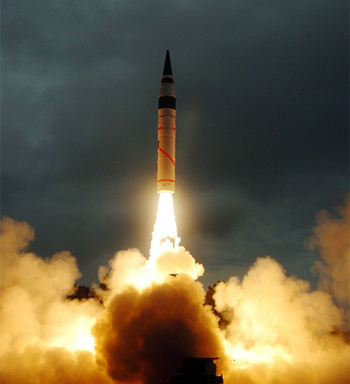
India’s intercontinental surface-to-surface ballistic missile Agni-V, capable of delivering nuclear warhead with high precision, was successfully launched on September 15, 2013, in a repeat of spectacular maiden launch last year.
A symbol of the Defence Research and Development Organisation’s (DRDO) technological excellence and India’s strength, the missile took off majestically at 0850 hours from DRDO’s launch complex at Wheeler Island, off the coast of Odisha, flew on a predefined path and reached its destination with expected precision.
The missile, powered by three-stage solid rocket motors, had a flawless, spectacular launch in auto mode and followed its entire trajectory in textbook manner, dropping the three motors at predefined stages into the ocean. The ships located in mid-range and at the target point tracked the vehicle and witnessed the final event. All the radars and electro-optical systems, ship-based and those based on ground stations along the path monitored the performance parameters of the missile and displayed information in real time.
All the systems and subsystems of the missile, such as the launch system, navigation system, control systems, rocket motors, the re-entry package, etc. performed well. The navigation systems, very high accuracy ring laser gyro-based inertial navigation system (RINS) and the most modern and accurate micro navigation system (MINS) ensured the missile reached the target point within a few metres of accuracy. The high speed onboard computer and fault tolerant software along with robust and reliable bus guided the missile flawlessly.
A major milestone, this second successful test of Agni-V has demonstrated the maturity, repeatability and robustness of the system, paving the way for initiation of productionisation and subsequent induction. The launch also clears the way for its canisterisation. The Agni-V missile, in its operational form, is designed to be stored and launched from the canister, enhancing its storage, operational readiness, transportability, response time and shelf life.
The Strategic Force Command team along with its top brass was present during all the operations to get acquainted with the system and trained.
Defence Minister A.K. Antony congratulated all the scientists of DRDO and said that “DRDO scientists have made the country proud”.
National Security Advisor (NSA) Shivshankar Menon congratulated DRDO scientists and said that the event is a milestone in the long-range missile era of India.