



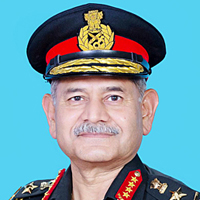
The insightful articles, inspiring narrations and analytical perspectives presented by the Editorial Team, establish an alluring connect with the reader. My compliments and best wishes to SP Guide Publications.

"Over the past 60 years, the growth of SP Guide Publications has mirrored the rising stature of Indian Navy. Its well-researched and informative magazines on Defence and Aerospace sector have served to shape an educated opinion of our military personnel, policy makers and the public alike. I wish SP's Publication team continued success, fair winds and following seas in all future endeavour!"

Since, its inception in 1964, SP Guide Publications has consistently demonstrated commitment to high-quality journalism in the aerospace and defence sectors, earning a well-deserved reputation as Asia's largest media house in this domain. I wish SP Guide Publications continued success in its pursuit of excellence.
India is accelerating defence indigenisation aimed at enhancing high-altitude mobility, operational flexibility, and domestic defence manufacturing capabilities.
 |
The Author is Former Director General of Information Systems and A Special Forces Veteran, Indian Army |
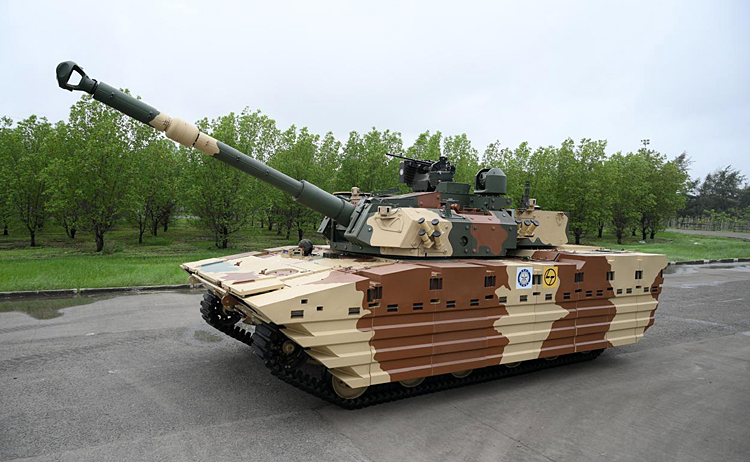
According to reports in January 2026, Bharat Forge has unveiled India's first fully indigenous light tank from the private sector, marking a significant milestone in the nation's defence manufacturing landscape. Bharat Forge achieved completion of this tank in a record time of under one year, showcasing the prowess of private industry in accelerating military hardware development. Scheduled for its official rollout in March 2026, the light tank will be ready for rigorous trials by September 2026. This rapid timeline underscores Bharat Forge's commitment to the 'Make in India' initiative.
Bharat Forge has unveiled India's first fully indigenous light tank from the private sector filling a critical gap in India's armoured corps, complementing heavier platforms like the Arjun MK-1A and Future Main Battle Tank (MBT).
With a combat weight under 25 tonnes, the tank is optimised for high-altitude operations, addressing India's strategic needs along mountainous borders like in Ladakh and Arunachal Pradesh. Its lightweight design enhances strategic mobility, allowing rapid deployment via airlift using platforms like the C-17 Globemaster or indigenous C-295 aircraft. The tanks main firepower is a potent 105 mm main gun, capable of engaging armoured threats with precision and lethality. This stabilised armament system ensures effective performance across diverse terrains, from deserts to high-altitude regions. The tank has amphibious capability, powered by dual rear-mounted water jets that enable swift water traversal at speeds up to 10 km/h. This ability expands its operational versatility for riverine crossings and littoral zones, vital for India's amphibious warfare doctrines in scenarios like the Andaman and Nicobar Islands.
The tank's modular architecture signals a forward-thinking design philosophy, facilitating rapid role-specific customisation. Operators can swiftly integrate add-on modules for reconnaissance, electronic warfare (EW), or anti-drone systems, while simplified maintenance reduces downtime and logistical footprints in forward areas. Unmanned turret options and remote weapon stations minimise crew exposure, incorporating AI-driven target acquisition and fire control algorithms. This integration reflects global trends in crewed-uncrewed teaming, enhancing survivability against precision-guided munitions. Powering the tank is a high-torque, low-emission diesel engine paired with an advanced automatic transmission, delivering a power-to-weight ratio exceeding 25 hp/tonne. This ensures agility with a top speed of 70 km/h on roads and an operational range over 500 km, bolstered by auxiliary power units for silent watch modes.
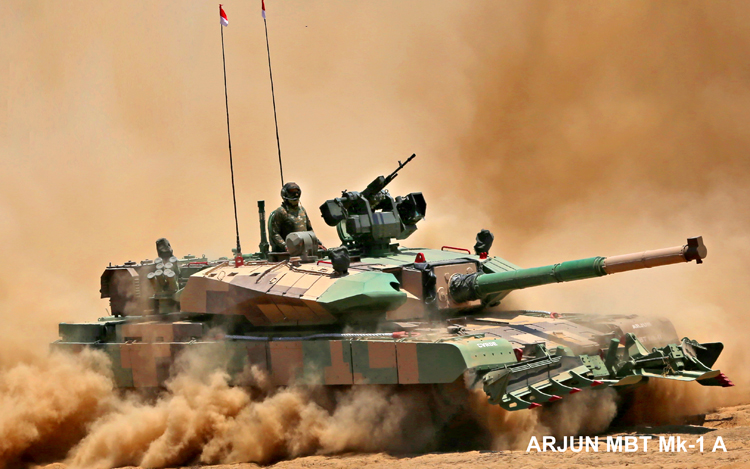
The tank's cockpit is state-of-the-art digital, which aligns the tank with modern network-centric warfare requirements. Featuring advanced battle management systems, augmented reality displays, and seamless data fusion from UAVs and sensors, it empowers crews with superior situational awareness. The advanced protection suites include composite applique armour, explosive reactive armour tiles, and active protection systems to counter anti-tank guided missiles (ATGMs). Signature management technologies reduce thermal, radar, and acoustic footprints, making the tank a elusive target in contested environments.
The tank fills a critical gap in India's armoured corps, complementing heavier platforms like the Arjun MK-1A and Future Main Battle Tank (MBT). It aligns with the Army's Zorawar project requirements, potentially fast-tracking induction for high-altitude infantry formations. User trials in 2026 will validate performance under extreme conditions, paving the way for bulk production orders. Export potential looms large, targeting friendly nations in South Asia, Africa, and Southeast Asia seeking agile, cost-effective solutions. Bharat Forge's light tank exemplifies private sector agility. It not only bolsters India's self-reliance but redefines light tank paradigms globally, blending lethality, mobility, and technology. Bharat Forge has forged expertise and investments in advanced manufacturing, including 3D printing for rapid prototyping. Collaborations with MSMEs and start-ups have democratised innovation, fostering a robust supply chain ecosystem.
Larsen and Toubro (L&T) have been awarded a contract by the Ministry of Defence (MoD) to supply the Indian Army with 18 x BvS10 Sindhu under the 'Make-in-India' initiative
Meanwhile, Larsen and Toubro (L&T) have been awarded a contract by the Ministry of Defence (MoD) to supply the Indian Army with 18 x BvS10 Sindhu under the 'Make-in-India' initiative, as reported in the media in December 2025. BvS10 Sindhu is a version of BAE System's 'Hagglund' articulated all-terrain vehicle (AATV) intensively customized in conjunction with the Indian Army to meet the Army's requirements for operations in high altitude areas like Ladakh, Sikkim and Arunachal Pradesh. The first BvS10 Sindhu, scheduled for production in 2027, is to have more than 60% indigenous content. The entire batch of 18 x bvS10 Sindhu, comprising a mix of troop carriers, command post and logistics variants) are to be delivered by mid-2018.
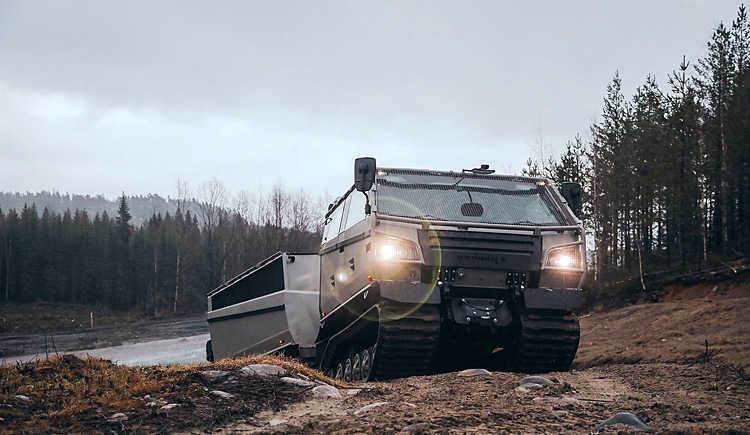
The Indian Army-specific modifications incorporated in the BvS10 Sindhu include the following: enhanced cold-start and high-altitude engine tuning for reliable operations above 18,000 feet; integration of indigenous Bharat Electronics tactical radios and battlefield management system (BMS); indigenous composite armour kits for improved protection against 14.5mm API rounds; locally developed thermal insulation and crew heating system tested down to minus 45 degrees Celsius; upgraded electrical architecture to support future integration of indigenous active protection systems.
Once the performance of this first batch of 18 BvS10 Sindhu is validated in extreme high-altitude and glacial terrain, the Army reportedly plans to procure additional 100 of these AATVs under a 'Make-I' project – with additional modifications, if warranted. The BvS10 Sindhu would help boost the combat potential of the India Army, especially in the environment where forces from both sides continue facing each other all along the Line of Actual Control (LAC).
Sagar Defence Engineering (SDE) unveiled its 'Varuna HA'; a dual-use two-man tactical aerial vehicle designed for high-altitude operations and advanced multi-mission roles
Concurrently in December 2025, Sagar Defence Engineering (SDE) unveiled its 'Varuna HA'; a dual-use two-man tactical aerial vehicle designed for high-altitude operations and advanced multi-mission roles, which would boost India's tactical aviation and logistics support capabilities. Developed under the iDEX-DIO and ADITI challenge,Varuna HA stands out as India's first two-man tactical aerial vehicle optimised for high altitude environments, a capability that is expected to deliver enhanced strategic and operational flexibility in mountains and remote regions.
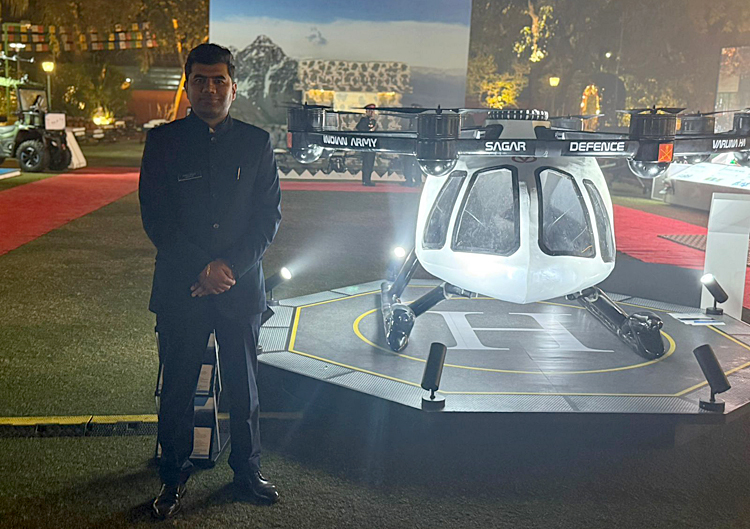
Designed as a force multiplier, Varuna HA integrates multi-mission payload capabilities with vertical take-off and landing (VTOL) performance, allowing it to operate from constrained spaces without the need for prepared runways. This flexibility significantly expands its potential roles, ranging from logistics support and reconnaissance to special operation and disaster response, both in military and civil contexts.
Varuna HA integrates with GENSYS (autonomous navigation and system management system of Sagar Defence), which enables the aircraft to take off, fly and land autonomously even from moving platforms; relevant for agile logistics operators where rapid deployment and recovery are essential, and where ground infrastructure may be limited or non-existent.
Varuna HA has been developed with a focus to reduce time, costs and risk to human life. By enabling quick, low-altitude short and medium haul transportation missions, including at high altitudes, it improves tactical responsiveness while minimising exposure of personnel to hazardous conditions. By combining manned operation with advanced autonomy, the platform addresses long-standing challenges related to logistics, surveillance and rapid mobility in difficult terrain, where conventional air assets can face difficulties.