




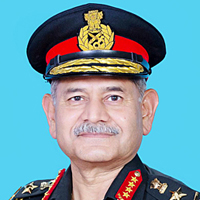
The insightful articles, inspiring narrations and analytical perspectives presented by the Editorial Team, establish an alluring connect with the reader. My compliments and best wishes to SP Guide Publications.
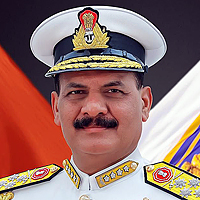
"Over the past 60 years, the growth of SP Guide Publications has mirrored the rising stature of Indian Navy. Its well-researched and informative magazines on Defence and Aerospace sector have served to shape an educated opinion of our military personnel, policy makers and the public alike. I wish SP's Publication team continued success, fair winds and following seas in all future endeavour!"

Since, its inception in 1964, SP Guide Publications has consistently demonstrated commitment to high-quality journalism in the aerospace and defence sectors, earning a well-deserved reputation as Asia's largest media house in this domain. I wish SP Guide Publications continued success in its pursuit of excellence.
One of the Indian Army's most experienced operational commanders and a key architect of its modernisation drive, Lt General Seth's appointment marks a continuation of the Army's broader transformation toward a technologically enabled, network-centric and highly agile fighting force
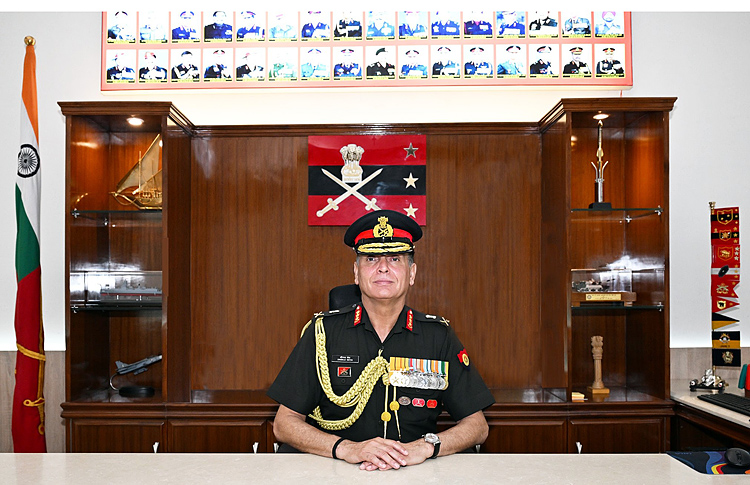
Lt General Dhiraj Seth, currently serving as the Vice Chief of the Army Staff, and one of the Indian Army's most experienced operational commanders and a key architect of its modernisation drive, has been appointed as the next Chief of the Army Staff (COAS), succeeding General Upendra Dwivedi, with effect from June 30, 2026.
His elevation comes at a crucial juncture when the Army is accelerating technological transformation following the lessons of Operation Sindoor and modernising to the changing character of warfare.
Lt General Seth went on to command both the South Western Command and the Southern Command, earning the rare distinction of leading two operational Army Commands
An alumnus of the National Defence Academy, Khadakwasla, Lt General Seth was commissioned into the Armoured Corps in December 1986. Over nearly four decades of service, he has built a reputation as a field commander, strategist and force planner, with experience spanning conventional warfare, counter-insurgency operations and international military engagements.
The new Army Chief has commanded formations at virtually every level in diverse operational environments. His command assignments include an Armoured Regiment in the desert sector, an Armoured Brigade in the western theatre and a Counter-Insurgency Force in Jammu and Kashmir.
As a Lt General, he commanded the prestigious Sudarshan Chakra Corps, one of the Army's premier strike formations tasked with offensive operations along India's Western Front.
Military observers believe Lt General Seth's extensive background in capability development makes him well-suited to lead the Army through this transformation
He later served as General Officer Commanding (GOC), Delhi Area, overseeing military engagements linked to national ceremonies, diplomatic visits and strategic events in the national capital.
On promotion to Army Commander, Lt General Seth went on to command both the South Western Command and the Southern Command, earning the rare distinction of leading two operational Army Commands. Over a period of more than two and a half years, he provided strategic oversight across critical theatres, strengthening operational preparedness and force integration.
Beyond command appointments, Lt General Seth has held several influential staff assignments that shaped the Army's long-term capability development. His tenure included positions such as Colonel Capability Development for Mechanised Forces, Brigadier Perspective Plans and Acquisition, and Additional Director General Capability Development. In these roles, he contributed significantly to the Army's Long-Term Perspective Plan and modernisation roadmap.
One of the key organisational reforms expected to receive renewed momentum under his leadership is the creation of Integrated Battle Groups (IBGs)
His appointment comes just over a year after Operation Sindoor, the four-day conflict with Pakistan in May 2025 that underscored the rapid evolution of warfare in South Asia. During the operation, the Indian military employed guided artillery, unmanned systems and artificial intelligence-enabled tools against terrorist infrastructure and Pakistani military targets. The conflict also highlighted the growing importance of non-contact warfare, involving long-range missiles and drones, as well as cognitive warfare aimed at influencing and disrupting adversary decision-making.
Military observers believe Lt General Seth's extensive background in capability development makes him well-suited to lead the Army through this transformation. He has been closely associated with initiatives to enhance mechanised warfare capabilities, accelerate indigenous technology adoption and improve force readiness for future conflicts.
One of the key organisational reforms expected to receive renewed momentum under his leadership is the creation of Integrated Battle Groups (IBGs). These lean, agile formations combine infantry, armour, artillery, air defence, engineers, signals and logistics units into integrated combat teams designed for rapid deployment and high-intensity operations.
Lt General Seth also assumes office at a time when the Army is placing unprecedented emphasis on emerging technologies
Lt General Seth also assumes office at a time when the Army is placing unprecedented emphasis on emerging technologies. Under his predecessor, General Dwivedi, the service prioritised artificial intelligence, autonomous systems and drone warfare. The Army introduced India's first sovereign agentic AI platform, initiated work on a sovereign large language model for military applications and expanded indigenous drone development capabilities.
Reflecting this shift, the Army designated 2024 and 2025 as the "Years of Technology Absorption." Building on that foundation, 2026 and 2027 have been declared the "Years of Networking and Data Centricity," signalling a move toward networked warfare, real-time battlefield awareness and data-driven decision-making.
Lt General Seth's experience with force planning, technology integration and operational command is expected to be central to these efforts.
The new Army Chief faces the task of ensuring that the world's second-largest army remains prepared for the battlefields of the future
As India confronts a rapidly evolving security environment marked by conventional threats, grey-zone challenges and technological disruption, the new Army Chief faces the task of ensuring that the world's second-largest army remains prepared for the battlefields of the future.
His appointment marks a continuation of the Army's broader transformation toward a technologically enabled, network-centric and highly agile fighting force.
Manish Kumar Jha is a Consulting & Contributing Editor for SP's Aviation, SP's Land Forces and SP's Naval Forces and a security expert. He writes on national security, military technology, strategic affairs & policies.