






The insightful articles, inspiring narrations and analytical perspectives presented by the Editorial Team, establish an alluring connect with the reader. My compliments and best wishes to SP Guide Publications.
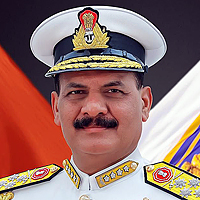
"Over the past 60 years, the growth of SP Guide Publications has mirrored the rising stature of Indian Navy. Its well-researched and informative magazines on Defence and Aerospace sector have served to shape an educated opinion of our military personnel, policy makers and the public alike. I wish SP's Publication team continued success, fair winds and following seas in all future endeavour!"

Since, its inception in 1964, SP Guide Publications has consistently demonstrated commitment to high-quality journalism in the aerospace and defence sectors, earning a well-deserved reputation as Asia's largest media house in this domain. I wish SP Guide Publications continued success in its pursuit of excellence.
Indian Navy has unveiled Trident-Samudra, an advanced AI-driven ocean surveillance system poised to revolutionise maritime domain awareness
 |
The Author is Former Director General of Information Systems and A Special Forces Veteran, Indian Army |
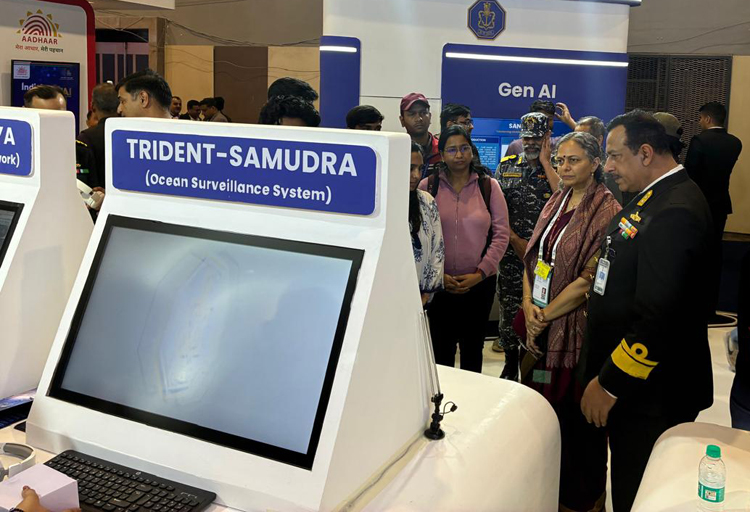
Oceanic Surveillance is not only an important tool for naval warfare, but is critical to a nation's security. The US Ocean Surveillance Systems emerged during the Cold War to track and monitor global maritime movements and activities. With oceans covering 70 per cent of the earth's surface, these advanced systems operate across multiple domains: land, sea, air, and space. Designed to detect threats, provide real-time data, and enable operations ranging from anti-submarine warfare and maritime Intelligence, Surveillance, and Reconnaissance (ISR) to strategic deterrence, these systems are a crucial component of US national security. America's strategic reorientation towards the Indo-Pacific has been accompanied by a heightened interest in matters maritime. In contrast to the primary theatres of the Cold War, the region's strategic and economic geography is strongly defined by its wide oceans, narrow choke points and contested waterways. As a result, the naval profiles of Asia's two rising powers, India and China, have attracted an unprecedented level of attention for good reason. The very nature of maritime competition appears to be undergoing a radical transformation. The proliferation of precision-guided weaponry has raised questions over the survivability of expensive, high-signature surface vessels, and maritime competition is increasingly being driven underwater. All this needs to be viewed in the backdrop of India's low surface and sub-surface capabilities compared to that of China.
Indian Navy's Trident-Samudra innovation underscores the Navy's commitment to integrating artificial intelligence into defence technologies and promises enhanced surveillance, security, and operational efficiency across the Indian Ocean Region (IOR)
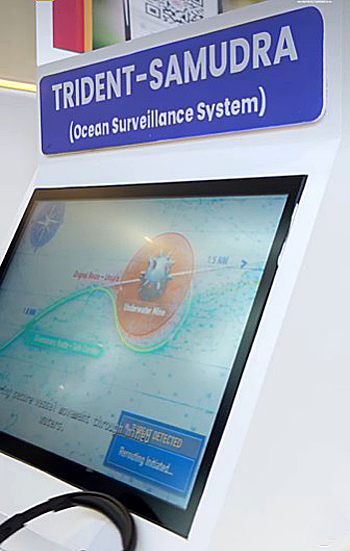
According to reports of March 7, 2026, the Indian Navy has unveiled Trident-Samudra, an advanced AI-driven ocean surveillance system poised to revolutionise maritime domain awareness. Showcased at the AI Impact Summit 2026 in New Delhi, the Indian Navy's Trident-Samudra innovation underscores the Navy's commitment to integrating artificial intelligence into defence technologies. Developed in collaboration with partners like the Bengaluru-based 'Blurgs Innovations Private Limited', it promises enhanced surveillance, security, and operational efficiency across the Indian Ocean Region (IOR).
Trident-Samudra functions as an intelligent surveillance, reconnaissance, and intelligence (ISR) tool. It employs sophisticated AI algorithms to identify, track, and monitor maritime activities in real time. From commercial shipping to potential adversarial movements, the system processes data streams to flag anomalies swiftly. A core strength of Trident-Samudra lies in its enhanced situational awareness capabilities. By analysing vast datasets from diverse sensors, satellites, and underwater arrays, Trident-Samudra detects suspicious patterns that might evade human operators. This fusion of multi-domain intelligence equips the Indian Navy and the Indian Coast Guard (ICG) with a comprehensive operational picture.
By analysing vast datasets from diverse sensors, satellites, and underwater arrays, Trident-Samudra detects suspicious patterns that might evade human operators
The Trident-Samudra has multiple operational benefits. Automation reduces the burden of manual coastline monitoring; It accelerates threat detection and decision-making, giving commanders seconds-to-minutes advantages in response times, which is critical in dynamic maritime environments where delays can prove costly. Particular emphasis falls on underwater security, a pressing concern amid rising submarine activities. The system targets foreign incursions, with specific focus on Chinese submarine presence in the Bay of Bengal and around the Andaman and Nicobar Islands. It bolsters India's strategic deterrence in these chokepoints.
Trident-Samudra's integration with frontline naval platforms exemplifies the 'Atmanirbhar Bharat' ethos. The system seamlessly embeds into vessels like INS 'Surat', providing AI-backed real-time security. This indigenous design minimises foreign dependencies while maximising interoperability with existing assets. Complementing broader Navy initiatives, it aligns with AI-driven drone surveillance and BELLHOP sonar simulations. These efforts collectively fortify maritime defences against asymmetric threats, from unmanned underwater vehicles to hostile surface incursions.
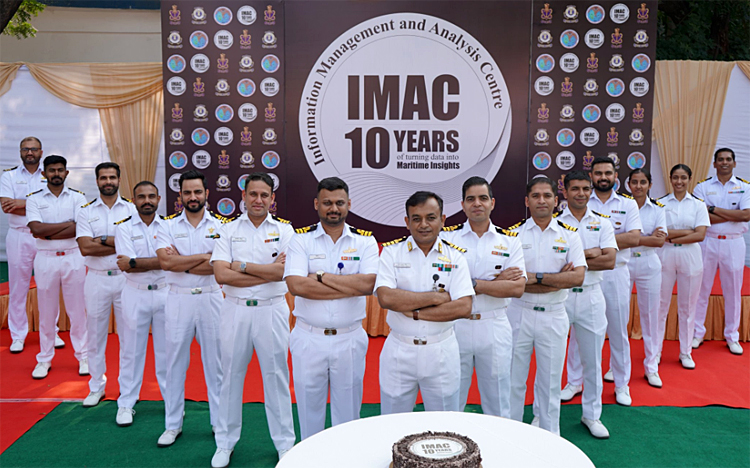
Integration with the Navy's Information Management and Analysis Centre (IMAC) creates a networked ecosystem, fusing Trident-Samudra data with national assets like GSAT-7 satellites
Technologically, the platform leverages machine learning for predictive analytics. It distinguishes between benign fishing vessels and covert operations through behavioural pattern recognition. Edge computing ensures low-latency processing even in contested environments. Deployment trials have demonstrated resilience in harsh oceanic conditions. Integration with the Navy's Information Management and Analysis Centre (IMAC) creates a networked ecosystem, fusing Trident-Samudra data with national assets like GSAT-7 satellites. The Indian Navy is mitigating challenges, such as cyber security vulnerabilities inherent to AI systems; through indigenous encryption and quantum-resistant protocols, ensuring data integrity against electronic warfare.
Finally, the Trident-Samudra's milestone at the AI Impact Summit signals a paradigm shift. Future expansions may incorporate hypersonic threat tracking and swarm drone coordination. As India pushes towards self-reliance, Trident-Samudra's positions the Navy as a technological frontrunner, safeguarding the 7,500-km coastline and the exclusive economic zone (EEZ). The system enhances India's blue-water capabilities, addressing escalating tensions in the Indo-Pacific and supports sharing actionable intelligence with strategic partners.