






The insightful articles, inspiring narrations and analytical perspectives presented by the Editorial Team, establish an alluring connect with the reader. My compliments and best wishes to SP Guide Publications.

"Over the past 60 years, the growth of SP Guide Publications has mirrored the rising stature of Indian Navy. Its well-researched and informative magazines on Defence and Aerospace sector have served to shape an educated opinion of our military personnel, policy makers and the public alike. I wish SP's Publication team continued success, fair winds and following seas in all future endeavour!"

Since, its inception in 1964, SP Guide Publications has consistently demonstrated commitment to high-quality journalism in the aerospace and defence sectors, earning a well-deserved reputation as Asia's largest media house in this domain. I wish SP Guide Publications continued success in its pursuit of excellence.
Indications are that India is moving towards the Agni-6 missile programme, highlighting its potential strategic reach, advanced MIRV and MaRV capabilities, strengthened nuclear deterrence, and parallel expansion of indigenous drone warfare capabilities
 |
The Author is Former Director General of Information Systems and A Special Forces Veteran, Indian Army |
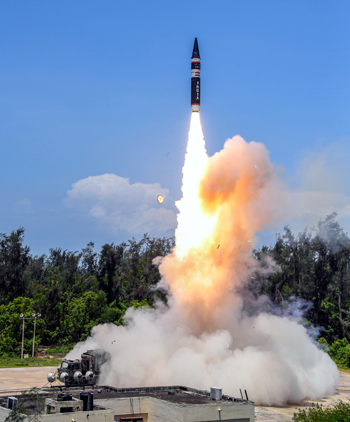
Though not officially acknowledged, certain government actions have led to the belief that India is testing the Agni-6 missile it's most powerful ICBM to-date. Many analysts also, believe India may be preparing for an Agni-6. This belief became even stronger after a recent statement a week ago by DRDO Chairman Samir V. Kamat that DRDO is fully ready to test a missile with a range of more than 10,000 km, and that the DRDO only awaits government approval.
To add to the above, on the first anniversary of Operation 'Sindoor', an official BJP social media post claimed that Agni-6, with a strike range of more than 10,000 km and Multiple Independently Targetable Re-entry Vehicles (MIRV) technology, is ready to create history, and that the missile would make India's security much stronger, placing the country among the world's most powerful nations. On the anniversary of Operation Sindoor, India announced the creation of a dedicated Drone Force.
Agni-6 having MIRV technology implies it can carry several nuclear warheads at one time
Pakistan launched a propaganda campaign showing how seriously it views the Agni-6 project, in response to the above statement by the DRDO Chairman. Pakistan's most advanced missile, Shaheen-3, has a range of around 2,750 km and India already has Agni-5, which can strike targets up to 7,000 km away.
Agni-6 having MIRV technology implies it can carry several nuclear warheads at one time. The missile first carries these warheads into space. Then the warheads separate and travel toward different targets. In a single launch, multiple cities or military bases can be attacked at the same time. These warheads return to Earth at hypersonic speeds, between Mach 20 and Mach 24. That means they travel 20 to 24 times faster than the speed of sound. At such speeds, interception becomes extremely difficult for any modern air defence system.
Moreover, Agni-6 is also expected to use Manoeuverable Re-entry Vehicle (MaRV) technology. Unlike traditional warheads, MaRV warheads do not travel in a straight-line during descent. They can change direction suddenly, zigzag, and avoid interceptor missiles, because of which experts believe stopping an Agni-6 strike would be extremely difficult. Reports also suggest that India may later develop a submarine-launched version of Agni-6. This would allow India to deploy the missile deep inside the oceans, making it hidden and difficult to destroy before launch.
With a range of 10,000 to 12,000 km, Agni-6 would place almost the entire world within India's strategic reach
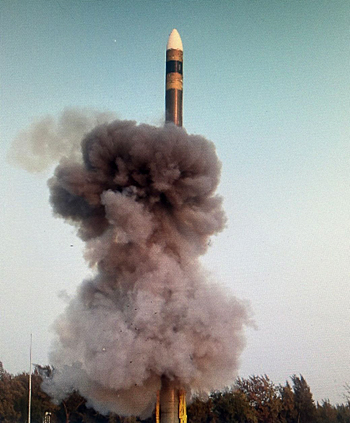
With a range of 10,000 to 12,000 km, Agni-6 would place almost the entire world within India's strategic reach. All of China would fall within range. Europe, Africa, Australia, and even parts of North America could also come under its reach. At present, only a few countries possess MIRV-capable intercontinental ballistic missiles. These countries include the United States, Russia, China, France, and Britain. If Agni-6 becomes operational, India will join this exclusive group.
MIRV and MaRV technologies, and especially Agni-6 would form an important part of India's second-strike capability; in that even if an enemy attacks India first, India would still be able to retaliate with devastating force. This capability acts as a strong deterrent against any first strike. It may be recalled that in early 2000s, the then Indian Army Chief has said that if Pakistan uses a nuclear weapon, seven Pakistani cities will be obliterated.
One year after Operation Sindoor, India's strategic message appears stronger than ever. BrahMos delivered a warning to Pakistan. Agni-6 is meant to demonstrate India's growing global reach and deterrence capability. In 2015, 15 per cent of India's military drones were made within the country. Today, that number has risen to 72 per cent. These indigenous drones can carry out surveillance, drop grenades, perform kamikaze attacks, and destroy enemy bunkers and vehicles. By 2027, the Indian Army plans to equip each of its 14 corps with thousands of drones. Altogether, the Army aims to build a network of nearly 1,00,000 drones.
MIRV and MaRV technologies, and especially Agni-6 would form an important part of India's second-strike capability
As part of the Dedicated Drone Force, some 50,000 soldiers are being trained for drone operations. Over the next three years, 15 advanced drone training centres will be established, using virtual reality systems to simulate real combat situations. Every battalion has already started deploying 'Ashni Platoons', which are specialised drone subunits of soldiers trained in surveillance and attack missions.