






The insightful articles, inspiring narrations and analytical perspectives presented by the Editorial Team, establish an alluring connect with the reader. My compliments and best wishes to SP Guide Publications.

"Over the past 60 years, the growth of SP Guide Publications has mirrored the rising stature of Indian Navy. Its well-researched and informative magazines on Defence and Aerospace sector have served to shape an educated opinion of our military personnel, policy makers and the public alike. I wish SP's Publication team continued success, fair winds and following seas in all future endeavour!"

Since, its inception in 1964, SP Guide Publications has consistently demonstrated commitment to high-quality journalism in the aerospace and defence sectors, earning a well-deserved reputation as Asia's largest media house in this domain. I wish SP Guide Publications continued success in its pursuit of excellence.
India successfully tested an advanced MIRV-enabled Agni-5 missile, demonstrating the capability to strike multiple targets with a single launch, significantly strengthening its strategic deterrence, second-strike capability and long-range missile arsenal
 |
The Author is Former Director General of Information Systems and A Special Forces Veteran, Indian Army |
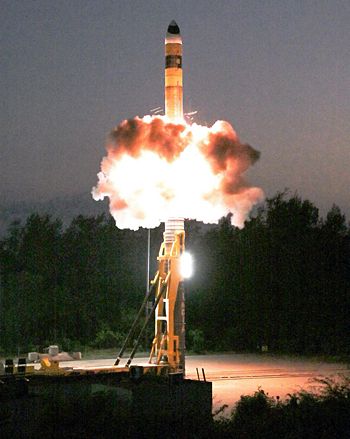
India successfully conducted the flight-trial of an advanced version of the Agni-5 missile equipped with the Multiple Independently Targeted Re-entry Vehicle (MIRV) system from Dr APJ Abdul Kalam Island, Odisha, on May 8, 2026. Development of this advanced Agni missile was spearheaded by the Defence Research and Development Organisation (DRDO) with extensive support from industries across the country. The trial was witnessed by senior DRDO scientists and personnel from the Indian Army, reflecting the collaborative effort between scientific institutions and the armed forces in advancing India's strategic arsenal. The presence of Army officials also highlights the operational relevance of the system, which is expected to be integrated into India's strategic forces in due course.
The missile was tested with multiple payloads, each directed towards different targets, and the trial was meticulously monitored through telemetry and tracking systems. These included both ground-based and ship-based stations, which followed the missile's trajectory from lift-off to the impact of all payloads. The comprehensive flight data confirmed that every mission objective was achieved, validating the robustness of the MIRV system and the precision of India's missile guidance and control technologies.
The MIRV capability represents a leap in deterrence technology, allowing a single missile to strike several strategic objectives simultaneously, enhancing India's second-strike credibility.
The MIRV capability represents a leap in deterrence technology, allowing a single missile to strike several strategic objectives simultaneously, thereby complicating adversary defence planning and enhancing India's second-strike credibility. This test marks a significant milestone in India's strategic weapons programme, showcasing the ability to deliver multiple payloads to distinct targets spread across a wide geographical area in the Indian Ocean Region (IOR).
This achievement underscores India's ability to integrate advanced re-entry vehicle technology with long-range ballistic missile systems. MIRV technology is considered one of the most sophisticated advancements in missile engineering, as it enables a single missile to carry multiple warheads that can be independently programmed to strike separate targets. Such a capability not only enhances offensive strike potential but also significantly strengthens deterrence by ensuring survivability against missile defence systems. The successful demonstration of MIRV technology is not merely a technical achievement but a strategic signal. It conveys India's resolve to maintain a credible and survivable deterrent in the face of growing regional and global uncertainties.
With this successful test, India has joined a small group of countries that operate the MIRV technology, including the United States, Russia, China, France and the United Kingdom.
With this successful test, India has joined a small group of countries that operate the MIRV technology, including the United States, Russia, China, France and the United Kingdom. The system changes the basic idea of missile use, where earlier missile was assigned to one target, while now multiple targets can be engaged through a single launch. The trial comes at a time when India is modernising its missile arsenal, with parallel developments in hypersonic weapons, long-range anti-ship missiles, and intercontinental ballistic missiles such as the Agni-6. Together, these advancements are reshaping India's strategic posture, ensuring credible deterrence and enhancing its ability to respond to diverse security challenges.
The DRDO used indigenous avionics, high-precision sensors, pressure systems, oxidiser components and composite materials to reduce missile weight by nearly 20 per cent. Carbon composites help protect warheads from extreme heat during re-entry, while decoy systems can be used to confuse enemy defence mechanisms. Each warhead can weigh up to 400 kg in the present configuration, the system can carry around four to five warheads, while experts believe that this number could increase to 10 or even 12 in future.
The MIRV-enabled Agni-5 significantly enhances India's second-strike capability, which is considered a core element of nuclear deterrence. This means the country retains the ability to respond even after absorbing an initial strike. One of the main features of this system is its resilience. Even if some warheads are intercepted, others can still reach their intended targets. This makes it difficult for existing missile defence systems to fully neutralise an incoming attack. During the test, the missile also executed a sharp 90-degree manoeuvre mid-flight, a complex movement that is extremely difficult for conventional systems. This adds to its ability to change direction unpredictably and bypass defensive radar networks.
The MIRV-enabled Agni-5 significantly enhances India's second-strike capability, which is considered a core element of nuclear deterrence.
Defence Minister Rajnath Singh congratulated DRDO, the Indian Army, and industry partners for the successful test. He emphasised that this breakthrough would add an incredible capability to India's defence preparedness, particularly in light of evolving threat perceptions in the region and beyond. The ability to target multiple strategic assets with a single missile system provides India with a decisive edge in deterrence and strengthens its position among the elite group of nations possessing MIRV technology.
The test comes at a time when missile development and advanced weapon systems are expanding across Asia. China's People's Liberation Army (PLA) continues to develop its missile capabilities, while activity in the Indian Ocean region is also increasing. With a range of 5,000 to 8,000 km, the Agni-5 provides India with reach over large parts of the region, including northern parts of China, adding depth to its deterrence posture. By mastering such advanced systems, India is ensuring that its strategic forces remain at the cutting edge of technology, capable of safeguarding national security and contributing to stability in the Indo-Pacific region.