




The insightful articles, inspiring narrations and analytical perspectives presented by the Editorial Team, establish an alluring connect with the reader. My compliments and best wishes to SP Guide Publications.
"Over the past 60 years, the growth of SP Guide Publications has mirrored the rising stature of Indian Navy. Its well-researched and informative magazines on Defence and Aerospace sector have served to shape an educated opinion of our military personnel, policy makers and the public alike. I wish SP's Publication team continued success, fair winds and following seas in all future endeavour!"

Since, its inception in 1964, SP Guide Publications has consistently demonstrated commitment to high-quality journalism in the aerospace and defence sectors, earning a well-deserved reputation as Asia's largest media house in this domain. I wish SP Guide Publications continued success in its pursuit of excellence.
Efforts are underway in India to build future-ready infrastructure for human spaceflight and long-duration missions, as well as orbital launch capability using clusters of semi cryogenic rocket engines
 |
The Author is Former Director General of Information Systems and A Special Forces Veteran, Indian Army |
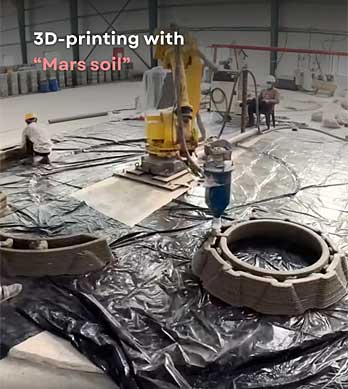
Ahmedabad-based Indian startup 'Aaka Space' has announced plans to establish the country's first underwater human spaceflight analogue mission and hyperbaric habitat programme, according to news reports of May 19, 2026. The startup recently also developed and tested Asia's first 3D-printed Mars radiation shield, marking progress in sustainable extra-terrestrial construction technologies.
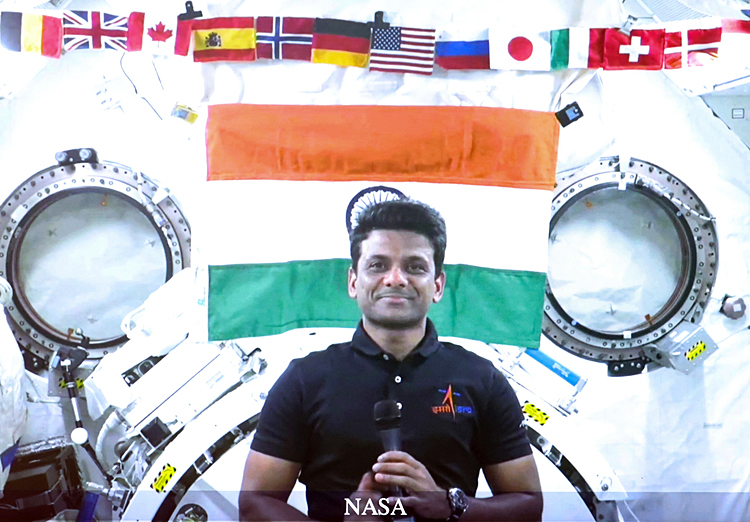
Group Captain Shubhanshu Shukla, who returned from the International Space Station during the Axiom-4 mission in 2025, highlighted how absence of gravity fundamentally alters body orientation, balance and task execution, underscoring the importance of such training environments. The initiative by Aaka Space is designed to replicate the operational and psychological conditions astronauts encounter during extended missions in space, providing a critical training and research platform for future lunar and deep-space exploration.
The initiative by Aaka Space is designed to replicate the operational and psychological conditions astronauts encounter during extended missions in space, providing a critical training and research platform for future lunar and deep-space exploration
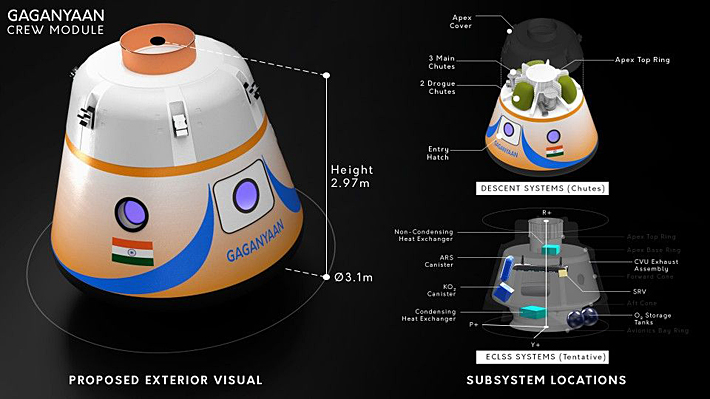
The Aaka Spece facility is expected to commence operations later in 2026; housed in a controlled aquatic environment, serving as a testbed for astronaut training, habitat systems research, microgravity simulation and human performance studies. Its importance should be viewed in context of India's future Gaganyaan manned mission, the proposed Bhartiya Antriksh Station (BAS), and the fact that astronauts travelling to the Moon or Mars may spend months inside enclosed artificial environments where stress, disrupted sleep cycles, fatigue, carbon dioxide accumulation and isolation can directly impact performance and survival.
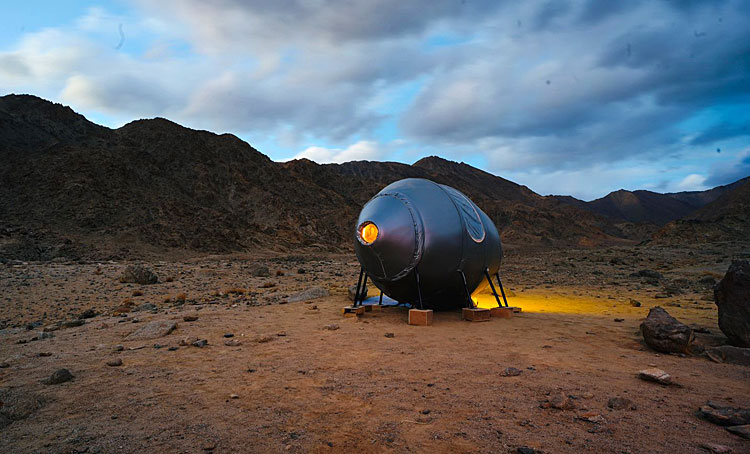
Underwater habitats are recognised globally as one of the closest Earth-based analogues to space conditions. Astronauts in orbit face isolation, confinement, reliance on engineered life-support systems, restricted mobility and altered spatial orientation. The Aaka Space habitat is being designed to simulate these challenges, with neutral buoyancy underwater serving as a proxy for microgravity. This technique allows astronauts to practise spacewalks, manoeuvre within confined habitats and interact with equipment in ways that closely mimic reduced-gravity conditions. The initial phase of the programme will be conducted in a controlled underwater setting rather than open-ocean deployments, ensuring safety while enabling researchers to study habitat systems, environmental control, ventilation, crew psychology and biomedical monitoring. Earlier, Aaka Space demonstrated its capabilities through India's first space analogue mission in Ladakh, where operational and psychological conditions similar to extra-terrestrial environments were simulated in high-altitude terrain.
The importance of this achievement lies in the fact that rocket engines are the most critical part of any launch vehicle
International studies have shown that confined environments can significantly affect cardiovascular function, respiratory response, cognitive performance and emotional stability, highlighting the need for robust life-support systems and psychological resilience strategies. Aastha Jhala, founder of Aaka Space, says the underwater habitat programme will support interdisciplinary research across human physiology, neutral buoyancy simulation, microgravity operations, biomedical telemetry, circadian rhythm regulation, behavioural psychology and confined-environment architecture. Discussions are on for training Indian astronauts in the Aaka Space habitat, final approval for which will be taken after clearance from the Indian Space Research Organisation (ISRO).
Concurrently, Chennai based 'Agnikul Cosmos', founded in 2017, has achieved a historic milestone by successfully test firing four semi cryogenic rocket engines simultaneously in a cluster, marking India's first such test and a major step toward orbital launch capability; a feat that represents a critical advance in India's private space sector. Each of the engines was 3D printed as a single piece of hardware at the company's Rocket Factory 1, eliminating assembly joints that traditionally pose risks of leakage and structural weakness.
India's Shukrayaan mission, scheduled for launch not earlier than March 2028, is expected to be the country's first dedicated mission to Venus and one of ISRO's most complex planetary exploration projects
The importance of this achievement lies in the fact that rocket engines are the most critical part of any launch vehicle. In real flight conditions, multiple engines must work in perfect synchrony, and even minor mismatches in thrust or timing can cause catastrophic failure. The engines use a special fuel that is easier to handle than conventional propellants, and they are powered by electric motor driven pumps. The test required careful calibration of eight pumps, eight motors, and eight speed control algorithms to ensure uniform start-up, steady operation, and shutdown across the system.
The engines tested will power Agnikul's 'Agnibaan' rocket, a small launch vehicle designed to carry small satellites into orbit rapidly and at lower cost. Flexible and low cost rockets such as this are increasingly vital as global satellite deployment accelerates. Agnikul's approach, centred on additive manufacturing and modular design, allows rapid production cycles and scalability. The company has indicated that future clusters will likely expand non linearly, enabling heavier payloads and higher orbits.
Together, the above efforts underscore India's determination to build future-ready infrastructure for human spaceflight and long-duration missions, as well as orbital launch capability using clusters of semi cryogenic rocket engines.
Underwater habitats are recognised globally as one of the closest Earth-based analogues to space conditions. The Aaka Space habitat is being designed to simulate these challenges, with neutral buoyancy underwater serving as a proxy for microgravity
Following Prime Minister Narendra Modi's visit to the Swedish Institute of Space Physics contributing the Venusian Neutrals Analyser (VNA) instrument this month, Sweden has formally joined India's 'Shukrayaan' mission to Venus. This collaboration strengthens Indo Swedish scientific ties and enhances the mission's ability to study Venus' atmosphere and its interaction with solar winds. The Memorandum of Understanding (MoU) was signed between ISRO and the Swedish National Space Agency(SNSA), according to news reports of May 19, 2026; marking bilateral scientific cooperation between the two nations in planetary exploration.
As part of the mission, Sweden's Swedish Institute of Space Physics will develop the Venusian Neutrals Analyser (VNA), a specialised scientific instrument that will fly aboard India's Venus orbiter. The VNA is designed to study the interaction between charged particles emitted by the Sun and the atmosphere of Venus. This is one of the most scientifically intriguing aspects of the planet, as it helps explain how solar winds strip away atmospheric particles over time.
India's Shukrayaan mission, scheduled for launch not earlier than March 2028, is expected to be the country's first dedicated mission to Venus and one of ISRO's most complex planetary exploration projects after the success of Chandrayaan 3 and the Mars Orbiter Mission. The mission aims to study Venus' dense atmosphere, volcanic surface, weather systems and mysterious super rotating clouds. It will also investigate whether Venus once had habitable conditions before evolving into its current hostile state.