






The insightful articles, inspiring narrations and analytical perspectives presented by the Editorial Team, establish an alluring connect with the reader. My compliments and best wishes to SP Guide Publications.

"Over the past 60 years, the growth of SP Guide Publications has mirrored the rising stature of Indian Navy. Its well-researched and informative magazines on Defence and Aerospace sector have served to shape an educated opinion of our military personnel, policy makers and the public alike. I wish SP's Publication team continued success, fair winds and following seas in all future endeavour!"

Since, its inception in 1964, SP Guide Publications has consistently demonstrated commitment to high-quality journalism in the aerospace and defence sectors, earning a well-deserved reputation as Asia's largest media house in this domain. I wish SP Guide Publications continued success in its pursuit of excellence.
Experts believe the technology could fundamentally change underwater operations which were previously impractical or too costly
 |
The Author is Former Director General of Information Systems and A Special Forces Veteran, Indian Army |
As US President Donald Trump was preparing to embark on his trip to China in the backdrop of tensions surrounding Taiwan, the South China Sea, and broader Indo-Pacific security, for the meeting requested by him with China's President Xi Jinping, news was circulating in global defence circles that after reports emerged that China has developed a new generation submarine so advanced that military analysts in the US are scrambling to assess its true capabilities.
Earlier reports had indicated that China has repurposed hundreds of obsolete, 1960s-era J-6 supersonic fighters into a massive fleet of "strike drones" (200 or more) stationed at six airbases near the Taiwan Strait; five bases in Fujian Province and one in Guangdong Province, as was reported in these columns recently. China has also converted its J-7 fighters into unmanned combat aerial vehicles (UCAVs). In addition, China has been indicating that it has the capability to eliminate US aircraft carriers covering Taiwan in 20 minutes. All this is viewed as heightening military competition between Washington and Beijing to levels not seen in decades.
China's new generation submarine point to breakthroughs in quiet propulsion systems, long-range missile integration, AI-assisted navigation, and advanced detection avoidance technology
Reports surrounding China's new generation submarine point to breakthroughs in quiet propulsion systems, long-range missile integration, AI-assisted navigation, and advanced detection avoidance technology. This is set to challenge the undersea dominance of the US; where US submarines operated with unmatched stealth, surveillance and strike capability across the world's oceans. Some analysts opine that the undersea rivalry between the US and China is unfolding silently in the Indo-Pacific, China is about to challenge America's dominance beneath the oceans, and that the balance of naval power has begun to shift in ways that are not fully visible.
Concurrently, according to news reports of May 13, 2026, Bremen-based Euroatlas, a European defence technology company, has unveiled the world's longest-endurance unmanned submarine, which can remain submerged for up to four months without the need for a support vessel. This submarine can track underwater activity across large maritime zones. Called 'Greyshark', it is an autonomous underwater vehicle (AUV) developed for long-range, underwater surveillance missions. This includes protecting critical subsea infrastructure, such as energy pipelines and communications cables, in contested waters.
The undersea rivalry between the US and China is unfolding silently in the Indo-Pacific with China challenging America's dominance beneath the oceans, and that the balance of naval power has begun to shift in ways that are not yet fully visible
The unmanned underwater vehicle (UUV) uses hydrogen fuel cell propulsion. This allows it to run underwater for 16 weeks nonstop. It features 17 high-resolution sensors, capable of generating seabed images with a resolution of 1.6 inches per pixel. These can also detect underwater hazards. The submarine can conduct persistent monitoring missions while significantly reducing the need for crewed naval deployments. It can travel up to 1,100 nautical miles at 10 knots, or 10,700 nautical miles at slower speeds of four knots. The submarine can dive, travel to mission areas, conduct search patterns, detect and report objects, and even complete mine warfare tasks on its own.
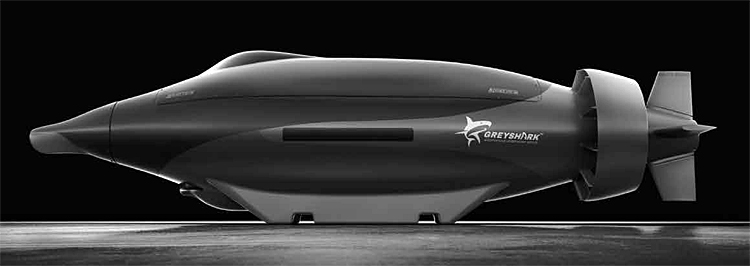
The Greyshark's system combines acoustic sensors, LiDAR, pressure sensors, and side-mounted detection systems into a fused onboard intelligence network, and its swarm capability allows multiple vehicles and sensors to operate simultaneously. According to the company, the Straits of Hormuz is one potential area for deployment of Greyshark; where the AUV could help track down the mines that Iran deployed in mid-April 2026 but find it difficult to find them now. The company also claimed that six Greyshark AUVs, operated by a single person, could precisely map the entire Strait of Hormuz in no longer than 24 hours, no manned asset would be able to do it that fast, and autonomy also makes the mission much safer.
By pairing these underwater assets with 47 Medium Unmanned Surface Vessels (USVs), the US Navy aims to create a cohesive, autonomous network that extends its reach into contested waters while significantly reducing the risk to human crews
The AUV could also be used to detect narco-submarines operated by the drug cartels to transport quantities of cocaine from South America to North America and Europe while avoiding detection. Experts believe the technology could fundamentally change underwater operations which were previously impractical or too costly. The technology has evoked significant interest in NATO nations. Sea trials for the Greyshark AUV are slated for August 2026.
According to another report, four aging Ohio-class guided-missile submarines and a dozen Ticonderoga-class cruisers of the US will reach mandatory retirement in coming years, resulting in the US Navy shedding 2,080 Vertical Launch System cells or Tomahawk Missiles (largest concentrated loss of naval strike capacity since the end of the Cold War, denting the Ohio-Class submarines.
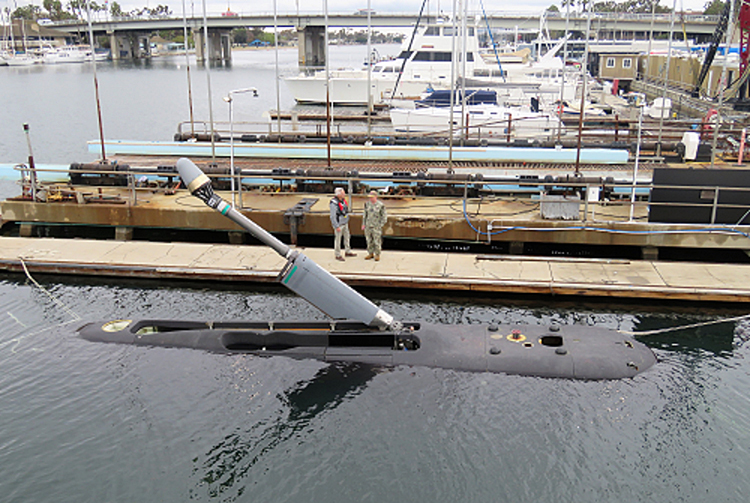
The latest, as per news reports of May 15, 2026, is that the US Navy has shifted Boeing's Orca-based Extra Large Unmanned Underwater Vehicle (XLUUV) from an experimental prototype to part of its planned fleet acquisition strategy. $135.8 million for 2 XLUUVs is catered in FY2027, with plans to procure 16 of these costing $1.13 billion through FY2031 across the Future Years Defence Program (FYDP).
The US Navy has drawn lessons from engaging with Iranian drones in the Mediterranean theatre. Indian policy makers, the Indian Navy and our defence industry need to do likewise
The Orca is a 51-foot submarine using a hybrid propulsion system which combines marine diesel generators with modern and powerful batteries, giving it a range of 6,500 nm. Its 34-foot modular payload section can carry up to 8 tonnes of equipment, enabling sensors, small unmanned vehicles and several classified packages. Orca cannot be detected easily since it does not rely on simple GPS or acoustics but rather on inertial navigation, Doppler velocity logs, and depth sensors to maintain its course. Its main advantage of the XLUUV lies in its ability to deliver "mission effects" rather than just acting as a weapons platform.
By pairing these underwater assets with 47 Medium Unmanned Surface Vessels (USVs), the US Navy aims to create a cohesive, autonomous network that extends its reach into contested waters while significantly reducing the risk to human crews. The decision to fund 16 XLUUVs for $1.13 billion compared to 10 Virginia-class submarines for $62.9 billion highlights a clear economic logic. Orca can be used for mine warfare, securing maritime chokepoints or defending sensitive geopolitical regions without risking a billion-dollar manned submarine or aircraft.
Finally, the US Navy has drawn lessons from engaging with Iranian drones in the Mediterranean theatre. Indian policy makers, the Indian Navy and our defence industry need to do likewise. Unmanned systems and vessels perhaps cannot replace manned ones 100 per cent but their significance cannot be ignored. The Indian Navy must have a sizeable number of armed UUVs in addition to USVs and manned systems.