





The insightful articles, inspiring narrations and analytical perspectives presented by the Editorial Team, establish an alluring connect with the reader. My compliments and best wishes to SP Guide Publications.

"Over the past 60 years, the growth of SP Guide Publications has mirrored the rising stature of Indian Navy. Its well-researched and informative magazines on Defence and Aerospace sector have served to shape an educated opinion of our military personnel, policy makers and the public alike. I wish SP's Publication team continued success, fair winds and following seas in all future endeavour!"

Since, its inception in 1964, SP Guide Publications has consistently demonstrated commitment to high-quality journalism in the aerospace and defence sectors, earning a well-deserved reputation as Asia's largest media house in this domain. I wish SP Guide Publications continued success in its pursuit of excellence.
India's first Model Border Village at Chumar marks an important shift in border management by combining strategic infrastructure with sustainable civilian habitation
 |
The Author is Former Director General of Information Systems and A Special Forces Veteran, Indian Army |
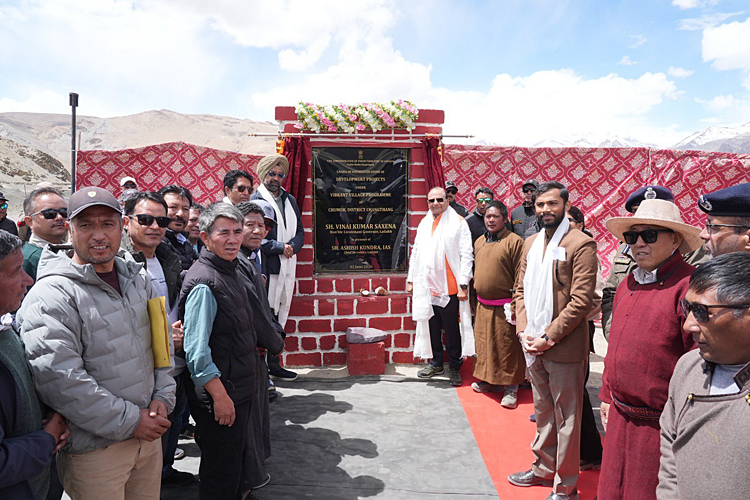
On June 3, 2026, Lieutenant Governor of Ladakh, Vinai Kumar Saxena, laid the foundation stone for India's first Model Border Village under the Vibrant Villages Programme at Chumar (also called Chumur), a settlement located 16,700 ft above sea level in the Rupshu block (Nyoma Sub-division) in eastern Ladakh's Changthang region. It is situated on the banks of the Parang River (Pare Chu), along the Indo-Tibet border. Chumar, a remote village of just 91 people, lies roughly 250 km from Leh. Civilians can access the area via the recently opened 91 km Hanle-Chumar road built by the Border Roads Organisation (BRO).
Chumar would be developed as Ladakh's first Model Border Village under the Vibrant Villages Programme
Sharing details of the initiative on X, Lieutenant Governor of Ladakh V.K. Saxena said that Chumar would be developed as Ladakh's first Model Border Village under the Vibrant Villages Programme, aimed at creating "self-reliant, climate-resilient, tourism-enabled and economically vibrant border villages" in high-altitude frontier regions. Home to 24 households, Chumar is the first village in Ladakh to be selected under the Centre's Vibrant Villages Programme (VVP), which focuses on improving infrastructure, housing and livelihood opportunities in remote frontier settlements.
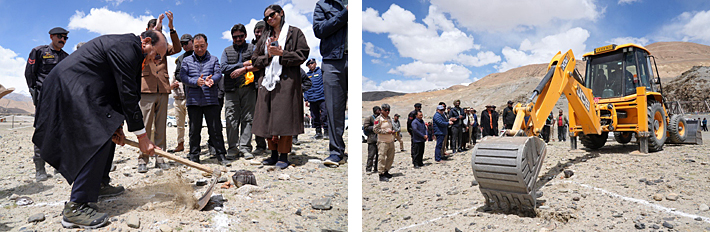
Home to only 24 households, Chumar lies close to the Line of Actual Control (LAC) and is among the country's most remote border settlements. Most residents depend on Pashmina-goat rearing, which remains the backbone of the local economy. Though small in size, the village sits at the centre of a broader effort to strengthen habitation in frontier regions that have witnessed migration due to harsh weather, difficult terrain and limited economic opportunities.
The project will also focus on infrastructure development, livelihood generation, tourism promotion and support for local economic activities
According to the Ladakh administration, all 24 households in the village will receive climate-resilient homes with thermally insulated walls designed to withstand the region's extreme weather conditions. Each house will also include an additional room that can be used as a homestay, creating an additional source of income for local families. Officials have said the houses are expected to be completed by September 2026, subject to weather conditions. The project will also focus on infrastructure development, livelihood generation, tourism promotion and support for local economic activities, including Pashmina production and traditional handicrafts.
The Vibrant Village Programme was launched by the Centre in 2023 amid growing concerns over migration from remote frontier settlements, where access to services, employment opportunities and connectivity often remains limited. For years, border development was largely viewed through the lens of roads, bridges and strategic infrastructure. Increasingly, however, attention has shifted towards ensuring that remote settlements remain inhabited and economically viable. That is what makes Chumar significant, with the village expected to serve as a pilot for similar projects planned elsewhere in Ladakh.
Increasingly, however, attention has shifted towards ensuring that remote settlements remain inhabited and economically viable
As work begins on India's first Model Border Village, the focus will be not only on the homes being built but also on whether better infrastructure and livelihood opportunities can help sustain communities in some of the country's most challenging border regions. For the Ladakh administration, the project is as much about creating opportunities as it is about creating infrastructure. The bigger challenge will be whether such initiatives can help slow migration from remote frontier settlements and ensure that villages along some of India's most strategically important borders remain inhabited in the years ahead.
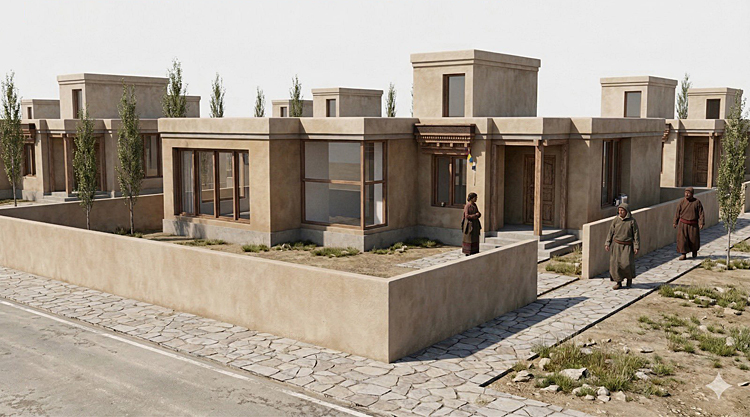
It is good that India is getting focused on sustaining civilian populations in border areas, considering development in such regions must go beyond roads and physical infrastructure, although we are in the 79th year since Independence. But is this enough? Have we forgotten that in 2013, a People's Liberation Army (PLA) patrol intruded into the Depsang Plains at 'Y' Junction on Raki Nala, and remained in situ even before, during and after the visit of Chinese Premier Li Keqiang to India from May 19 to 22? This PLA patrol withdrew only after forcing India to dismantle surveillance cameras/equipment from Chumar which was 150 km southeast from the intrusion area. It is high time that we move beyond improving border villages to stop migration and providing livelihoods by way of homestays.
China's border villages (Xiaokang or 'well-off' villages) along the Line of Actual Control (LAC) serve as dual-use infrastructure
China's border villages (Xiaokang, or "well-off" villages) along the Line of Actual Control (LAC) serve as dual-use infrastructure, built to bolster territorial claims. These settlements usually incorporate People's Liberation Army (PLA) facilities, air defence (AD) components, and electronic warfare (EW) capabilities. Though designed to house civilians and demographically secure the Tibet Autonomous Region (TAR), these villages feature hardened facilities and staging grounds that can accommodate military forces during a conflict. Under China's Land Borders Law, residents are formally expected to assist the PLA and the Chinese People's Armed Police (PAP) in securing borders. The CCP usually settles retired PLA veterans in these villages, using them as an organised, loyal civilian militia.
India needs to draw lessons from this and incorporate suitable measures into our Model Border Villages under the Vibrant Villages Programme
Satellite and defence analyses identify Chinese dual-use villages as containing military outposts, satellite communications facilities, and heavy-truck parking areas within or directly adjacent to these enclaves. These outposts are nodes for electronic warfare, communication jamming and short-range air-defence capabilities, acting as force multipliers for frontline troops. We need to draw lessons from this and incorporate suitable measures into our Model Border Villages under the Vibrant Villages Programme. We also need to increase the pace of developing Model Border Villages, including using 3D construction (wherever feasible), considering the expanse of our borders with the TAR.