






The insightful articles, inspiring narrations and analytical perspectives presented by the Editorial Team, establish an alluring connect with the reader. My compliments and best wishes to SP Guide Publications.

"Over the past 60 years, the growth of SP Guide Publications has mirrored the rising stature of Indian Navy. Its well-researched and informative magazines on Defence and Aerospace sector have served to shape an educated opinion of our military personnel, policy makers and the public alike. I wish SP's Publication team continued success, fair winds and following seas in all future endeavour!"

Since, its inception in 1964, SP Guide Publications has consistently demonstrated commitment to high-quality journalism in the aerospace and defence sectors, earning a well-deserved reputation as Asia's largest media house in this domain. I wish SP Guide Publications continued success in its pursuit of excellence.
The rapid evolution of subsea warfare technologies underscores their growing strategic importance in protecting critical maritime infrastructure, strengthening naval capabilities and shaping the future of underwater security and defence
 |
The Author is Former Director General of Information Systems and A Special Forces Veteran, Indian Army |
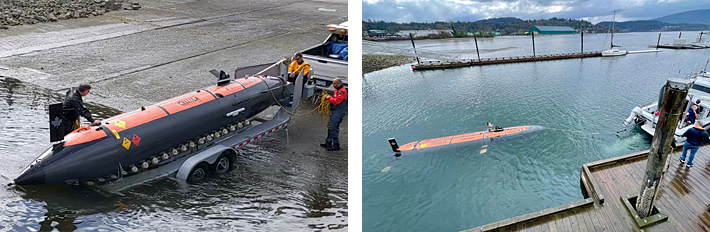
Subsea technologies are playing a major in advanced, multi-domain frontier - Seabed Warfare. These technologies focus heavily on protecting or sabotaging critical underwater infrastructure, deploying intelligent autonomous networks, and leveraging deep-sea geography for stealth and strategic denial. With 95-98 per cent global internet traffic and vital energy pipelines on the ocean floor, safeguarding these assets is a paramount national security priority – exemplified by the Straits of Hormuz.
Countries are deploying:
Canada has a hydrogen submarine drone that can silently watch a cable or pipeline in the seabed continuously for 16 days, with no ship overhead to give it away, according to news reports of June 8, 2026. Anything that runs on a battery eventually has to stop and charge, and the robots sent to the bottom of the ocean are no exception. The usual fix is to send a crewed ship out to winch it up every few days, swap or recharge its batteries, and drop it back over the side. According to 'Infinity Fuel Cell and Hydrogen', the Connecticut company that built the power system, a support vessel the drone can cost as much as USD 1,00,000 per day. Compare this to Canada's hydrogen submarine drone that stayed continuously underwater for 385 hours and covered over 2,023 km on a single hydrogen fuel cell without surfacing – the world's first.
With 95-98 per cent global internet traffic and vital energy pipelines on the ocean floor, safeguarding these assets is a paramount national security priority
The hydrogen submarine drone called 'Envoy' has been developed by the Burnaby-based company 'Cellula Robotics' in British Columbia. On April 21, 2026, the company said the Envoy's run exceeded the Envoy's published performance specification. The Envoy's published numbers for the hydrogen version put it at 2,000 km range and 370 hours of endurance, roughly 15 days, but the mission ran 2,023 km and 385 hours – exceeding the figures given in the brochure.
Cellula Robotics sells the same Envoy hull with a lithium-ion battery pack instead of a fuel cell, which makes the comparison clean. The battery version is rated for up to 168 hours and about 930 km. The hydrogen version is rated for more than double that on both counts. The reason boils down to energy density. Hydrogen carries far more usable energy per kg than a lithium-ion cell, and that advantage matters enormously when the mission is measured in weeks and the nearest plug is a ship floating 2,000 meters above you. Moreover, a drone that stays subsea for 16 days needs the ship for a launch and a recovery, not in between. Interestingly, the hydrogen cell power system came out of the work Cellula Robotic has been doing with NASA and the US Navy, including a regenerative fuel-cell system tested for potential lunar use.
Canada's hydrogen submarine drone stayed continuously underwater for 385 hours and covered over 2,023 km on a single hydrogen fuel cell without surfacing – the world's first
The Envoy is a survey tool with a 2,000-metre depth rating and a 500-litre payload bay that can carry synthetic-aperture sonar, multibeam echosounders, sub-bottom profilers, cameras, lasers, and magnetometers down to depths most crewed operations would rather avoid, mapping the seabed, surveying pipeline and cable routes, checking subsea infrastructure for damage, and supporting offshore wind.
India definitely needs assets like hydrogen submarine drones to stay ahead in the race, especially since New Delhi is planning a massive 2,000-km undersea gas pipeline connecting Gujarat to Oman, estimated to cost around ₹40,000 crore. This pipeline will be an ideal sabotage target for forces inimical to India, and guarding it will not be easy.
The hydrogen version is rated for more than double the battery version on both counts of endurance and range. The reason boils down to energy density.
According to news reports of April 12, 2026, US company Nuburu Inc and Italian firm SunCubes have signed an agreement to develop an underwater laser-based power transmission system capable of delivering energy wirelessly to autonomous underwater vehicles (AUVs) and other subsea systems, potentially transforming the way underwater assets are powered and operated. Headquartered in Centennial, Colorado, Nuburu Inc handles the development and design of its high-power industrial blue lasers and security technology. Milan-based SunCubes (founded in 2023) specialises in developing laser-based wireless power and data transmission stems.
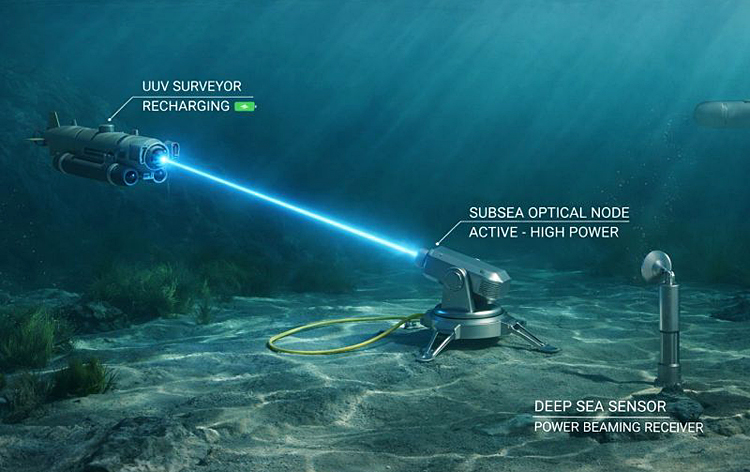
Further, a binding head of terms agreement focuses on the development and industrialisation of laser-based wireless power transmission, vehicle-mounted laser arm systems, and the 'DEEP LIGHT' underwater power platform. With this new deal, Nuburu Inc could soon deliver energy wirelessly to autonomous underwater vehicles.
India definitely needs assets like hydrogen submarine drones to stay ahead in the race, especially since New Delhi is planning a massive 2,000-km undersea gas pipeline connecting Gujarat to Oman
The 'DEEP LIGHT' platform is designed around a high-power laser transmitter and receiver architecture that enables contactless energy transfer underwater. The system seeks to transmit power over distances of several tens of metres using laser beams operating in the blue-green optical spectrum. This wavelength range is particularly important because blue and blue-green light experiences lower attenuation in water than many other wavelengths, allowing energy and data to travel more efficiently through underwater environments.
The collaboration highlights growing interest in underwater autonomy, subsea infrastructure protection, maritime security, and offshore energy applications. As navies increasingly deploy autonomous underwater systems, the need for reliable long-range power delivery and recharging solutions continues to grow. Success of the DEEP LIGHT platform will mark an important milestone in the development of next-generation underwater energy systems.
The 'DEEP LIGHT' platform is designed around a high-power laser transmitter and receiver architecture that enables contactless energy transfer underwater
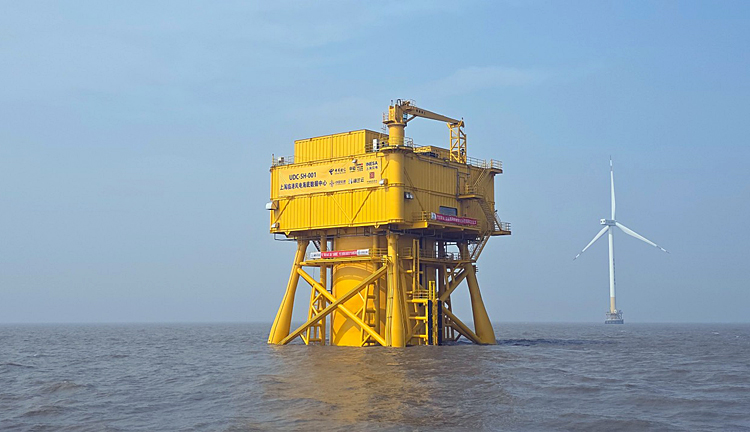
In May 2026, China commenced operations of the world's first underwater data centre off the coast of Shanghai, construction of the $226 million project having been completed in October 2025. The data centre is 35 meters beneath the sea off the coast of Shanghai's Lingang Special Area.
The 24MW facility housing nearly 2,000 servers is dedicated to AI, 5G, and big data. Powered directly by adjacent offshore wind farms. It achieves a highly efficient Power Usage Effectiveness (PUE) of under 1.15, significantly below the industry average. By placing servers in the stable, cold environment of the deep sea, operators can use the surrounding seawater as a massive passive heat sink. The slashes cooling-related electricity demand to less than 10 per cent, requires no freshwater, and reduces overall land occupation by more than 90 per cent compared to traditional land facilities.
China commenced operations of the world's first underwater data centre off the coast of Shanghai
In addition to the subsea data centre off the coast of Shanghai, China has established a Commercial Cluster off the coast of Lingshui County in Hainan Province. It consists of 1,300-ton underwater data cabins operating on the seafloor. This cluster is part of a larger plan to deploy up to 100 underwater cabins to support the region's marine-based economy.
In 2018 Microsoft had lowered a server capsule to the ocean floor off Scotland's coast. It did face some failures but not too many. However, in 2024 Microsoft shelved the entire project, possibly finding it too hard to handle.