





The insightful articles, inspiring narrations and analytical perspectives presented by the Editorial Team, establish an alluring connect with the reader. My compliments and best wishes to SP Guide Publications.
"Over the past 60 years, the growth of SP Guide Publications has mirrored the rising stature of Indian Navy. Its well-researched and informative magazines on Defence and Aerospace sector have served to shape an educated opinion of our military personnel, policy makers and the public alike. I wish SP's Publication team continued success, fair winds and following seas in all future endeavour!"

Since, its inception in 1964, SP Guide Publications has consistently demonstrated commitment to high-quality journalism in the aerospace and defence sectors, earning a well-deserved reputation as Asia's largest media house in this domain. I wish SP Guide Publications continued success in its pursuit of excellence.
India's indigenous programmes, including Ghatak, Abhimanyu and CATS Warrior, reflect the country's growing ambition to develop next-generation combat aircraft capable of operating alongside manned fighters in future network-centric battles
 |
The Author is Former Director General of Information Systems and A Special Forces Veteran, Indian Army |
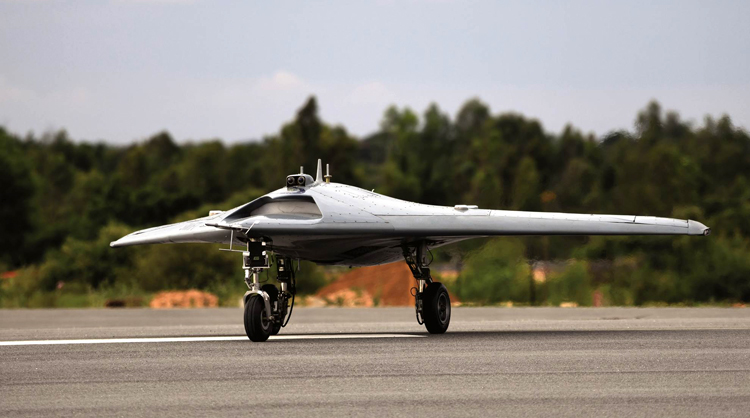
India's Ghatak Unmanned Combat Aerial Vehicle (UCAV) project, which began in 2009 as the Autonomous Unmanned Research Aircraft (AURA), transitioned to the series-procurement phase of Ghatak UCAVs in 2016, with the Defence Acquisition Council, headed by then Defence Minister Manohar Parrikar, clearing the procurement of 60 Ghatak UCAVs at an estimated cost of ₹39,000 crore. Ghatak is currently undergoing development and certification tied to the indigenous "dry" Kaveri engine. The Kaveri programme, started in the late 1980s to power the LCA Tejas fighter, failed to meet the requirements and was reoriented into a "dry" (non-afterburning) variant producing 48–52 kN of thrust.
The Aeronautical Development Agency (ADA) has successfully flight-tested Ghatak's technology demonstrator (SWiFT)
The Aeronautical Development Agency (ADA) has successfully flight-tested Ghatak's technology demonstrator (SWiFT), and the UCAV is expected to be fully mission-ready and inducted into the Indian Armed Forces within the next seven to eight years, with full induction of 60–80 Ghatak UCAVs by 2034.
The 13-tonne, jet-powered Ghatak, carrying 1.5-tonne precision-guided munitions, smart bombs and missiles, is equipped with advanced computers, AI-driven autonomous navigation, and collision-avoidance systems to operate independently in environments where GPS and communications are jammed. It can slip undetected through advanced integrated air-defence systems to neutralise enemy radars and missile batteries, flying as a loyal wingman alongside jets like Tejas Mk2. It can also conduct ISR operations, lingering at 30,000 ft to conduct extended reconnaissance missions in hostile territory.
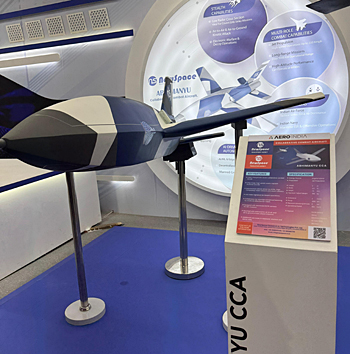
The Indian Navy's 'Abhimanyu' jet-powered loyal wingman drone, being developed as part of the Naval Collaborative Combat Air Vehicle (N-CCAV) Programme, is designed for manned-unmanned teaming (MUM-T) with carrier-based fighters such as the MiG-29K and Rafale M. Abhimanyu, designed to support multiple variants for electronic warfare, target decoy, surveillance and precision strikes, serves as a cost-effective and rapidly scalable force multiplier. It can withstand attrition-style warfare, protect human pilots while extending their sensor reach into contested airspace. The platform is in advanced testing and operational induction phase.
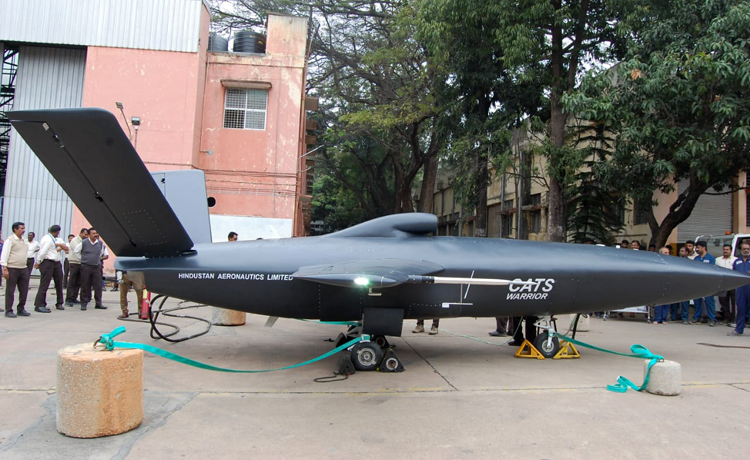
The Combat Air Teaming System (CATS) Warrior Project is an advanced, stealthy UCAV developed by Hindustan Aeronautics Limited (HAL). The full-scale demonstrator was built in a compressed 14-week timeline with the help of private-sector partners such as Tata Elxsi. The 2.2-tonne CATS Warrior is designed to act as an autonomous wingman for manned fighter aircraft such as the Tejas, Rafale and Su-30MKI. Controlled via a secure data link, the drone pairs with a mothership aircraft, allowing a human pilot in the cockpit to act as a mission commander, deploying the drone to execute the most dangerous tasks.
FUFA is envisioned as a high-performance combat aircraft capable of supersonic flight and advanced air combat operations
Key capabilities and features of CATS Warrior include:
CATS Warrior is part of a larger ecosystem that includes 'CATS Hunter', a reusable cruise missile; 'CATS ALFA' swarm munitions; and 'CATS Infinity' pseudo-satellites. To validate the CATS technology, HAL modified older aircraft (such as the Kiran jet trainer) as testbeds to evaluate data links and coordination with manned aircraft before the final UCAV takes to the skies.
Abhimanyu, designed to support multiple variants for electronic warfare, target decoy, surveillance and precision strikes, serves as a cost-effective and rapidly scalable force multiplier
Prototypes and scale models of CATS Warrior have been showcased at recent Aero India exhibitions, with extensive flight testing and system development pushing the initiative towards full integration into the Indian Air Force (IAF). The IAF has projected a potential requirement for up to 100 of these indigenous combat drones.
HAL is also working on a larger and more capable five-tonne-class CATS Warrior-2, which is expected to carry larger payloads, possess greater endurance, and undertake more complex combat missions alongside frontline fighters. In parallel, DRDO is pursuing another ambitious concept called the Future Unmanned Fighter Aircraft (FUFA). Unlike the subsonic Ghatak or traditional loyal-wingman drones, FUFA is envisioned as a high-performance combat aircraft capable of supersonic flight and advanced air-combat operations. Designed for non-contact warfare, it weighs roughly 15 tonnes, features internal weapon bays for stealth, and focuses on suppression of enemy air defences (SEAD) and air dominance. The first flight is targeted for around 2030, with formal induction into the IAF anticipated by 2035.
The 2.2-tonne CATS Warrior is designed to act as an autonomous wingman for manned fighter aircraft
It was covered in these columns earlier that China and the UK are rapidly advancing AI-enabled and autonomous airpower capabilities. China has converted J-6 aircraft into robot drones and J-7 aircraft into UCAVs. Britain is accelerating plans to establish an Artificial Intelligence (AI) Air Force. The Royal Air Force aims to integrate automated systems by 2030, one element of which is collaborative combat aircraft (CCA) or robot fighter jets. The US Air Force (USAF) has utilised modified F-16 Fighting Falcon aircraft (designated QF-16) for target practice. Iran has developed numerous drones, some of which utilise design principles from older conventional aircraft.
Militaries are moving at a fast pace towards autonomous collaborative platforms, but crewed combat air platforms will remain at the heart of air power in the foreseeable future, particularly in airborne air defence to counter enemy aircraft. At the same time, autonomous collaborative platforms provide mass and capability across a range of tasks, including air defence, strike and electromagnetic attacks. Elon Musk denounced the F-35 stealth fighter programme, saying it is destined to lose against drones. But future air power consisting completely of autonomous or remotely controlled drones is unlikely.
Production, induction and convergence of the above systems should be given top priority
India is on the right track in developing the Ghatak UCAV, Abhimanyu jet-powered loyal wingman, CATS Warrior and the FUFA project, giving a major leap in indigenous unmanned aviation technology. The convergence of these programmes would drive the reassessment of future force-structure requirements. One fighter squadron of the IAF could be supported by several loyal wingman platforms, dramatically increasing the number of sensors, weapons and electronic warfare assets available during combat operations, allowing generation of greater combat mass without proportionally increasing pilot requirements or operational risk.
Indian policy makers, the IAF and the Navy need to decide on the future force structures; the mix of manned, unmanned and collaborative combat aircraft. Production, induction and convergence of the above systems should be given top priority.