





The insightful articles, inspiring narrations and analytical perspectives presented by the Editorial Team, establish an alluring connect with the reader. My compliments and best wishes to SP Guide Publications.

"Over the past 60 years, the growth of SP Guide Publications has mirrored the rising stature of Indian Navy. Its well-researched and informative magazines on Defence and Aerospace sector have served to shape an educated opinion of our military personnel, policy makers and the public alike. I wish SP's Publication team continued success, fair winds and following seas in all future endeavour!"

Since, its inception in 1964, SP Guide Publications has consistently demonstrated commitment to high-quality journalism in the aerospace and defence sectors, earning a well-deserved reputation as Asia's largest media house in this domain. I wish SP Guide Publications continued success in its pursuit of excellence.
Growing regional competition is reinforcing the strategic importance of strengthening the nation's space capabilities
 |
The Author is Former Director General of Information Systems and A Special Forces Veteran, Indian Army |
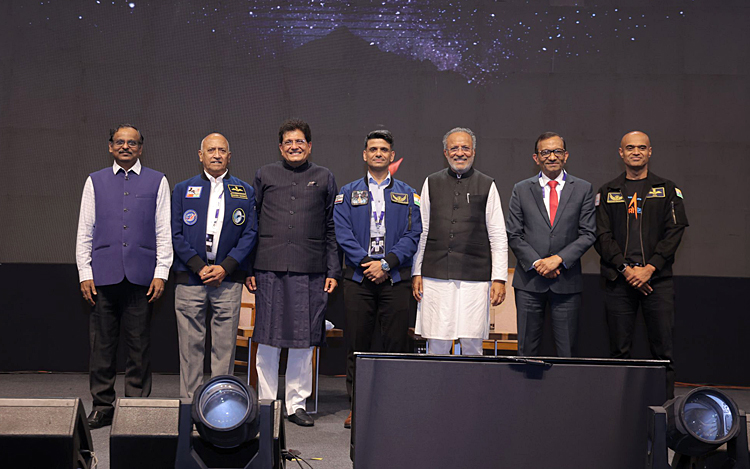
Speaking at the 10th Industry Connect event organised by IN-SPACe in Ahmedabad on June 11, 2026, V. Narayanan, Chairman of the Indian Space Research Organisation (ISRO), said that India will need to launch more than 200 satellites in the next three years to meet growing national and commercial requirements. Calling for deeper participation from private industry, startups and academia in the space sector, he said: "Currently, we have 56 satellites in orbit. But we require more than 200 satellites in another three years for the country. ISRO alone cannot do this. The entire space ecosystem has to work towards that. There are many opportunities." He said ISRO is increasingly positioning itself as an enabler for the broader ecosystem rather than working in isolation, noting that India's space start-up ecosystem has expanded significantly following sectoral reforms, with more than 400 startups operating in the domain.
IN-SPACe signed an agreement with the Tamil Nadu Government for developing the Common Technical Facility at the upcoming Space Vehicles Cluster at SIPCOT Allikulam for manufacturing, testing and integration of launch-vehicle systems. The facility is for shared use by industries operating within the cluster, reinforcing a Centre–State partnership model aimed at scaling India's space-manufacturing capabilities.
India will need to launch over 200 satellites in the next three years to meet growing national and commercial requirements
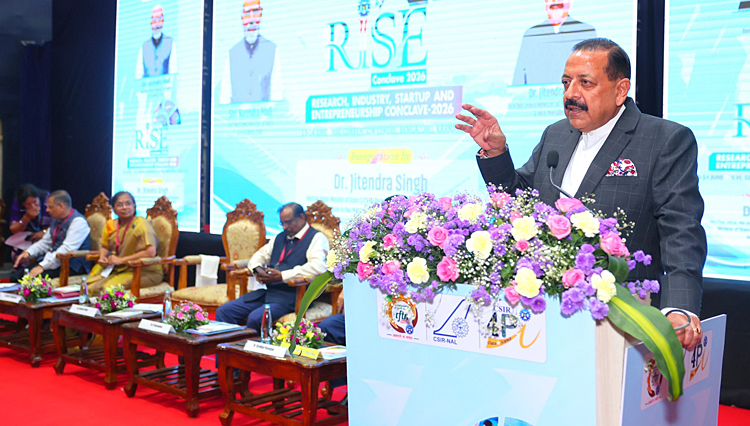
India suffered consecutive PSLV launch failures on January 12, 2026 (PSLV-C62), and May 17, 2025 (PSLV-C61), which was a major setback for ISRO. Speaking at the RISE Conclave in Bengaluru on June 6, 2026, Union Minister of State for Science, Technology and Space, Jitendra Singh, said that the national-level expert committee had submitted its report and that the cause of the anomaly had been detected and successfully resolved. With the issues rectified and the necessary certifications in place, ISRO is preparing to resume its ambitious launch schedule.
India will soon test-fly a full-scale model of the indigenous High-Altitude Pseudo-Satellite for surveillance, according to news reports dated June 7, 2026. The High-Altitude Platform System (HAPS), developed by the National Aerospace Laboratories (NAL), will be able to fly up to 75,000 ft and stay airborne for at least 90 days. Its wingspan will be as wide as that of a Boeing 737 commercial aircraft. The first test flight of HAPS is likely to take place soon, enabling longer-duration surveillance from an aerial platform over geographical locations. NAL is India's dedicated research institute for civil aerospace applications under the Council of Scientific and Industrial Research (CSIR).
HAPS offer a cost-effective alternative to satellites for surveillance, telecommunication, and environmental monitoring
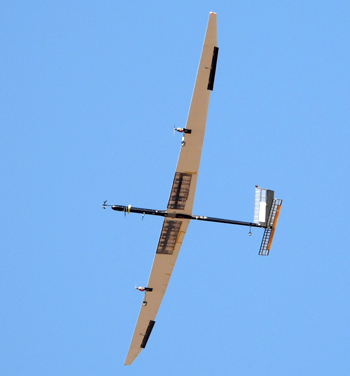
A scaled-down model of HAPS has already been test-flown by NAL to an altitude of 7.5 km with an endurance of more than 10 hours. The full-scale platform is being designed to operate at an altitude of 23 km (more than 75,000 ft) and stay airborne for at least 90 days. In order to study flight performance and endurance, NAL undertook the first flight of the scaled-down prototype in 2024, a five-metre-long, solar-powered platform with a wingspan of 11 metres and weighing 23 kg. The full-scale model will have a wingspan of 33 metres.
HAPS are like drones, except that they are expected to operate in the stratosphere—well above where commercial aircraft fly—and can be powered by solar cells and a battery system to hover for days on end. A fully operational HAPS can be used for a variety of applications, from surveillance to beaming 5G signals. They can also double as towers in the sky and offer greater flexibility than satellites by being able to map a specific area from above.
Bellatrix Aerospace has signed a Memorandum of Understanding (MoU) with South Korea's TelePIX Company Limited
HAPS offer a cost-effective alternative to satellites for surveillance, telecommunications and environmental monitoring, opening a new frontier for India's aerospace sector. According to the European Space Agency (ESA), such a pseudo-satellite is an uncrewed aerial platform that watches over the Earth from the stratosphere, operating like a satellite but from much closer to Earth. ESA describes HAPS as the "missing link" between drones flying close to Earth's surface and satellites orbiting in space.
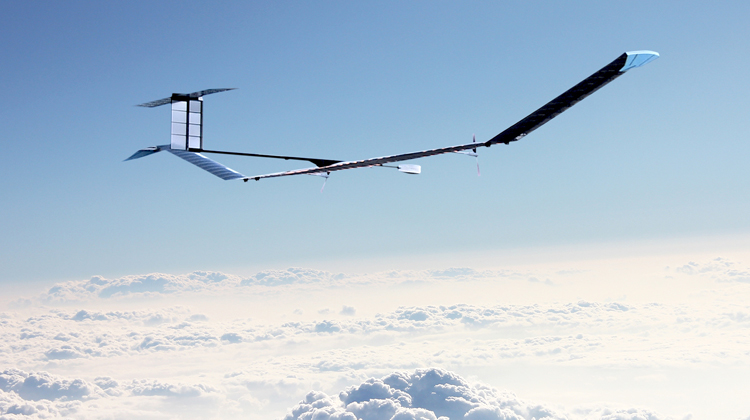
Only a few global players, including the US, the UK, Germany, South Korea, New Zealand and Japan, are investing in similar technologies, and India's entry into this domain demonstrates its growing scientific capabilities. Airbus conducted stratospheric flight tests of its 'Zephyr' HAPS in Arizona, US, with a 26-day flight in July 2018 and a 64-day flight in the summer of 2022. Zephyr can provide very high-resolution imagery and near-real-time video from the stratosphere.
NAL's HAPS can also find use in the Indian Armed Forces
NAL aims to design and build the HAPS' propellers, battery-management system, carbon-composite airframe, flight-control system and high-powered electric motors capable of withstanding extreme temperature ranges. NAL's HAPS can also find application with the Indian Armed Forces, as current drone platforms are not designed to reach such high altitudes, while launching surveillance satellites is complex, time-consuming and expensive.
According to another media report dated June 1, 2026, Bengaluru-based deep-tech space start-up Bellatrix Aerospace has signed a Memorandum of Understanding (MoU) with South Korea's TelePIX Company Limited, a space AI solutions firm, to collaborate on a next-generation Very Low Earth Orbit (VLEO) satellite demonstration. The MoU was signed in the city of Daejeon, South Korea. VLEO satellites, operating closer to the Earth, unlock game-changing improvements in optical-imaging resolution compared with conventional Low Earth Orbit (LEO) systems.
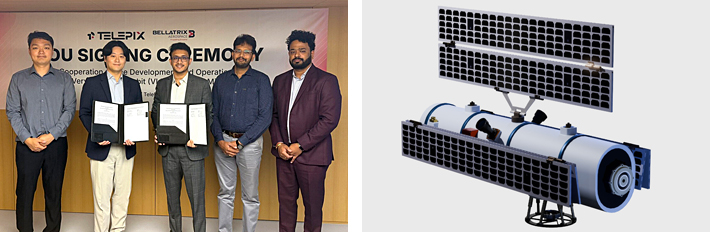
Bellatrix Aerospace thanked TelePIX Company Limited, IN-SPACe (India) and the Korea AeroSpace Administration for organising the India-Korea Space Industry Meet, which led to the signing of the MoU. Bellatrix Aerospace is targeting a demonstration launch of its VLEO satellite in 2028, with sights set on future constellation-scale deployments and expanded commercial missions.
This development also signals India's entry into the next phase of strategic warfare, where survivability is as critical as range and payload
There is concern in media over China's grant of military-grade BeiDou navigation access to Pakistan since 2018 (centimetre-level positioning for Pakistani missiles/aircraft/ships), Chinese assistance to Pakistan during Operation 'Sindoor', five of Pakistan's recent satellites rode on Chinese launchers, making Rawalpindi part of the larger Chinese architecture. All these satellites are focused on India. Significantly, Pakistan's satellites, Commander of Defence Forces (CDF) and the rocket force together enable compressing the sensor-decision-shooter chain into hours compared to India's decision-making cycle taking days. Indian policy makers and the military are obviously aware of all these developments. But can the political authority focus on this and the Armed Forces stop internal bickering over an Integrated Rocket Force, which the bureaucrats preside over and enjoy?
The latest is that Reliance Jio is planning its own LEO satellite constellation (1,600-1,650 satellites) within next 2-3 years to provide broadband and direct-to-device connectivity services. Such indigenisation should have happened 10-years back instead of adopting Starlink to appease the US.
Finally, Bundeswehr General Michael Traut has warned that Russia could be developing technology to place a nuclear device in orbit that could destroy a third of NATO satellites. But if that be true, are the other P5 sitting idle?