






The insightful articles, inspiring narrations and analytical perspectives presented by the Editorial Team, establish an alluring connect with the reader. My compliments and best wishes to SP Guide Publications.

"Over the past 60 years, the growth of SP Guide Publications has mirrored the rising stature of Indian Navy. Its well-researched and informative magazines on Defence and Aerospace sector have served to shape an educated opinion of our military personnel, policy makers and the public alike. I wish SP's Publication team continued success, fair winds and following seas in all future endeavour!"

Since, its inception in 1964, SP Guide Publications has consistently demonstrated commitment to high-quality journalism in the aerospace and defence sectors, earning a well-deserved reputation as Asia's largest media house in this domain. I wish SP Guide Publications continued success in its pursuit of excellence.
Major powers are advancing directed-energy capabilities in orbit, while Israel's emerging space-laser ambitions add urgency to India's need for next-generation orbital defence.
 |
The Author is Former Director General of Information Systems and A Special Forces Veteran, Indian Army |
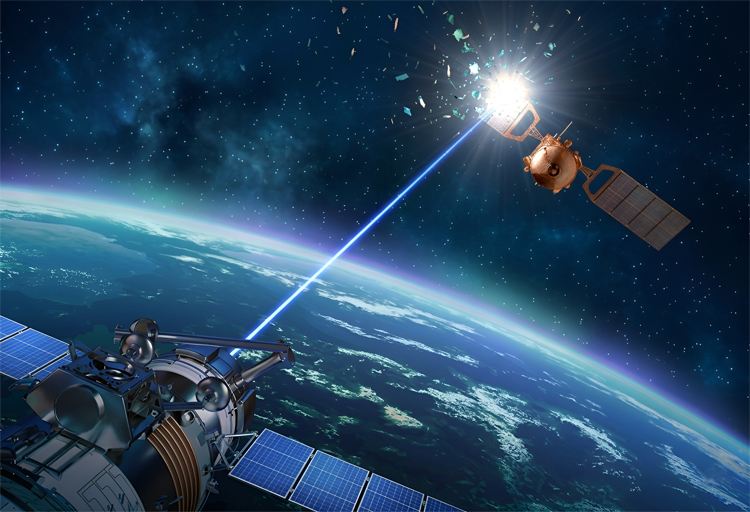
Major global powers, specifically the US, China and Russia, are actively researching and developing space-based directed-energy and anti-satellite laser capabilities. These nations are expanding upon decades of research into space weaponisation to intercept ballistic missiles, neutralise adversary satellites, and manage orbital debris. Reports and assessments indicate that both countries have the technology and experience required to target satellites using laser interference and kinetic-strike mechanisms.
The US has invested heavily in Directed Energy Weapons (DEWs) for decades, including past initiatives like the Airborne Laser and ongoing investments in space-based tracking and relay systems to support potential orbital defence applications. Chinese military and academic researchers have extensively studied and published theoretical plans on how to disable or destroy Starlink satellites, including the use of space-based laser weapons and submarine-based lasers. However, these have remained in the conceptual and simulation phase. Beijing's concern is that the large-scale satellite constellation could be utilised by the US for intelligence and military communications.
US, China and Russia are advancing research into space-based directed-energy and anti-satellite capabilities, with lasers being explored for orbital defence and counter-space missions.
On June 27, 2026, Israel Katz, Israel's Defence Minister, announced that Israel is developing space-based laser technology. "As of today, no country has the ability to mount attacks in space. We must be the leading country in the world with this capability," said Katz. Aiming to establish a global first in offensive and defensive orbital capabilities, the project serves as a strategic deterrent against adversaries like Iran. The initiative extends Israel's advancements in directed-energy weapons.
The upcoming space project builds heavily on Israel's existing directed-energy infrastructure. Key milestones and operational components include the Iron Beam. Israel has already delivered its ground-based Iron Beam system to its Armed Forces. This system destroys short-range rockets, mortars, and drones using high-energy focused laser pulses. In addition, Israel has successfully completed joint operational tests, integrating the Iron Beam with the Iron Dome air defence system to handle concentrated saturation salvos. The goal of the newly announced orbital initiative is to mount offensive and defensive systems in space, capable of neutralising ballistic missiles, hypersonic threats, and hostile satellites.
Israel has announced an ambition to develop space-based laser capabilities, building on its ground-based Iron Beam directed-energy programme and broader missile-defence infrastructure.
Briefing the military reporters, Katz said, "One of the central goals that the Prime Minister and I set is that we are recruiting the best minds. As of today, no country has the ability to mount attacks in space. We must be the leading country in the world with this capability. If we achieve this, it will ensure the advantage of deterrence, the ability to attack and destroy, and all of the other matters, versus our enemies with large resources".
On June 25, Katz had said Israel was committed to becoming the leading player with capabilities to attack from space. During the briefing, Katz was apparently referring to Iran. Notably, during the war with Iran this year, Israel struck multiple Iranian facilities related to the space war, including those that were developing capabilities to attack satellites in space, according to a media report.
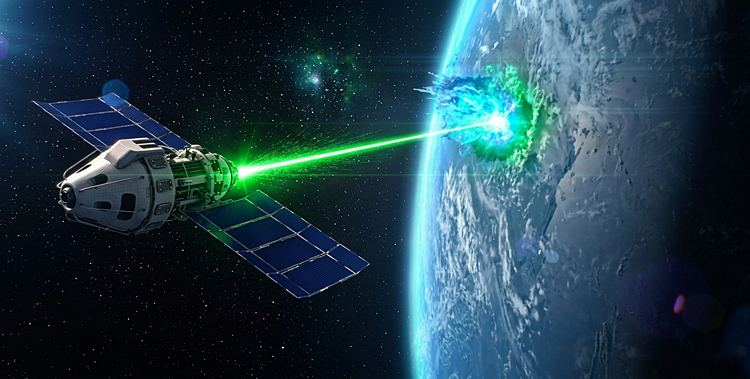
However, it remains unclear whether Katz seeks to deter Russia and China from assisting Iran in the space race and other matters. His statement that no other country has these capabilities was not entirely accurate, because both Russia and China have performed attacks on their own satellites and convincingly destroyed their test targets. Lasers could potentially destroy enemy satellites and incinerate debris caused by attacks in space, according to reports in foreign media. There has been speculation that Israel has the capability to destroy enemy satellites using the Arrow 3 missile system, which currently can strike ballistic missiles in space.
India's defence cooperation with Israel includes laser technology, with Israeli expertise being considered for India's layered air-defence ambitions and advanced directed-energy systems.
With Russia and China having experience in dealing with space debris, many countries are working on other techniques, such as paralysing, damaging, jamming, dragging, or using lasers against satellites in space. Israel's apprehension is that if Iran or other enemies were to get ahead of Israel in the space race, they could attack Israel's satellites and reduce its surveillance capabilities. Israel has over a dozen active satellites in orbit, with at least eight to nine specifically dedicated to military surveillance and reconnaissance. Technology developed by Israeli defence contractors, such as Israel Aerospace Industries and Rafael Advanced Defence Systems, support over 100 satellites worldwide.
The India-Israel Defence Agreement is a 'Special Strategic Partnership' built on a core MoU for the joint development and co-production of advanced military technologies. The framework emphasises AI-enabled security solutions, cyber defence, and missile systems. The agreement explicitly includes laser technology. India is specifically eyeing Israel's cutting-edge DEWS, like the Iron Beam laser system, to build a multi-layered air defence shield capable of instantly neutralising drones and missiles.
The article argues that India's Mission Sudarshan Chakra should incorporate space-based lasers as part of a broader indigenous response to China's growing counter-space capabilities.
India's Mission Sudarshan Chakra is slated for full operational completion by 2035. While the program aims for heavy indigenous production by the DRDO and private Indian firms, it is directly inspired by and heavily draws upon Israeli technology. The system is fundamentally modelled on Israel's Iron Dome and potentially Iron Beam, with a focus on integrating Integrated Air and Missile Defence (IAMD) technologies. Bilateral talks and strategic partnerships focus on Israeli cooperation to provide advanced systems, radar engineering, AI drone integration, and joint production capabilities to help secure the shield.
Finally, with the India-Israel defence agreement framework grounded in a formalised technology-intensive partnership, and both nations focused on manufacturing next-generation defence systems in India, aligning with the Atmanirbhar Bharat (self-reliant India) initiative, India's Mission Sudarshan Chakra must include space-based lasers. Offensive and defensive orbital capabilities for India are essential given China's progress in this field.