






The insightful articles, inspiring narrations and analytical perspectives presented by the Editorial Team, establish an alluring connect with the reader. My compliments and best wishes to SP Guide Publications.

"Over the past 60 years, the growth of SP Guide Publications has mirrored the rising stature of Indian Navy. Its well-researched and informative magazines on Defence and Aerospace sector have served to shape an educated opinion of our military personnel, policy makers and the public alike. I wish SP's Publication team continued success, fair winds and following seas in all future endeavour!"

Since, its inception in 1964, SP Guide Publications has consistently demonstrated commitment to high-quality journalism in the aerospace and defence sectors, earning a well-deserved reputation as Asia's largest media house in this domain. I wish SP Guide Publications continued success in its pursuit of excellence.
The Indian Army's proposed Baaz Battalions aim to strengthen drone-enabled surveillance, ISR and battlefield awareness while accelerating its wider transformation for future warfare.
 |
The Author is Former Director General of Information Systems and A Special Forces Veteran, Indian Army |
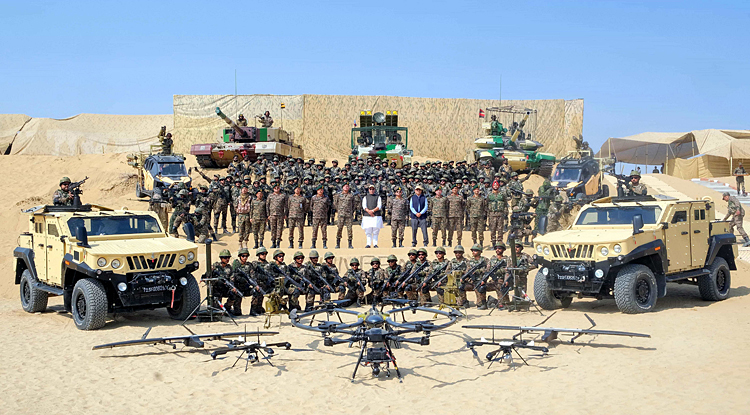
According to news reports of July 3, 2026, quoting unnamed sources, the Indian Army is raising 'Baaz Battalions' that will provide frontline units with advanced aerial surveillance and surveillance tools. These battalions will strengthen border monitoring drone-warfare preparedness, operational readiness along sensitive frontiers and coordination between frontline units and intelligence systems.
The outgoing Army Chief, General Upendra Dwivedi, had said that Baaz Battalions will build upon existing remotely piloted aircraft (RPA) flights; RPA is a type of unmanned aerial vehicle (UAV) that does not carry a human pilot on board but is actively flown from a remote pilot station. According to the report, these battalions will comprise a special pool of trained personnel to operate and manage RPA systems. The initiative is aimed at enhancing intelligence, surveillance and reconnaissance (ISR) capabilities through integrated aerial surveillance, persistent battlefield awareness and rapid response, while contributing to a more technology-enabled and future-ready Indian Army. These Baaz Battalions are likely to be placed under the Army Aviation Corps.
The proposed Baaz Battalions will create a specialised pool of trained personnel to operate and manage RPA systems, strengthening the Army's ISR and persistent battlefield surveillance capabilities.
The Army took this initiative after drawing lessons from the recent conflicts, especially the NATO war on Russia, using Ukraine as NATO's proxy, standoffs along the Line of Actual Control (LAC) with China, and Operation 'Sindoor' with Pakistan, where drone capabilities proved crucial. On drones becoming an integral part of any battlefield, Gen Dwivedi had said: "About two years ago, the Indian Army possessed only a few hundred drones. Today, that number has gone up significantly and now stands beyond 50,000. Based on our current roadmap and operational requirements, we expect this strength to grow further over the next few years and potentially double within the next two to three years."
During the 2025 Chanakya Defence Dialogue, then Army Chief General Upendra Dwivedi announced a three-phase plan to transform the Indian Army into an integrated, AI-driven, network-enabled, future-ready force by 2047. Aligned with the government vision of Viksit Bharat 2047: Phase 1 (until 2032) - accelerate transitions in capability development, force structure, and operational readiness; Phase 2 (until 2037) – consolidate gains achieved in the first phase; Phase 3 (until 2047) – leap to a fully integrated force designed for next-generation warfare. He emphasised: self-reliance – in defence manufacturing, space capability, and technology absorption; innovation – enterprise-level impact in AI, cyber, quantum, and autonomous systems; adaptation to the larger ecosystem; integration - deeper military-civil fusion, promoting synergy among academia, industry, and the Armed Forces. It appears that, combined Phases 1 and 2 (until 2037) cover transitions in capability development, force structure, and operational readiness – extended period of what the Army calls a Decade of Transformation.
The initiative builds on lessons from recent conflicts and border confrontations, where drones have become increasingly important to battlefield awareness, operational readiness and combat effectiveness.
But what happens in the intervening period if war is thrust upon us? We must acknowledge that China is our primary enemy, notwithstanding that it has drawn Pakistan, Nepal, Bangladesh and Sri Lanka into its strategic sphere. Pakistan and Bangladesh may act as Chinese proxies, but we must acknowledge that China is and will remain our primary enemy, laying claim to large chunks of Indian territory. This includes 90,000 sq km of Arunachal Pradesh.
Militaries alone cannot cope with the new multifaceted threats that have emerged with globalisation. India's national security concerns demand that all interests and all institutions of national power are brought to work and synergised to provide a Comprehensive National Power (CNP) response through Effect-Based Operations (EBOs). The hybrid conundrum includes: conventional warfare; cyber warfare; political warfare; irregular warfare; asymmetric and no-contact warfare; information warfare; psychological operations; terror, sabotage, subversion and criminality with advanced technologies. India ranks 14th in the Global Terrorism Index 2025.
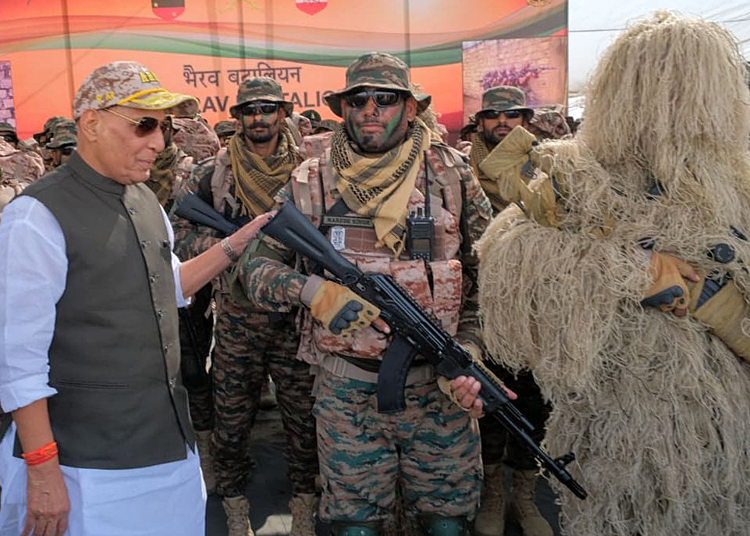
The Baaz Battalions form part of a wider Indian Army transformation alongside Rudra Brigades, Bhairav Light Commando Battalions and Shaktibaan Artillery Regiments.
Last year, the banned Meitei Insurgent group People's Liberation Army of Manipur (PLA-Manipur) released a video clip of its drone attack on a 3 Assam Rifles (AR) Mobile Unit, using drones to drop bombs in Kamjong District of Manipur (Operation 'LANG-OL'), in which four AR personnel, including a JCO, were injured. According to sources, the drone attack was well-planned and was in retaliation to a drone attack on a PLA camp a few days back. It shows the challenges for ground forces in new age warfare. At present, the Army is not fully ready to counter drone terrorism, according to a former Northern Army Commander.
UAVs, as part of drone warfare, till now have been generally exploited at the tactical level, that too in an ad hoc manner by dual-tasking personnel within existing units. This approach works well with low-end drones used as an additional weapon by frontline small subunits for combat. However, high-technology drones require specialised training and dedicated organisations. The Indian Army is set to correct this anomaly.
Successful implementation will depend on speed of execution, jointness and integration, advanced-technology adoption, specialised training and high levels of operational readiness.
As part of its transformation for future wars, the Indian Army has or is in the process of establishing 'Rudra Brigades', 'Bhairav Light Commando Battalions', 'Shaktibaan Artillery Regiments', and now 'Baaz Battalions'. The ultimate success of all this will be the speed of execution, jointness or integration (within the Indian Army and with the Navy and the IAF as applicable), adaptation of advanced technology, superior training and extraordinary levels of operational readiness, catering to the mounting threats to India's security.