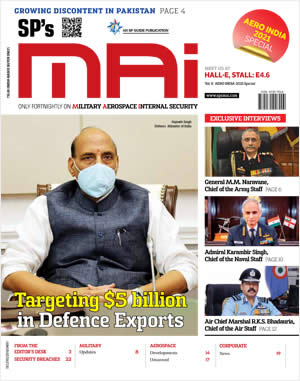





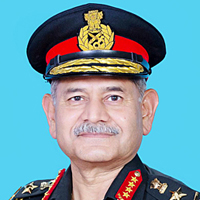
The insightful articles, inspiring narrations and analytical perspectives presented by the Editorial Team, establish an alluring connect with the reader. My compliments and best wishes to SP Guide Publications.
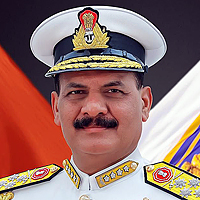
"Over the past 60 years, the growth of SP Guide Publications has mirrored the rising stature of Indian Navy. Its well-researched and informative magazines on Defence and Aerospace sector have served to shape an educated opinion of our military personnel, policy makers and the public alike. I wish SP's Publication team continued success, fair winds and following seas in all future endeavour!"

Since, its inception in 1964, SP Guide Publications has consistently demonstrated commitment to high-quality journalism in the aerospace and defence sectors, earning a well-deserved reputation as Asia's largest media house in this domain. I wish SP Guide Publications continued success in its pursuit of excellence.
India and Japan are broadening their strategic partnership beyond trade, with economic security, advanced technology, defence, energy resilience and supply-chain cooperation taking centre stage.
 |
The Author is Former Director General of Information Systems and A Special Forces Veteran, Indian Army |
Indo-Japanese relations are ancient. Buddhism originated in India in the 6th century BCE, travelling through Central Asia and China over the next thousand years. Buddhism was formally introduced in Japan in the mid-6th century CE through South Korea. However, prominent monks from India also travelled directly to Japan; most notable was Bodhisena, an 8th-century Indian monk who arrived in 736 CE, and famously performed the 'eye-opening' ceremony for the Great Buddha at the Todai-ji Temple.
India and Japan unveiled a 16-point roadmap to deepen their Special Strategic and Global Partnership, with economic security, AI and energy resilience emerging as key priorities.
India's Justice Radhabinod Pal, member of the International Military Tribunal for the Far East (the Tokyo War Crimes Trials) following World War II, had dissented in the 11-judge panel; concluding that all the Japanese defendants were not guilty – arguing that the tribunal was a tool for retribution by the victors and a sham employment of the legal process. He also argued that the tribunal ignored Allied war crimes, particularly the atomic bombings of Hiroshima and Nagasaki.
Ashes of Netaji Subhas Chandra Bose are preserved at the Renko-ji Temple in Suginami, Tokyo. Official Japanese and British government inquiries concluded Netaji died in a 1945 plane crash in Taiwan and his remains were subsequently brought to Tokyo. Indian prime ministers, including Prime Minister A.B. Vajpayee, have visited the temple, where an annual ceremony is held on August 18. Some members of Netaji Bose's family, including his daughter Anita Bose Pfaff, have been calling for DNA testing of the ashes, but India's internal politics prevented such action, especially since a positive DNA identification will debunk years of political spin-doctoring.
Five priority sectors—semiconductors, critical minerals, ICT, AI and energy security—will form the core of expanded economic and technological cooperation.
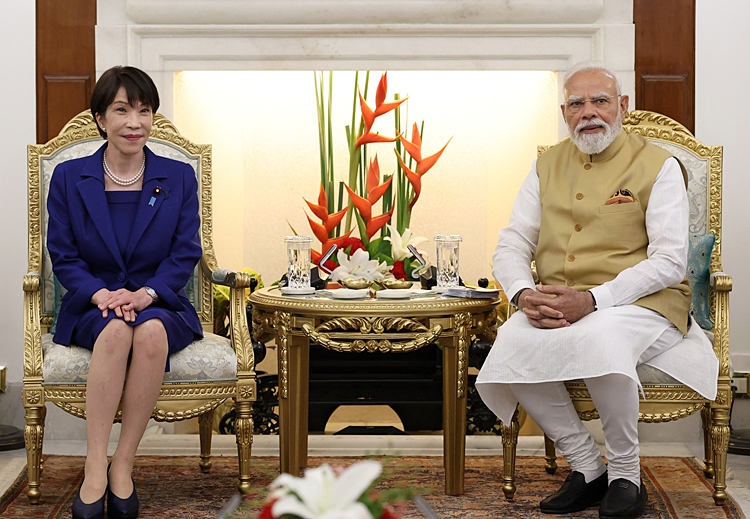
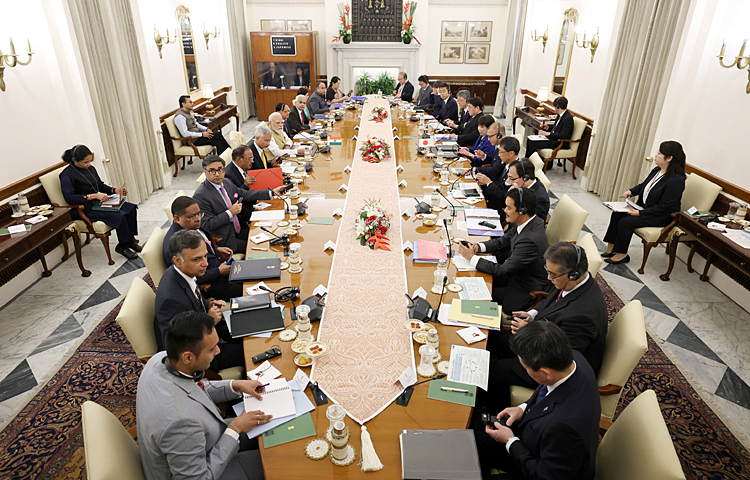
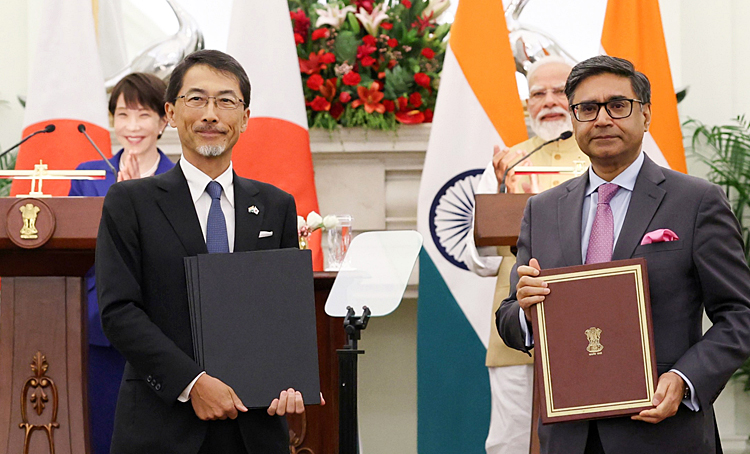
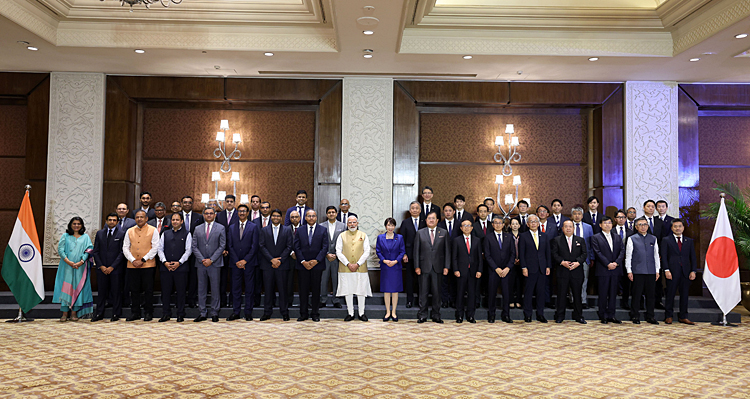
During the visit of Japanese Prime Minister Sanae Takaichi to India from July 1 to July 3, 2026, for the 16th India-Japan Annual Summit, India and Japan unveiled a 16-point roadmap to deepen their Special Strategic and Global Partnership, signalling a major expansion of cooperation beyond traditional trade and investment. Prime Minister Narendra Modi and Prime Minister Sanae Takaichi unveiled three key policy documents on economic security, artificial intelligence and energy resilience after delegation-level talks in New Delhi, alongside a series of agreements across emerging technologies, mobility, critical minerals and financial services.
The roadmap places economic security, artificial intelligence (AI), resilient supply chains and clean energy at the centre of bilateral ties. The roadmap outlines a broad framework for cooperation across strategic sectors that both countries consider essential for future economic growth and national security. According to the Ministry of External Affairs (MEA), economic security will now serve as a foundational pillar of the partnership. The two sides said their cooperation is based on mutual trust, shared values and aligned interests, while recognising that their economic prosperity and security are increasingly interconnected. The initiative also reflects growing concerns over economic coercion, arbitrary export restrictions and non-market practices that can disrupt global supply chains, particularly for critical minerals and strategic industries.
Defence and high-tech manufacturing are gaining prominence, with both countries pursuing greater defence-equipment cooperation, joint ventures and technology transfer.
The roadmap identifies five priority sectors under the economic security partnership:
In addition, bilateral agreements were signed across several strategic sectors. These included a memorandum on trusted battery supply chains, strengthened cooperation on pharmaceutical supply chains for Active Pharmaceutical Ingredients and Key Starting Materials, and deepening collaboration in geological exploration of critical minerals. The Next Generation Mobility Partnership will expand cooperation in railways, automobiles, aviation, shipbuilding, logistics, ports and urban infrastructure while promoting India as a global manufacturing hub. Both countries also signed agreements in biotechnology, internet governance and financial regulation, covering deep tech research, internet security, IPv6 adoption, FinTech and RegTech.
The deepening of India-Japan industrial ties was indicated by Baba Kalyani, Chairman and Managing Director of Bharat Forge, meeting Prime Minister Narendra Modi and Japanese Prime Minister Sanae Takaichi in New Delhi. The interaction was part of a packed schedule of high-level business engagements that underscored the growing role of industry in shaping bilateral ties. Discussions during Baba Kalyani's meeting with the two leaders centred on expanding collaboration across advanced manufacturing, defence components and precision engineering. These are sectors where Bharat Forge has established a strong footprint and where Japan is keen to secure dependable supply chains. The meeting was significant as the joint declaration identified five priority areas for fast-tracked cooperation: semiconductors, critical minerals, information and communications technology, clean energy and pharmaceuticals. Both governments have been urging greater involvement of Indian industry in Japan's investment roadmap for India. At the summit, leaders reiterated that linking India's growth story to Japan's own economic expansion would be central to the next decade of ties.
The partnership is expanding across mobility, pharmaceuticals, biotechnology, space technology, clean energy, financial technology, logistics and infrastructure.
Prime Minister Takaichi later posted on X that India and Japan, as trusted partners sharing strategic direction, had agreed to a roadmap for medium to long-term collaboration. She also noted progress on concrete security cooperation, including the transfer of defence equipment. Both New Delhi and Tokyo are keen to expand joint ventures and technology transfer, with defence and high-tech manufacturing remaining at the forefront. Baba Kalyani had earlier co-chaired the 12th edition of the India-Japan Business Leaders' Forum alongside Keidanren Chairman Tsutsui-san, in the presence of Prime Minister Modi and then Japanese Prime Minister Shigeru Ishiba. The forum, held after a gap of seven years, identified priority areas for deeper cooperation such as green energy, electric mobility, space technology, artificial intelligence, semiconductors, digital technology, data centres, healthcare and electronics.
India and Japan have emphasised that they will work toward the 75th anniversary of diplomatic ties next year by jointly creating economic growth and strengthening business linkages. Apart from economic ties, Takaichi's visit saw concrete movement on security cooperation, with Takaichi stressing that India and Japan made progress on defence equipment transfer and agreed to hold a 2+2 Ministerial Meeting this year, which signals deeper coordination between the foreign and defence ministries of both countries. The summit concluded with a reaffirmation of commitment to a Free and Open Indo-Pacific and to building resilient supply chains in a period of global uncertainty.