




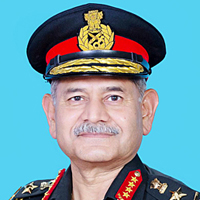
The insightful articles, inspiring narrations and analytical perspectives presented by the Editorial Team, establish an alluring connect with the reader. My compliments and best wishes to SP Guide Publications.
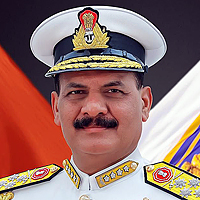
"Over the past 60 years, the growth of SP Guide Publications has mirrored the rising stature of Indian Navy. Its well-researched and informative magazines on Defence and Aerospace sector have served to shape an educated opinion of our military personnel, policy makers and the public alike. I wish SP's Publication team continued success, fair winds and following seas in all future endeavour!"

Since, its inception in 1964, SP Guide Publications has consistently demonstrated commitment to high-quality journalism in the aerospace and defence sectors, earning a well-deserved reputation as Asia's largest media house in this domain. I wish SP Guide Publications continued success in its pursuit of excellence.
As India marks its 80th Independence Day, the country's economic gains, technological advances and deepening social challenges demand a renewed national focus on inclusive development.
 |
The Author is former Chief of Staff of a frontline Corps in the North East and a former helicopter pilot. He earlier headed the China & neighbourhood desk at the Defence Intelligence Agency. He retired in July 2020 and held the appointment of Addl DG Information Systems at Army HQ. |
Turning 80 is a significant milestone for us pensioners, as it triggers an automatic increase in our basic pension. Once a central government pensioner crosses 80, the government adds an extra 20 per cent to the basic pension automatically, with no form filling and no medical test.
A significant Hindu ceremony Shathabhishekam, is performed to honour an individual on their 80th birthday. The term "Shathabhishekam" combines "Shata" (meaning hundred) and "Abhishekam" (meaning sacred bath or anointment), symbolising the completion of a thousand full moons (approximately 80 years). This auspicious occasion marks a major milestone, celebrating the wisdom, experiences, and spiritual maturity accumulated over eight decades. The ceremony is conducted to express gratitude to the divine, seek blessings for continued health, prosperity, and spiritual fulfilment in the years ahead.
India opened up its economy, ended the Licence Raj, lifted millions out of poverty and has now piled up over $650 billion foreign-exchange reserves.
What does turning 80 mean for a country? August 15, 2026, marks India's 80th Independence Day. Translating the significance of turning 80 from the individual to the collective of Bharat Varsha, have we accumulated the desired wisdom and maturity as a nation over the last eight decades? Where are we now, and where are we headed?
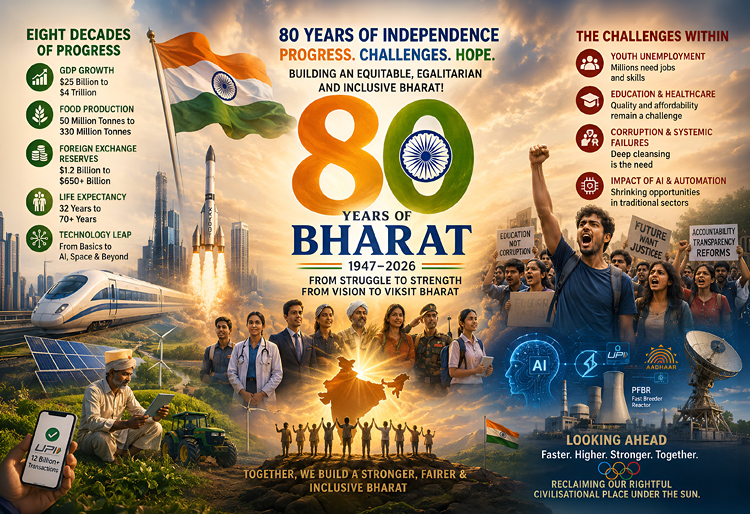
Since independence in 1947, we have added a billion people while more than doubling life expectancy from 32 to 70+ years. The GDP has increased 160-fold over 80 years, from $25 billion to $4 trillion while raising per capita income from a measly 250 to 2,35,000 per annum. Food-grain production to feed our teeming millions has jumped from a starving 50 million tonnes to over 330 million tonnes, transforming the country from a net receiver of food aid under the US PL 480 programme until the late 1960s, to a country that routinely delivers food aid to countries in distress. On the foreign exchange reserves front, we started with a precarious $1.2 billion at the time of independence and landed in a stressful 1991 when it was less than $1 billion, enough for only 3 weeks of imports, forcing us to airlift nearly 47,000 kg of gold to England to raise a $405-million emergency loan and prevent a sovereign default. India opened up its economy, ended the Licence Raj, lifted millions out of poverty and has now piled up over $650 billion foreign-exchange reserves.
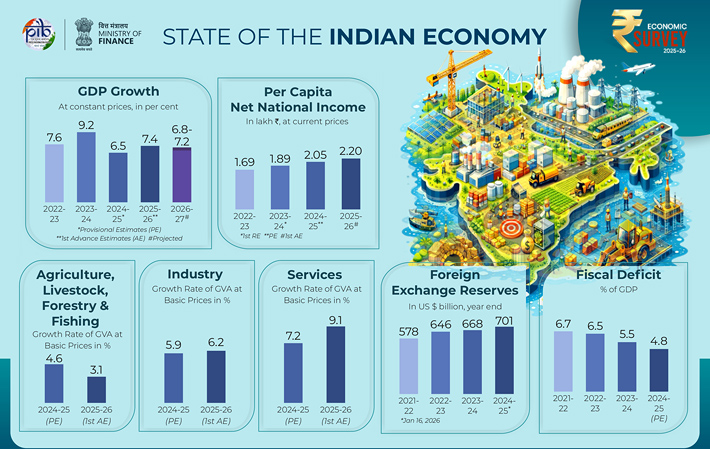
India is billed as the fastest-growing large economy in the world for the past five years with the International Monetary Fund (IMF) projecting it to remain the fastest growing major economy over the next two years, expected to grow by 6.3 per cent in 2026. Structurally, there has been a massive shift from agriculture which contributed to over 50 per cent of output at the time of independence now making up below 15 per cent of GDP while the services sector dominates with over 60 per cent.
Last month, on July 18, 2026, Indian space-tech start-up Skyroot successfully test-launched a low-orbit rocket carrying a payload of 350 kilograms, marking its entry into the global satellite launch market dominated by American and Chinese companies. Krutrim AI, Sarvam AI and Vibe-coding start-up Emergent have emerged as frontline artificial intelligence unicorns to be valued at more than a billion dollars, signalling that India was finally entering the AI race. We have the world's largest biometrics ID (Aadhaar), DigiLocker and UPI which processed over 12 billion transactions last month.
Despite enormous challenges, such as four major wars with neighbours Pakistan and China, COVID-19 crisis and contesting geopolitical pressures we have chugged on, almost miraculously.
India has become only the second nation after Russia to operate a commercial-scale Fast Breeder Reactor (PFBR). Fast breeder reactors are special because they produce more fuel than they use, making them highly efficient. India has one of the largest thorium reserves in the world. PFBR helps in using this resource effectively. This energy trajectory is on top of 80 GW of installed solar power capacity to overcome critical dependence on crude oil and gas imports which have geopolitical, geo-economic and geostrategic encumbrances. This development needs to be viewed in the backdrop of serious challenges to our energy security that emerged in February 2022 with the beginning of the war in Ukraine, further exacerbated by the Iran war since February 28, 2026.
All this sounds good, almost like chest-thumping. Despite enormous challenges, such as four major wars with neighbours Pakistan and China, COVID-19 crisis and contesting geopolitical pressures we have chugged on, almost miraculously. But while we have a sound, stable economy and polity, there are serious concerns that are significant though not insurmountable. India is the world's most populous country with the world's largest youth population at approximately 371 million people aged 15-29. Many young people are entering the job market without the necessary skills to meet industry demands. The economy will need to generate millions of new jobs to keep up with the growing workforce.
The distress is palpable and potent.
The NEET paper leak and cancellation of the exams in May affecting nearly 2 million youth is symptomatic of deep-rooted corruption and systemic failure that grievously affects the youth of our country. The agitation last month at Jantar Mantar, led by the Cockroach Janta Party (CJP), a satirical political movement, forced the Union Education Minister to resign. This is a vivid illustration of how a single-issue student protest in contemporary Bharat can rapidly metastasise into a focal point for the nation's deeper political fault lines.
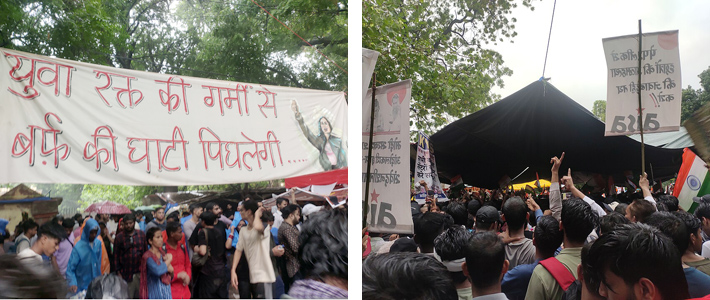
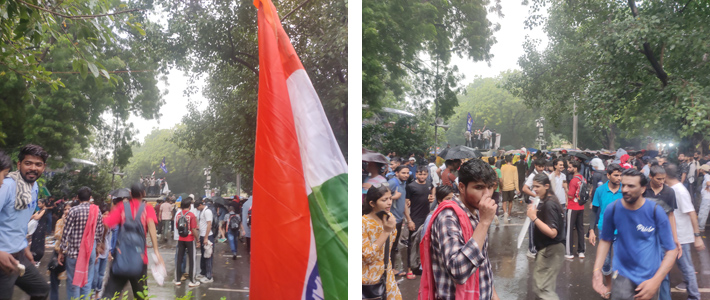
The Gen Z is in a state of turbulence, and unless there are major systemic reforms, this will only aggravate. 80 per cent of higher education is in the private sector that has huge cost implications for the parents and 80 crore of our population are on ration handouts since COVID-19. The distress is palpable and potent.
India has to refocus on quality education to count as a civilised and developed country.
Gen Z-led movements have violently thrown out governments in Sri Lanka (2022), Bangladesh (2024) and Nepal (2025). Lessons must be learnt. Endemic corruption will need deep cleansing of the officialdom and the governing apparatus. Keeping lakhs of government jobs vacant, while splurging thousands of crores on outsourcing, needs a serious review, especially when the constant march of AI and robots is shrinking opportunities in the manufacturing and IT sectors. India has to refocus on quality education to count as a civilised and developed country. Quality public healthcare must get the due attention.
Indian leadership has to navigate the prevailing geopolitical tensions, volatile energy prices, supply-chain disruptions, tariff wars and above all, the geostrategic turmoil with China and the US up to their necks for global dominance. At this historic turning point of time, we may as well adopt the Olympic motto: faster, higher, stronger and together. As a nation turning 80, we must pull all our energy together to regain our rightful civilisational place under the sun.
Together, we must build an equitable, egalitarian and inclusive Bharat!