




The insightful articles, inspiring narrations and analytical perspectives presented by the Editorial Team, establish an alluring connect with the reader. My compliments and best wishes to SP Guide Publications.
"Over the past 60 years, the growth of SP Guide Publications has mirrored the rising stature of Indian Navy. Its well-researched and informative magazines on Defence and Aerospace sector have served to shape an educated opinion of our military personnel, policy makers and the public alike. I wish SP's Publication team continued success, fair winds and following seas in all future endeavour!"

Since, its inception in 1964, SP Guide Publications has consistently demonstrated commitment to high-quality journalism in the aerospace and defence sectors, earning a well-deserved reputation as Asia's largest media house in this domain. I wish SP Guide Publications continued success in its pursuit of excellence.
ISRO's reported loss of scientists to the private sector raises concerns over institutional capacity, strategic space capabilities and the balance between public and private space development.
 |
The Author is Former Director General of Information Systems and A Special Forces Veteran, Indian Army |
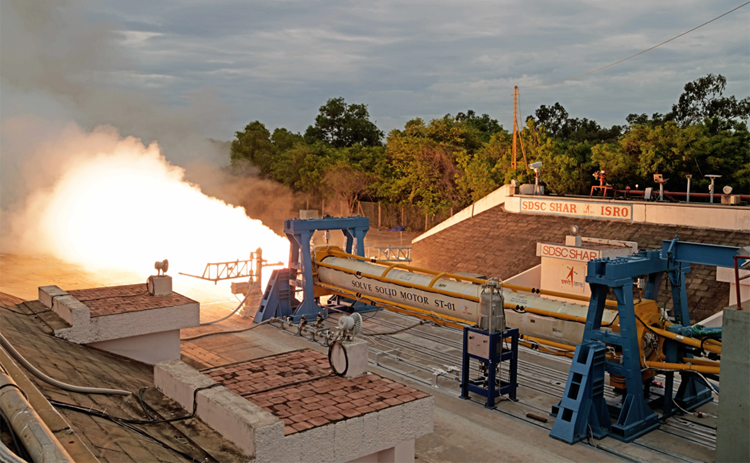
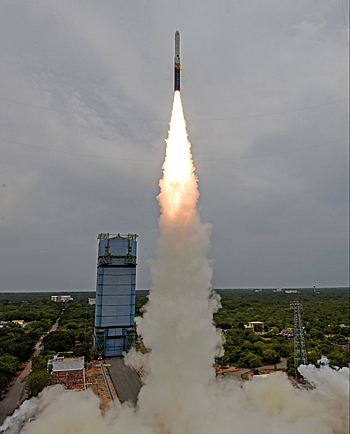
On July 3, 2026, ISRO successfully completed the first ground test of the solid motor for its Sub-Orbital Launch Vehicle for Experiments (SOLVE), marking a crucial step in validating the parachute-based deceleration system for the Gaganyaan mission. Conducted at Sriharikota, the test confirmed that all performance parameters met expectations. ISRO conducted the static test of the SOLVE-ST01 motor at the Static Test Facility of the Satish Dhawan Space Centre in Sriharikota.
ISRO's successful SOLVE-ST01 solid-motor ground test marks another step towards validating the parachute-based deceleration system for the Gaganyaan mission.
SOLVE is designed as a platform to conduct integrated parachute tests for the Gaganyaan Crew Module. These missions will involve carrying the Crew Module to altitudes between 10 and 17 km before separation. Once detached, a sequenced deployment of 10 parachutes will slow the module ahead of its splashdown in the sea, ensuring astronaut safety during re-entry and recovery.
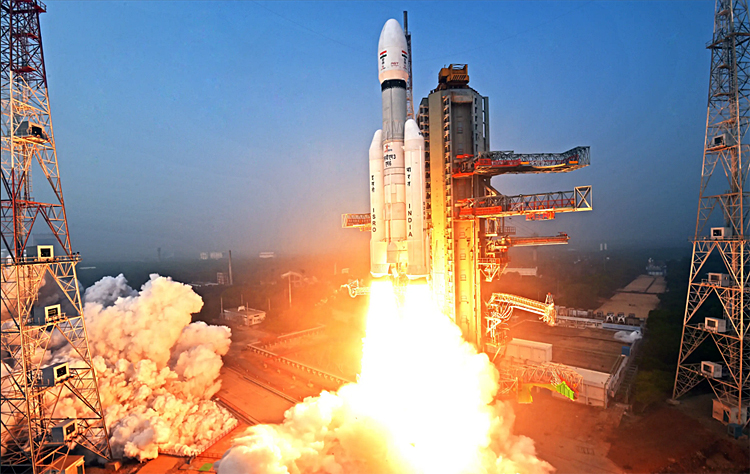
Derived from the Polar Satellite Launch Vehicle (PSLV) strap-on motor, SOLVE is modified to meet Gaganyaan's requirements, enabling simulation and validating the deceleration system under different operational conditions, ensuring that astronauts can be safely returned to Earth. ISRO Chairman V. Narayanan recently confirmed that three uncrewed Gaganyaan missions will precede the crewed flight, with the first uncrewed mission expected later this year.
India's private space sector has expanded rapidly since 2020, with more than 400 active startups and companies including Agnikul Cosmos, EtherealX, GalaxEye, Dhruva Space, Pixxel and Digantara developing new capabilities.
The spectacular milestone achieved by Skyroot Aerospace successfully launching Vikram-1 rocket on July 18, 2026 into Low Earth orbit (LEO) under Mission 'Aagaman' has been covered in these columns separately. In 2020, India opened the space sector to private firms, allowing them to build rockets and satellites and use ISRO's launch facilities with the aim of increasing the country's share in the global business market from two per cent at present to 10 per cent by 2030. The private space ecosystem has boomed to over 400 active space startups. Following Skyroot's success, many other private ventures are in the offing, a few examples of which are as follows:
Amid all the excitement over the growth of our private space sector, the news about 100–120 scientists resigning and leaving ISRO is most disturbing. The reasons being cited are: private aerospace startups offering double or triple the remuneration, plus lucrative corporate benefits and stock options; bureaucratic project delays, centralised decision-making and restricted senior roles creating workplace frustration in ISRO; senior researchers expressing innovative ideas could be executed and commercialised much faster in private-sector environments. But this is not all; forced dislocations to places like Lucknow and Chennai, etc., disrupted niche expertise and family lives causing frustration. The most affected reportedly are the UR Rao Satellite Centre (URSC) in Bengaluru and the Vikram Sarabhai Space Centre (VSSC) in Thiruvananthapuram.
The reported resignation of 100–120 ISRO scientists, attributed to private-sector remuneration, bureaucratic delays, centralised decision-making and disruptive transfers, raises concerns over the loss of specialised institutional expertise.
In response to losing top-tier project directors and engineers from flagship programmes, including the Gaganyaan human spaceflight mission, Chandrayaan-3, and SpaDeX, the Department of Space (DoS) has issued instructions that resignations or voluntary retirements from scientists on flagship missions of ISRO must now route through DoS for final review. But the ironic part is that this was allowed to happen in the first place – where is the accountability? ISRO functions directly under DoS, which in turn is under the Prime Minister's Office (PMO), with the PM assisted by Jitendra Singh, Union Minister of State (MoS) for the DoS. Jitendra Singh is the same minister who, while cutting out the Army component from the Survey of India (SoI), publicly said, "Army officers are useless." Incidentally, SoI has never conducted surveys of areas along the Line of Actual Control (LAC).
The question in the media is whether, amid the euphoria of growth of the private space sector, the government is sanguine about ISRO losing its prominence, akin to what happened to Bharat Sanchar Nigam Limited (BSNL), especially when we don't even have 24/7 satellite cover along our borders, the indigenous NavIC satellite system is reportedly defunct, and the like? Scaling in a market where domestic demand is still thin is a problem no single successful launch like Skyroot's Vikram-1 can solve. Pixel reported already has a small constellation in orbit, but there is little is known about how its imagery is actually being used, if at all. The excuse of a private space sector to neglect ISRO will be most foolish and a costly mistake. Even as of now it is poorly funded. Besides, can DoS and Jitendra Singh explain why 3 out of every 10 sanctioned posts in ISRO stood vacant at the end of the last fiscal year – the widest gap in 25 years? Such neglect is inexcusable.
ISRO must retain responsibility for India's strategic space requirements, including indigenous navigation, defence and surveillance satellites, while the private sector expands commercial space activity.
Space remains a capital-intensive, high-risk, patience-testing business, which can hardly be left to the private sector borrowing ISRO's technological base and facilities. Can we learn from NASA? ISRO must continue to be responsible for India's basic strategic requirements – an indigenous functioning navigation system, and adequate defence and surveillance satellites. Lastly, while there is so much hoopla about privatisation, why is privatisation of the DRDO not happening despite recommendations by multiple government-appointed committees?