




The insightful articles, inspiring narrations and analytical perspectives presented by the Editorial Team, establish an alluring connect with the reader. My compliments and best wishes to SP Guide Publications.
"Over the past 60 years, the growth of SP Guide Publications has mirrored the rising stature of Indian Navy. Its well-researched and informative magazines on Defence and Aerospace sector have served to shape an educated opinion of our military personnel, policy makers and the public alike. I wish SP's Publication team continued success, fair winds and following seas in all future endeavour!"

Since, its inception in 1964, SP Guide Publications has consistently demonstrated commitment to high-quality journalism in the aerospace and defence sectors, earning a well-deserved reputation as Asia's largest media house in this domain. I wish SP Guide Publications continued success in its pursuit of excellence.
India's Integrated Battle Groups mark a major Army transformation, combining combat arms, fire support, technology and logistics into agile formations designed for rapid mobilisation.
 |
The Author is Former Director General of Information Systems and A Special Forces Veteran, Indian Army |
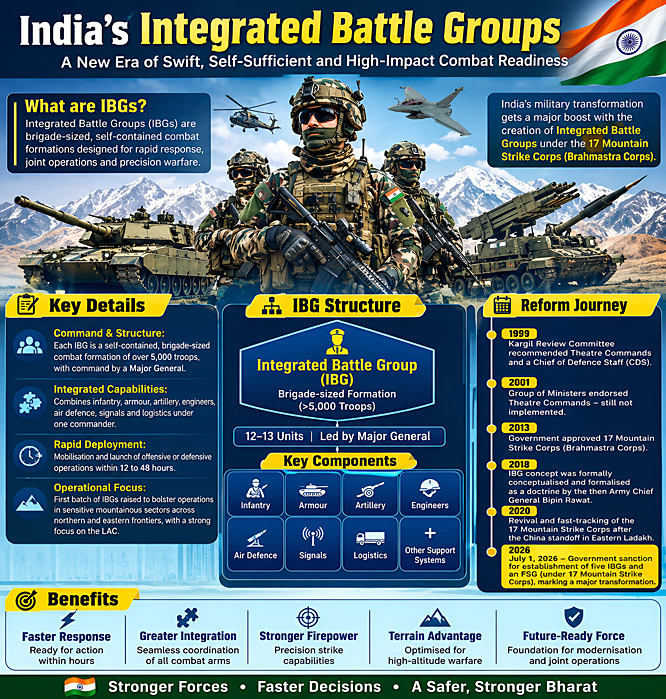
The Indian Military's 17 single-service operational commands are being merged into three Theatre Commands, as has been covered in these columns elsewhere. Concurrently, the Indian Army is also in the transformation mode. The Indian Army announced the beginning of establishing Integrated Battle Groups (IBGs) after receiving the formal government sanction on July 1, 2026. This marks a major transformation in the warfighting doctrine of the Indian Army. Piloted under the 17 Mountain Strike Corps (Brahmastra Corps), the five new IBGs and a Fire Support Group (FSG) are being deployed to enhance rapid response capabilities along the Line of Actual Control (LAC) with China. The move marks the first large-scale implementation of the IBG concept, which aims to replace lengthy mobilisation procedures with integrated, mission-ready combat formations capable of responding to threats at short notice.
The Indian Army has begun establishing five Integrated Battle Groups and a Fire Support Group under the 17 Mountain Strike Corps, following government sanction on July 1, 2026.
Key details of the new IBG structure include: Command and Structure - each IBG is a self-contained, brigade-sized combat formation of over 5,000 troops, consisting of 12 to 13 units, with the IBGs commanded by officers of the Major General rank; Integrated Capabilities - unlike traditional brigades that await support and reinforcements, IBGs organically combine infantry, armour, artillery, engineers, air defence, signals, and logistics under a single commander; Rapid Deployment - designed for fast-paced modern conflicts, the units are to be capable of mobilising and launching offensive or defensive operations within 12 to 48 hours; Operational Focus – the first batch of IBGs have been raised to bolster operations in sensitive mountainous sectors across the northern and eastern frontiers, with a strong focus on the LAC.
The creation of five IBGs and an FSG (with the FSG also commanded by a Major General) under the 17 Mountain Strike Corps constitutes a major organisational reform designed to eliminate logistical delays and enhance operational speed. By integrating infantry, armour, and artillery into permanent, self-sufficient units, these IBGs aim to provide rapid precision-strike capabilities while acting as a pilot for broader military modernisation – a future-ready force.
Each IBG is envisaged as a self-contained, brigade-sized formation of more than 5,000 troops, integrating infantry, armour, artillery, engineers, air defence, signals and logistics.
As part of the reforms, the Army has introduced the position of Chief Operations Officer (COO), a Brigadier-level appointment responsible for coordinating planning, intelligence, logistics, firepower and battlefield execution, allowing the IBG commanders to concentrate on broader strategic and operational decisions. The newly created FSG will bring together long-range artillery, rocket systems, precision strike capabilities and surveillance assets under a single commander to ensure concentrated firepower in support of IBG operations. The ongoing reforms include the creation of agile formations, greater jointness with other services, integration of drones and loitering munitions, expansion of network-centric warfare and decentralisation of command. The introduction of the IBG and FSG model, along with continued technological integration and organisational changes, represents a significant step towards developing a future-ready force.
Ironically, the pace of India's military modernisation is extremely slow, which reflects poor political decision making, as can be gauged from the following:
The formations are designed for rapid mobilisation, with the ability to launch offensive or defensive operations within 12 to 48 hours, while the FSG concentrates long-range artillery, rockets and precision-strike capabilities.
IBGs of the Brahmastra Corps are planned to be rolled out in a phased manner. Of the two Divisions of the Corps (23 and 57), 23 Division will first be transformed into two IBGs, followed by 57 Div in about two years' time. This is to ensure there are no gaps in case of any operational need, since the Brahmastra Corps is an active Corps having a very significant mandate. All IBGs will be terrain and sector specific; resources, in terms of equipment, will be determined by terrain, enemy threat and the task. The FSB will be established concurrently with the establishment of the IBGs of 23 and 57 Divisions.
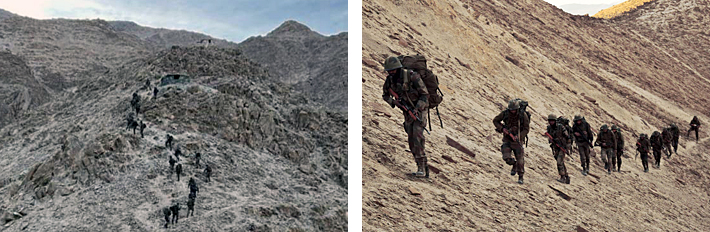
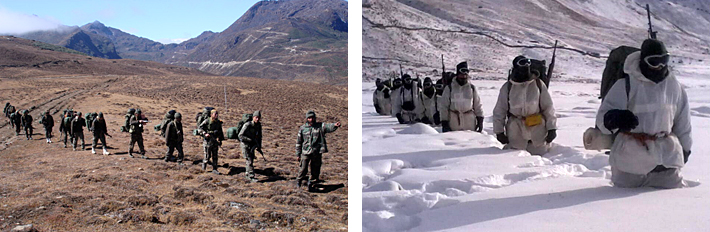
IBGs are to form the backbone of the Indian Army's future operational strategy across all Strike Corps and the refined model would then be extended across the Army's 42 Infantry, Mountain, Rapid, Armoured, and Artillery Divisions, and 12 Independent Armoured/Infantry Brigades. No date for completing all this has been announced, but the speed of rollout and adoption of state-of-the-art technology will be crucial; integral Intelligence, Surveillance and Reconnaissance (ISR), fire support must be integrated into a real-time sensor network, an AI-enabled battlefield management and decision-support system, logistics redesign with predictive maintenance, autonomous resupply, distributed ammunition dumps, and digital inventory management. Hopefully, this will be earlier than the Indian Army's plan to be a future-ready force by 2047 (aligned with India's 100 years of Independence), as announced during the 2025 Chanakya Defence Dialogue, by then Army Chief General Dwivedi.
The IBG model is intended to become the backbone of the Army's future operational strategy, supported by ISR networks, AI-enabled battlefield management, predictive logistics and autonomous resupply.
Finally, it is being said that the IBGs will be primed to strike in less than 24 hours. This needs to be viewed in the following context: the often-announced free-hand to the Army is a misnomer because of political micro-management; the speed of political decision-making is too slow, looking at our response to the Pahalgam massacre. Following the Galwan clash, the defence minister held an 8-hour meeting at his residence before going to the prime minister; allowing IBGs to take the initiative against China to get a slice of territory for political bargaining appears utopian considering our pusillanimous response in Ladakh during 2020; will IBGs facing Pakistan be only reactive considering US-China support to Pakistan, the CPEC, and the slow-paced territorial gains in the Ukraine War? Isn't this why we haven't made any effort to regain POK?