





The insightful articles, inspiring narrations and analytical perspectives presented by the Editorial Team, establish an alluring connect with the reader. My compliments and best wishes to SP Guide Publications.

"Over the past 60 years, the growth of SP Guide Publications has mirrored the rising stature of Indian Navy. Its well-researched and informative magazines on Defence and Aerospace sector have served to shape an educated opinion of our military personnel, policy makers and the public alike. I wish SP's Publication team continued success, fair winds and following seas in all future endeavour!"

Since, its inception in 1964, SP Guide Publications has consistently demonstrated commitment to high-quality journalism in the aerospace and defence sectors, earning a well-deserved reputation as Asia's largest media house in this domain. I wish SP Guide Publications continued success in its pursuit of excellence.
China's plan to expand its J-20 fleet to 1,000 aircraft by 2030, combined with its supply of 40 J-35A (FC-31) fifth-generation stealth fighters to Pakistan, creates a steep airpower imbalance against India
 |
The Author is Former Director General of Information Systems and A Special Forces Veteran, Indian Army |
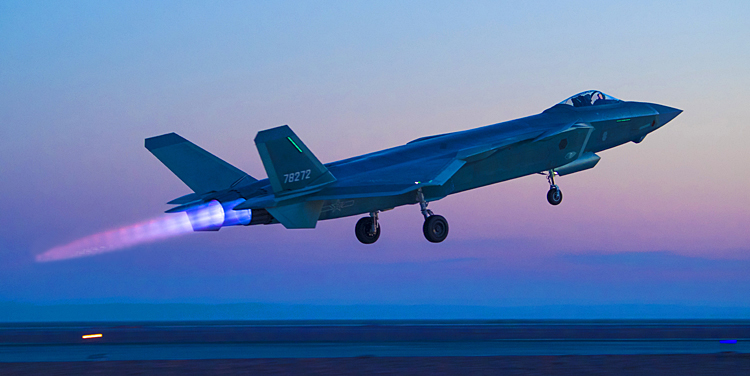
Satellite imagery of July 2026 showed that China has deployed at least 12 Chengdu J-20 'Mighty Dragon' fighter jets at Hotan Airbase (245-km northeast of DBO and 389-km from Leh) and Damxung Airbase (344-km northwest of Tawang), marking the largest concentration of 5th-generation stealth fighters stationed near India. Earlier intelligence reports indicated 6 J-20's deployed at Shigatse - less than 150-km from Sikkim. These 18 J-20s already pose severe capability asymmetry vis-à-vis the Indian Air Force (IAF). China already has 500 operational J-20s, which means the J-20 deployment against India could keep going up.
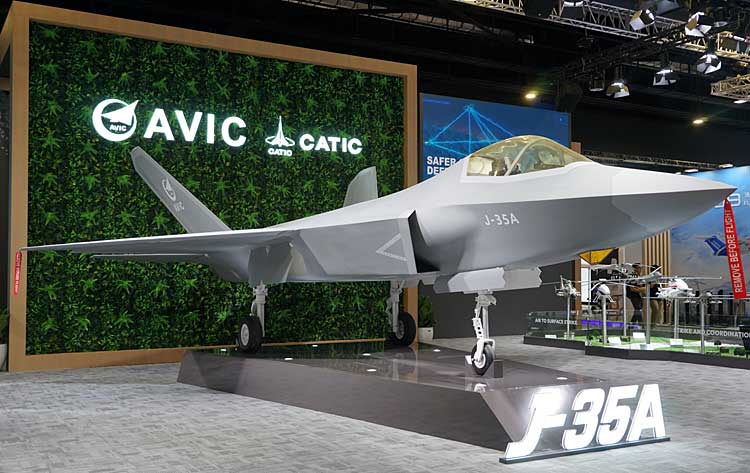
Pakistan has signed an agreement with China to acquire around 40 J-35A (FC-31) 5th-generation stealth fighters, with pilots already undergoing simulator training and initial deliveries expected in the coming months—well before India's AMCA enters serial production.
China showcased its single-seat J-20A and twin-seat J-20S on September 3, 2025 – both highly optimised, dual-engine heavy fighter with unique combat roles. Estimates are China's J-20 fleet will expand to 600-620 J-20's by 2027 and to 1,000 by 2030. This timeline underscores a massive capability gap vis-à-vis India along the Line of Actual Control (LAC). India's 5th-generation Advanced Medium Combat Aircraft (AMCA) is targeting its first prototype flight by 2028-29, with full serial production not anticipated until 2033–2035.
China produces its indigenous military aero-engines including the J-10C, J-11B, J-15, J-16, JF-17, J-20, J-20A, J-20B, JF-31, J-35, J-35A, Y-20, JH-7 and JH-7A. A former Indian Army Vice Chief writes: "No country ever will part with the design at any cost, especially the core of an aeroengine. What can best be can expected is technology which is being phased out. The sad part is that despite the in-house talent and potential, we are unable to harness domestic talent which is in abundance here."
While India plans to procure 114 additional Rafale fighters, these 4.5-generation jets lack radar-deflecting stealth geometry and internal weapon bays, leaving them vulnerable to severe attrition in high-intensity combat against 5th-generation platforms.
India plans acquisition of 114 additional Rafale fighter jets, but none of these will be 5th-generation because the Rafale platform is not built with a 5th-generation low-observable (stealth) airframe; it relies heavily on the SPECTRA electronic warfare (EW) suite for electronic stealth but lacks internal weapon bays and radar-deflecting geometry. These 114 Rafales are projected to begin deliveries in late 2029 or 2030, stretching in gradual batches through the mid-to-late 2030s: 18-20 manufactured in France and delivered in fly-away condition; 94-96 under 'Make in India' (2031–2038).
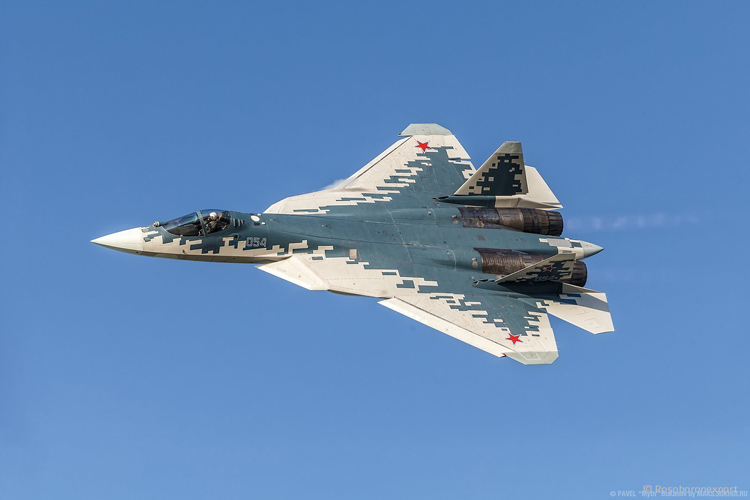
Russia has offered India its 5th-generation Su-57E fighter jet with 100 per cent technology transfer but India fears US sanctions. This, despite a 2025 study by the French Institute of International Relations (IFRI), which included senior veteran French Air Force officers, concluding that non-stealth platforms like Rafale could face severe attrition within three days in high-intensity combat scenarios against 5th-generation fighter jets; like the Russian Su-57 and Chinese J-20.
Lacking immediate 5th-gen fighters, the IAF is relying on an integrated air defence ecosystem that leverages multi-frequency radar networks (like the Surya VHF radar), S-400 systems, and passive Infrared Search and Track (IRST) sensors to target the J-20's thermal footprint and RCS vulnerabilities.
Notably, China is supplying its J-35A (FC-31) 5th-generation stealth fighter to Pakistan. Pakistani leadership and state media confirm Pakistan Air Force (PAF has signed an agreement to acquire around 40 J-35A stealth fighters. Open-source intelligence trackers and satellite imagery have reported Pakistani fighter pilots actively undergoing simulator and cockpit transition training in China. According to Jane's Defence, technical negotiations are largely complete, with initial aircraft batches projected to begin arriving in Pakistan within the coming months.
With the IAF lacking 5th-generation fighter jets, India's counter strategy, centres around building a comprehensive, network-centric defence model that integrates diverse sensors, extensive situational awareness, and a multi-layered air defence grid; stepping up its integrated air-defence networks, counter-stealth tracking, and long-range response plans. Notably, the J-20 and its advanced variants have critical vulnerabilities in their stealth profile, aerodynamic design, and operating environment, which include:
To neutralise the J-20 threat, the IAF's approach revolves around exploiting the strengths of a broader air defence ecosystem; a key pillar involves passive detection, particularly Infrared Search and Track (IRST) technology because IRST sensors scan for heat rather than radar waves, bypassing traditional radar-stealth shapes. The Su-30 MKI and Rafale are equipped with IRST and EW suites that can identify J-20's thermal footprint from a distance without revealing own positions.
While China mass-produces its own military aero-engines across platforms, India faces significant delays with AMCA serial production (not expected until 2033–2035) due to core engine access barriers and slow domestic harnessing, prompting calls to evaluate options like Russia's Su-57E.
The IAF is leaning on multi-frequency radar networks since J-20s are often visible to low-frequency VHF and UHF EW radars. By linking long-range, low-frequency sensors with high-frequency fire-control radars, India's AD network can spot stealth jets early and guide missiles to the target. India's integrated network of Airborne Early Warning and Control (AEW&C) aircraft, ground sensors, and upcoming High-Altitude Pseudo-Satellites (HAPS) forces the enemy to stay in the air longer. India's Surya VHF Radar counters 5th-generation stealth geometry. Under a ₹200 crore contract, the first of six Surya VHF units have been delivered to the IAF, which have been integrated alongside other air defence network, operating in tandem with S-400 and Akash QR-SAM batteries to secure the LAC.
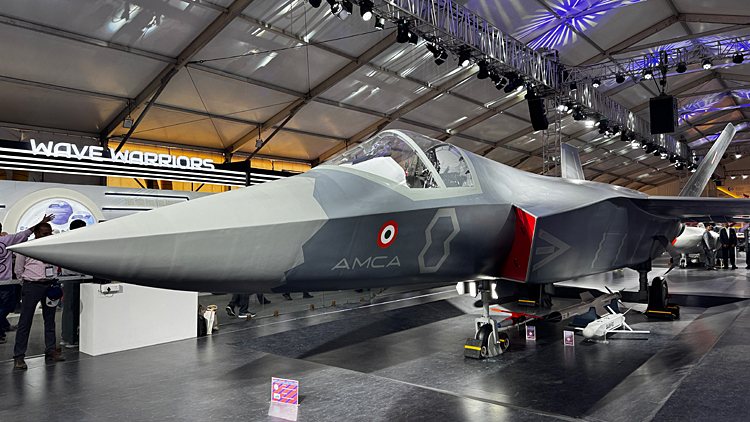
China is fully aware of vulnerabilities of Rafale fighters through Pierre-Henri Chuet, serving French Navy Rafale pilot clandestinely visited China 2018 and 2019 activities benefiting China, due to which China helped Pakistan down an IAF Rafale in Op 'Sindoor'. China began receiving the S-400 in 2021, having signed the deal with Russia (before India) in 2018. China's Integrated AD System (IADS), deployed along the LAC is a dense, overlapping network of surface-to-air missile (SAM) systems that includes S-400, S-300 and indigenous systems like HQ-9, HQ-9B, HQ-16, HQ-17, HQ-17A, HQ-22 (FK-3).
Finally, we must acknowledge India has no alternative but to adopt a defensive network. Serial production of India's AMCA is not anticipated until 2033–2035. China's current J-20 fleet is estimated to increase to 1,000 by 2027 and to 1,200-1,300 by 2030. Pakistan is also likely to receive J-35A 5th-generation fighters from China before IAF gets the AMCA. India should seriously consider the Russian Su-57E offer alongside the Rafale; do its best to procure 5th-generation fighter jets earliest, followed by 6th-generation fighters.