





The insightful articles, inspiring narrations and analytical perspectives presented by the Editorial Team, establish an alluring connect with the reader. My compliments and best wishes to SP Guide Publications.
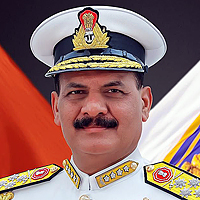
"Over the past 60 years, the growth of SP Guide Publications has mirrored the rising stature of Indian Navy. Its well-researched and informative magazines on Defence and Aerospace sector have served to shape an educated opinion of our military personnel, policy makers and the public alike. I wish SP's Publication team continued success, fair winds and following seas in all future endeavour!"

Since, its inception in 1964, SP Guide Publications has consistently demonstrated commitment to high-quality journalism in the aerospace and defence sectors, earning a well-deserved reputation as Asia's largest media house in this domain. I wish SP Guide Publications continued success in its pursuit of excellence.
India is deepening space cooperation with NASA and ESA in lunar exploration, human spaceflight and planetary missions. However, geopolitical rivalries, resource ownership, technology transfer and militarisation of space, pose challenges for India.
 |
The Author is Former Director General of Information Systems and A Special Forces Veteran, Indian Army |
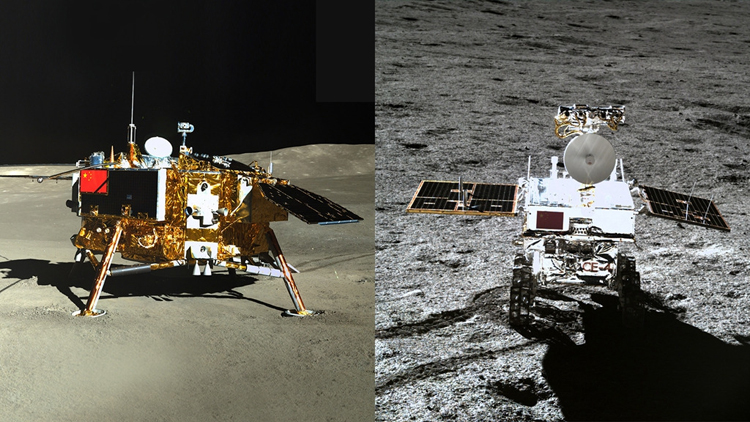
The renewed global push for establishing permanent human presence on the Moon was covered in these columns on June 12, 2026: the Indian Space Research Organisation (ISRO) roadmap to land astronauts on the Moon by 2040; NASA's plan for a $20 billion Moon Base by 2032; China's Chang'e-4 spacecraft's moon landing on January 3, 2019; China-Russia announcing an International Lunar Research Station (ILRS) open to all in 2021, with construction beginning by 2031.
NASA's entire Moon Base architecture is being designed around operations near the South Pole
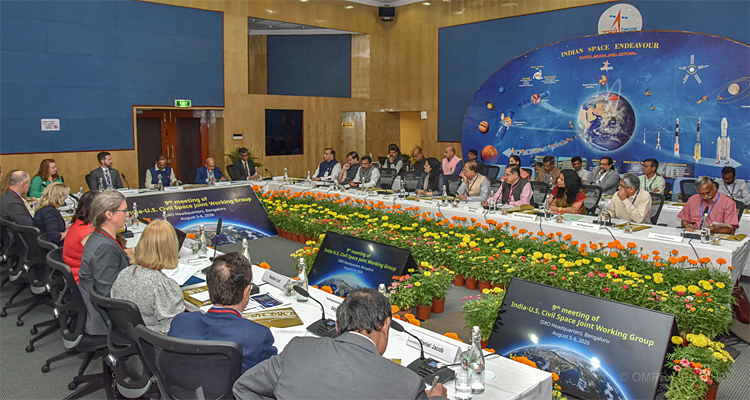
At the 9th India-US Civil Space JWG meeting at ISRO Bengaluru headquarters on August 5-6, the US invited India to participate in NASA's Moon Base programme. Three years after Chandrayaan-3 achieved a soft landing near Moon's South Pole, NASA appears keen to deepen cooperation with ISRO, building on the two countries' partnership under the Artemis Accords.
NASA describes the Moon Base as "humanity's first lunar outpost, a place where astronauts will live, work, and explore near the Moon's South Pole. NASA says the facility will be developed through a series of crewed and uncrewed missions that will establish the infrastructure needed to support an enduring human presence on the lunar surface. The aim is to stay on the Moon, learn to live off the land, develop new technologies and prepare for future human missions to Mars.
According to NASA, the lunar South Pole offers unparalleled scientific opportunities, including access to permanently shadowed craters believed to contain water ice. Water ice can be converted into drinking water, oxygen and rocket fuel, making it one of the most valuable resources for any future lunar settlement. NASA's entire Moon Base architecture is being designed around operations near the South Pole. For India, NASA's invitation carries special significance being the only nation that has successfully soft landed a spacecraft in the vicinity of the lunar South Pole. Chandrayaan-3's Vikram lander and Pragyan rover touched down in August 2023 and established India as a pioneer in one of the most challenging regions of the Moon.
The Moon is rapidly splitting between the US-Led Artemis Alliance anchored by NASA and the Artemis Accords (signed by India in 2023) and the Russia-China-led Alliance
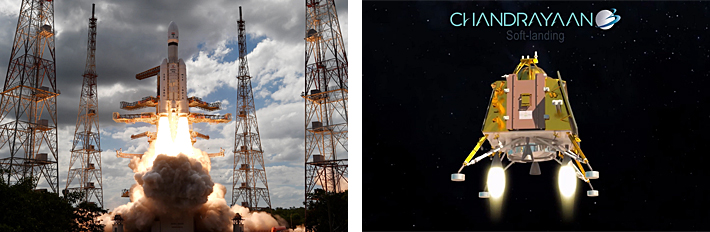
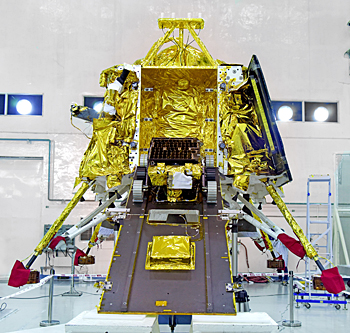
Vikram and Pragyan remain enduring symbols of India's presence on the Moon as 'India's lunar Ambassadors' and have given India unique operational experience in the very region where NASA now plans to build its future outpost. India's long-term vision extends well beyond low Earth orbit. Under Space Vision 2047, the country has outlined ambitions that include advanced lunar exploration and eventual human operations related to the Moon.
However, the NASA-ISRO partnership faces significant challenges stemming from severe geopolitical friction, technological protectionism, resource ownership debates, and conflicting sovereign space priorities, like:
Concurrently, the European Space Agency (ESA) and ISRO intensified cooperation in human space flight, lunar exploration, and Venus missions, with discussions held at the International Space Summit in Paris, on September 9, 2026, building on existing agreements for Gaganyaan ground support and extends to India's ambitious Bhartiya Antriksh Station (BAS) and the Venus Orbiter Mission scheduled for 2028.
During the delegation-level ISRO-ESA talks, headed by ISRO Chairperson V. Narayanan and ESA DG Josef Aschbacher, Aschbacher emphasised that exploration remains a priority for both agencies and that several cooperation points are already under discussion. Daniel Neuenschwander, ESA's Director for Human and Robotic Exploration, elaborated that the agencies are exploring collaboration in human space flight and lunar exploration.
ESA is keen to explore how both sides can mutually benefit from these capabilities, beginning with low Earth orbit and extending to lunar exploration. ISRO and ESA have already signed a Technical Implementation Plan (TIP) for Ground Tracking Support for Gaganyaan missions, enabling ESA to provide ground station support, ensuring continuity in data flow and communication with the Orbital Module for monitoring and orbital operations.
The 167 Outer Space Treaty strictly bans national appropriation/ ownership of celestial bodies, but establishing permanent Moon bases complicates this
The Gaganyaan project aims to launch a 3-member crew to an orbit of 400-km for a three-day mission, before safely returning to Indian seas. Both agencies are also exploring cooperation in the Venus Orbiter Mission. India's maiden Venus Orbiter Mission, with an approved outlay of ₹1,236 crore, is scheduled for launch in March 2028. The spacecraft will embark on a 112-day journey to Venus, departing Earth on March 29, 2028 and arriving on July 19, 2028. It will be launched aboard the Launch Vehicle Mark-3 (LVM-3). The mission will carry 19 payloads, including 16 Indian instruments, two collaborative payloads, and one international payload. This comprehensive suite reflects India's growing scientific ambition and its willingness to integrate international collaboration into planetary exploration.
Sweden has already joined the mission with its Venusian Neutrals Analyser payload, while Norway has expanded cooperation with ISRO in space applications, Arctic observations, and infrastructure support. These partnerships highlight Europe's increasing interest in India's planetary programs. The Venus mission aims to study the planet's dense atmosphere, volcanic surface, extreme weather systems, and super-rotating clouds. Scientists are particularly interested in understanding whether Venus once resembled Earth before a runaway greenhouse effect transformed it into a hostile world.
Infrastructure meant for peaceful lunar science and hardware meant for space warfare has inherent dangers
External Affairs Minister S. Jaishankar has been saying India's foreign policy is of "multi-engagement". The question, therefore, is when India is collaborating with NASA, ESA and Jaxa, what is the scare to not join the Russia-China-led ILRS? Would that not be "multi-engagement" or "multi-alignment" in the true sense?
Finally, the Moon has become a war fighting domain of major militaries with the US, Russia and China having weaponised space, no permanent lunar base can survive without a continuous, multi-day supply line from Earth to transport water, equipment, fuel, and humans. But adversaries could use non-kinetic orbital weapons to blind navigational sensors, hijack automated cargo landers via cyber attacks, or sever critical satellite communications between the ground crew on the Moon and mission control on Earth. A lunar base cut off from its terrestrial supply chain becomes an instant humanitarian and logistical catastrophe. Infrastructure meant for peaceful lunar science and hardware meant for space warfare has inherent dangers. For example, lasers, autonomous rovers, satellites equipped with robotic grappling arms, are dual-use technologies that can be used against adversaries. And, deployment and potential use of kinetic or counter space weapons in orbit pose an existential threat to anything nearby.